
Our Mission

Founded in 1989, HtH is the oldest all volunteer, action, homeless organization in the state of Texas. The mission is Education and Advocacy around the issues of ending and preventing homelessness.

Urgent Issues

Re-Criminalizing Homelessness — Speak up now!

HtH supports the direction being taken by the City of Austin’s relatively new Homeless Strategy Office, led by a very committed and responsive David Gray, and with the commitment of Charles Loosen and other staff. We further strongly advocate ALL positions below that preceded The vote to basically criminalize homelessness — especially:

reinstating a camping ban must consider that those with disabilities, the aged, and in fact anyone with no place to go. The no sit/no lie ordinance is absolutely inhumane and unconscionable we must have at least 15 minute respites particularly for those with disabilities and make other provisions.

Mayor Kirk Watson, elected in 2023, is working to secure funding for homeless services from the State and within the City Budget.

2025 interests:

City Council approved a resolution making homelessness a top financial priority.

Increase the capacity of the Homeless Strategy Office to address and implement a comprehensive approach to strategic advancements in homelessness response. (Plan detailed in a 50-page memo from David Gray, June 2025).

Examples:

1. Expand HOST (Homeless Outreach Street Team) support including team members:

APD officers, EMS paramedics, behavioral health clinicians, social workers, peer support staff.

2. Support for Marshaling Yard operations.

3. Rapid Response housing and safe housing, especially for families.

4. Increase shelter beds with support; and more.


The Austin city council recently voted to put on its May 2021 ballot a vote to reinstate the no camping ban including the no sit/no lie ordinances. Now is the time to contact your mayor and council members particularly those who have supported decriminalizing homelessness, such as Mayor Adler, Kathy Tovo, Ann Kitchen, Greg Casar, Sabino Renteria, and others, we pray.

First call to action is cold weather shelter. Anyone that reads this, our urgent plea is to email our mayor and city council in this urgent time of cold weather. House the Homeless is encouraging to use the Convention Center or other alternatives sites that are already over burdened due to Covid-19 or at capacity.

A second call to action is to not displace unsheltered neighbors from bridges and the four major camp areas without having an immediate plan for alternative shelter/housing.

Finally, advise your mayor and council members that the wording for the May ballot regarding reinstating a camping ban must consider that those with disabilities, the aged, and in fact anyone with no place to go. The no sit/no lie ordinance is absolutely inhumane and unconscionable we must have at least 15 minute respites particularly for those with disabilities and make other provisions.

Federal Minimum Wage Debate

Federal resolve is insufficient; highly recommend Universal Living Wage formula indexed on the cost of housing wherever the person lives and works. 

Formerly Homeless Actor Michael Pitt

Okay, granted, with movie star biographies you can never really be certain of the facts. Some of those Hollywood people will just say anything, you know? Still, there is no reason to doubt Michael Pitt’s biography, including a phase in which he was a person experiencing homelessness.

At age 16, he took off for the big city, at first renting a room from his acting teacher. In an interview conducted by Max Michaels for Movement Magazine, Pitt said,

Then the apartment thing fell through, and I was on the street for a while. Like um, just kind of panhandling and stuff, ya know?… I was sleeping behind the NYU recreational building, ya know? With a bunch of other kids who had no place to go.

When he started getting work, he shared a one-bedroom apartment with seven roommates, where…

[…] those of us who had mattresses, you had to pack them up in a stack because the whole floor was covered… I sort of just did that for two years.

When Pitt appeared in his first off-Broadway play, there were warrants out for his arrest because of the unpaid fines for things like not having a place to sleep. (Sometimes, it’s just plain illegal to be homeless.) When he was approached by a professional agent who wanted to represent him, the actor thought he was busted.

Pitt is also a musician and his band is called Pagoda. To write a 2005 New York Times profile, Julia Chaplin hung out with the actor/singer/guitarist before a show and learned that his aunt rides a Harley, and that the band’s bassist was, until meeting Pitt, homeless and living in a Portland squat.

In the film Delirious, Pitt plays (very realistically, of course) a character named Toby who describes himself not as homeless, but “moving around right now.” Toby is (just like Pitt in real life) an aspiring actor, who lands the role of a homeless serial killer who only wipes out the deserving. It seems to be some kind of satire on vampire movies. There’s a touching love scene, with a girl who says, “You’ve taught me so much about being homeless…” Pop culture is a strange and wondrous thing.

Hell always has more than one level. Just like most things in life, homelessness has degrees. The life of a technically homeless kid trying to get into show business often includes couch-surfing into some interesting situations that she or he can later write screenplays about. If you’re young and halfway attractive, there will usually be someone willing to put you up for a while. Plus, you’re in New York or Los Angeles, an adventure in itself. The life of a teenager with Academy and Grammy dreams is not quite the same as the life of a homeless, brain-injured combat veteran.

But still, even for the young, brave, and fit, living on the streets can be rough. Sure, there are hope and the vision of a future. There is also enormous risk. After all, what tiny percentage of young actors actually “make it”? You could end up being a hobo for the rest of your life. Or die young. Kids on the street, with immune systems weakened by malnutrition, are vulnerable to catching anything that goes around. They can’t help getting involved in criminal activity, even if it’s such a bum rap as sitting on a sidewalk at the wrong hour. They are vulnerable to rape and worse.

And face it, most kids who live on the streets, in garages, sheds, cars, or abandoned houses are not going to become movie stars. The average kid who is experiencing homelessness needs a suitable environment in which to at least get a high school diploma. Next, he or she needs a job that pays a living wage. Not just any wage. Economic homelessness is when the pay is so low, a person can’t afford a place to live even if they work full-time. More people are in that in-between situation than you might guess. We’re talking about the Universal Living Wage ULW (National Locality Wage – NLW), as described in Looking Up at the Bottom Line. The benefit of the Universal Living Wage ULW (National Locality Wage – NLW) is that it will end homelessness for over 1,000,000 minimum-wage workers, and prevent economic homelessness for all 10.1 million minimum wage workers. Check it out.

Reactions?

Source: “HIP-GNOSIS – interview with actor michael pitt,” MovementMagazine.com, 2002
Source: “Michael Pitt: Indie Nirvana,” NYTimes, 07/17/05
Image by istolethetv, used under its Creative Commons license.
5
The Homeless Ex-Offender, Part 2

Forensic psychologist Karen Franklin says that the majority of sex offenses are committed by men without criminal records, so no matter how stringently those with records are controlled, these crimes will continue. And most convicted sex offenders are never arrested for a second sex crime. A very small minority of ex-offenders, in the area of 15%, are the ones who need watching. With the rest, it’s a waste of time an energy, and actually causes more problems.

We talked about Jessica’s Law in California and similar measures in other states, requiring that ex-offenders not live within certain distances of schools, parks, and other places where children gather; and the unforeseen results that have led to even more problems, such as an increase in homelessness, and a less safe environment.

As Franklin puts it,

Time and time again, here’s the way the story goes:

1. An exceedingly rare but highly troublesome event occurs.
2. A knee-jerk scramble ensues to find the cause and affix blame.
3. Existing laws are impulsively altered.
4. Unintended consequences ensue, most of them harmful.

Another issue is that, in some places, even if their sentence is served, inmates cannot be let out without giving an address, which of course many do not have. Earlier this year in Wisconsin, an appeals court decided that homeless sex offenders who leave prison are not obligated to do this, acknowledging that the requirement to register an address just can’t be met by a released prisoner with nowhere to go, and no prospects.

The same question came up in Alabama, where Thornal Lee Adams was being punished, in violation of the Constitution, for being homeless. Adams won in court, and his attorney David Schoen is quoted as saying the decision was:

[…] stunning in its recognition of the unique hardships that poverty places on members of our society, and it speaks in the strongest terms possible against penalizing that status through the criminal law.

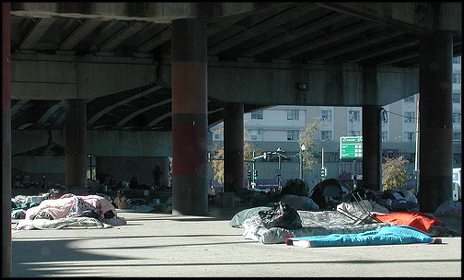
A couple of years back, a Florida judge made national news by ordering several homeless sex offenders to live beneath a highway bridge. Their registration address was the Julia Tuttle Causeway, and they were ordered to stay under there nightly from 10 PM to 6 AM. The futility can easily be seen. Has anyone proven that assaults on children never take place during daylight?

One of those five men, Kevin Morales, after serving his sentence, had recovered his life to the point of having a job, a car, and an apartment, which he was forced to leave because of the residency restriction laws. He petitioned the judge to go back to jail, where at least there were no rats, but was refused. (His current address is listed as “Transient.”)

In California and some other states, in addition to strict residency rules, ex-offenders have to wear Global Positioning System ankle bracelets for the rest of their lives. One might ask, if GPS monitors are required, aren’t the restrictions on residence pretty much redundant?

Why isn’t it enough to just settle for having the ankle bracelets tracked in real time? It would not matter if the nearest child was 20 feet away, as long as the permitted radius was 10 feet. If the authorities are going to make use of those devices anyway, why not trust the devices to do their job? And why not expand them to other areas? When Enron’s Andy Fastow gets out of prison, for instance, it might be useful to keep an eye on him.

As it turns out, the GPS units need to be recharged periodically. Someone living under a bridge, or even in a homeless shelter, can’t get access to electricity for the required recharging of the GPS unit. Functional GPS monitors would make the probability of being caught and proven guilty about 100%.

John Simerman reports that even George Runner, the senator who got Jessica’s Law passed, says that he’s never heard of a homeless parolee with a GPS monitor being a repeat offender. So, by his own logic, he ought to see that having these men stabilized in places where their anklets can be recharged is a good idea. You’d think he would see the advantage of finding them places to live. But, Senator Runner says,

I’m sure that’s a personal hassle for them, but that’s not my concern.

Well, it should be of concern. When any kind of menacing person is homeless, including sex offenders, they can’t be kept track of, or located for questioning if need be. This makes society less safe overall. There are many compelling reasons not to go all medieval over ex-offenders.

Reactions?

Source: “Sex offender fallout hitting unrelated laws,” In the News: 05/27/10
Source: “Court: Sex offender notification law can’t apply to homeless,” PrisonTalk, 11/07/10
Source: “Where Can You Live in Florida if You Are a Registered Sex Offender?,” JusticeFlorida.com, 08/22/08
Source: “Court challenges mount against sex offender law,” Mercury News.com, 12/21/10
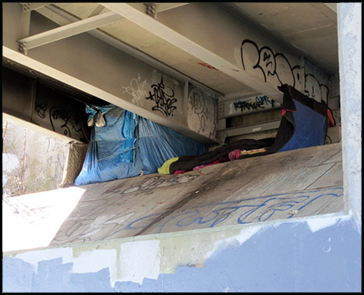
Image by Editor B (Bart Everson), used under its Creative Commons license.

Remembering Susan Bright

I first met Susan in 1989 when she helped me as I created our local homeless publication; Notes from the Blues Box which later evolved into the Austin Homeless Advocate and finally into the Austin Advocate.

Then, in 2009 after five (5) years of fruitless searching for a Publisher for my book, Looking Up at the Bottom Line, I returned to Susan for advice. As a publisher of poetry, she felt compelled to tell me right up front that there was nothing she could do for me. However, as busy as she was, she took the time to read it anyway. She realized that it was a story about Austin and our formula to end homelessness for over 1,000,000 minimum wage workers nationwide. Her response was simply, “The book is too important not to publish”…and so she did.

For me, she was all Austin.

– Richard Troxell

Learn more about Susan and sign the guest book at: http://www.caringbridge.org/visit/sbright

Support to End Economic Homelessness Grows

As our campaign to put a copy of our book into the hands of each member of the U.S. Congress and all governors continues, favorable responses abound. The responding political dignitaries include:

Gov. Terry E. Branstad (IA)
Gov. Scott Walker (WI)

Gov. John W. Hickenlooper (CO)
Gov. Steven L. Beshear (KY)
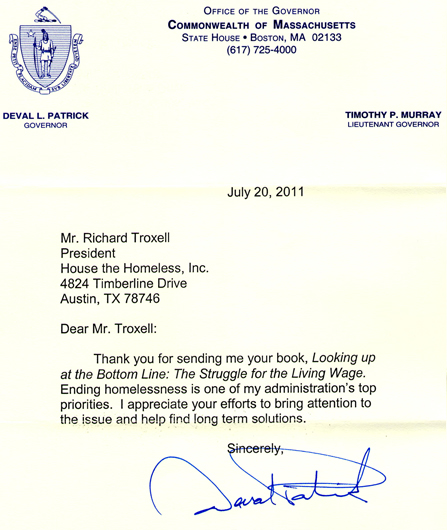
Gov. Deval L. Patrick (MA)
Gov. Brian Sandoval (NV)
Gov. Lincoln D. Chafee (RI)
Gov. Bill Haslam (TN)
Gov. Gary R. Herbert (UT)
Gov. Sean Parnell (AK)

Gov. Rick Snyder (MI)
Sen. Kelly A. Ayotte (NH)
Sen. Olympia J. Snowe (ME)
Sen. Daniel K. Inouye (HI)
Sen. Joe Manchin lll (WV)
Sen. Michael B. Enzi (WY)
Sen. Marco Rubio (FL)
Sen. Bob Corker (TN)
Rep. Michele Bachmann (MN)
Rep. Ed Whitfield (KY)
Rep. Spencer Bachus (AL)
Rep. Dennis J. Kucinich (OH)
Rep. James Lankford (OK)
Rep. Lamar Smith (TX)
Rep. Charles A. Gonzalez (TX)
Rep. Joaquin Castro (TX)
Rep. Rosa DeLauro (CT)
Rep. Mo Brooks (AL)

The Homeless Ex-Offender, Part 1

Registered sex offenders have a very rough time, since they’re forbidden to live near anything except a toxic waste dump. Okay, that’s a slight exaggeration. And some might say, why remind the audience of their least favorite variety of people experiencing homelessness? Unhoused people do come in many shapes, sizes, colors, occupations, and states of physical and mental health; and some of them, it’s true, have been convicted of sex crimes, and they have served time for it.

There are three things to remember. One, not every accused and convicted person is guilty. Two, the term “sex offender” covers not only the pedophile with a long history of molesting kids, but the youth convicted for having sex with his underage girlfriend, and the guy who has downloaded kiddie porn to his computer.

In terms of public menace, there’s a difference. Nobody here is condoning any kind of sex crimes. But if you’ve ever had a family member or a friend who ran afoul of the law in this way, you know what a slim chance they have of living a normal life again.

Now, here comes the really big theme: If the problem of homeless sex offenders can be solved, it will go a long way toward improving the general public opinion toward people experiencing homelessness, and possibly prevent some hate crimes. What stands in the way, in more than 30 states, are the restrictions on where an ex-offender may live.

Iowa was the first state to create tough residency restrictions. Consequently, the number of “whereabouts unknown” sex offenders doubled. When Kansas enacted its law, a constitutional challenge was slapped down, encouraging other states to “get tough” too. When residency requirement laws were enacted in various states, they not only forced some ex-offenders out of homes they rented or even owned, and cost them their jobs, but had made it nearly impossible for those newly released from prison to find anywhere to live at all. Some would even have families to return to, if not for rules about distance from places frequented by children.

The year 2006 saw the enactment of Jessica’s Law in California, named after the victim in an especially heinous case. In the following years, other horrendous crimes have taken place in the state regardless, and there were other unintended consequences. Within two years, the number of transient sex crime parolees rose by 800%. As of last month, the ban had led to what one reporter called “a dangerous 24-fold increase in the number of homeless sex offenders.” [The link is ours.] Isn’t that, like, a 2,400% increase? Sounds awful, when you put it that way.

With residency restrictions, ex-offenders tend to move to rural areas, where it’s easier to live far from a school or park, but this is difficult for the settled country residents. In the city, any landlord willing to rent to these unwanted people will probably be overwhelmed with applications. Washington Post reporter Karl Vick pointed out that in Long Beach, 19 ex-offenders ended up living in the same small apartment complex, and Carson had 30 pariahs in one hotel.

This kind of thing is alarming, so the neighbors become irate and active, and do whatever they can to eject the frightening newcomers… who are soon homeless once more, adding another spiral to the vicious circle. In Orange County, over a third of registered sex offenders are homeless, and a lot of them live in an encampment in the industrial part of Anaheim, the same town where Disneyland is located, which is kind of weird.

Understanding how unreasonable residency restrictions are, judges had been granting exemptions to parolees on an individual basis, but what a waste of court time and public money it is. Then, the state Superior Court recently found some parts of Jessica’s Law unconstitutional. A recent Los Angeles Times editorial said,

Before parents shudder at the thought of sex offenders now being allowed to live within 2,000 feet of schools and parks, they should remember the utter lack of evidence that the restriction ever kept a child from being molested.

Jessica’s Law could not change the ugly fact that most child victims (93%, according to the Justice Department) are molested by someone they know, family members or friends of the family, who live in the same house or have unquestioned access to their victims, and no prior convictions to provide a clue. Neighborhoods refuse to recognize that, preferring to obsess about strangers, and enjoying a false sense of security if the strangers can be kept at bay.

Of course, with limited funding and resources, it’s easy to think, “Wait a minute, why should we find housing for ex-convicts, when there are so many deserving young families out in the cold?” The prioritizing of who should be helped first is too big a question to go into right now.

The bottom line is, as many are beginning to discover, it’s better to be “smart on crime” than “tough on crime.” Even Georgia, not a notoriously liberal state, has loosened up, abandoning residency restrictions for those who have committed offenses before 2003. The state officials might even decide to exempt the elderly and disabled ex-offenders.

Coming Up: The Homeless Ex-Offender, Part 2.

Reactions?

Source: “The flaw in Jessica’s Law,” Los Angeles Times, 11/06/10
Source: “Laws to Track Sex Offenders Encouraging Homelessness,” The Washington Post, 12/27/08
Image by Tony the Misfit, used under its Creative Commons license.

The New NIMBY: Now In My Backyard

Venice, California, has been a city of Beats, hippies, and progressives of many stripes, and thanks to the beachfront culture and the ghetto-ish Oakwood area, it has always been a very “street” kind of place. Also, there are neighborhoods where people have lived for many years. St. Joseph Center has existed in its midst, in the local’s “backyard” so to speak, for more than three decades.

There is a café called Bread and Roses that serves people experiencing homelessness. Clients can send and receive mail, make phone calls, wash their clothes, or wash themselves. There is a thrift store. The staff members and volunteers (around 400) do a lot of things, like find emergency shelter and medical help for clients, and that includes people who might be mentally ill or substance abusers, or both. The Center offers various kinds of aid and advocacy in applying for benefits.

St. Joseph Center’s website states,

Homeless individuals who are ready to make long-term change may enroll in case management. Service plans developed jointly by the individual and the case manager assess each person’s strengths and needs and lay out a pathway to long-term stability and increased self-sufficiency by addressing issues such as permanent housing, job training, employment and ongoing treatment.

The part about the long-term change enrollment seems unknown to some of the neighbors, who don’t understand the levels of participation possible at the Center, and believe that all the clients must be fully enrolled in order to take advantage of the services.

I used to live within blocks of the Center, which was founded by nuns in 1976, so it was almost brand-new in my day. In 2006, the new main service center (family service and administration) was built on Hampton Drive, as described in this piece by Suzanne Thompson, in the Free Venice Beachhead (PDF),

Despite being so venerable, the institution has been embattled for years. I don’t live there anymore, but have followed the controversy through the neighborhood newsletters and other publications from Venice. Many of the neighbors equate the clients with criminals. Some are, some are not, and the same is true at any facility of this kind. A lot of people have records. A lot of people have been locked up at some point in their lives. (If you know a hundred people, one of them is in jail.) If they did their time, they’re even. Theoretically, here in America, a person with a criminal record has the same right to a free bowl of soup as anybody else.

There are always complaints about human excrement in the area. Why is that? It seems like, after the first year or so, the Center and/or the city would have figured out the restroom problem. The neighbors hate graffiti, and having their car windows smashed with bottles (or possibly from the impact of somebody’s skull). Some neighboring homeowners and renters live in constant fear. Others summon up their spiritual ideals or their old-school 60’s spirit, and try to exercise tolerance while they cope.

Some neighbors feel general compassion, but are exasperated by individual cases. They bring up the “homeless by choice” argument. It is true that throughout the history of the world there have been people who prefer to be vagabonds, and some prefer it now. But not nearly as many as the housed neighbors want to believe. Some call the center an “enabler,” and believe that any such facility that offers services to people experiencing homelessness will only encourage the lifestyle. Others disagree, such as Lars Eighner, who was quoted on this subject by House the Homeless a few days ago.

Almost a year ago, Va Lecia Adams, executive director of the homeless center, told Tidings Online:

We’ve always served families but, proportionally, we are seeing more families now. Certainly housing has been a very serious issue for our families. And I think so many families are just on the brink. When a member loses his or her job, it all can just crumble — especially in Santa Monica and Venice, where people are fighting to keep their housing.

At that time, the Center was serving 150 hot meals a day, and giving out thousands of bags of groceries. Donations were down, the staff was cut. Things have only gotten worse since then. There was a bright spot in September, when the Venicestock Festival with its seven bands raised money and awareness for the Center to continue its work. St. Joseph Center is currently, by the way, looking for a Manager of Venice Chronic Homeless Intervention Projects.

Reactions?

Source: “Homeless Services,” St. Joseph Center
Source: “Our History,” St. Joseph Center
Source: “St. Joseph Center struggles to serve Westside’s needy,” The Tidings Online, 01/29/10
Image by Steven W. Belcher, used under its Creative Commons license.

More Stuff About Stuff

During this materialistic holiday season, there is more to say about belongings. Coats, for instance. Viking Moving and Storage in New York has a long-standing tradition that helps people experiencing homelessness. It sponsors an annual Coat Drive, and this is one of the interesting facts the company shares with the public:

90% of homeless adults need a new, warm coat each winter because they have no place to keep one over the summer months.

Where do all the old coats go? Are they all so worn and soiled that they can’t be refurbished? Doesn’t anybody sort them out and dry-clean the salvageable ones and save them till next year? What a waste, if they are all just thrown away.

And what about the “Element S(urvival)” coat that converts into a sleeping bag? Whether this remains a handcrafted item made by the inhabitants of homeless shelters, or somehow goes into mass production, the intention is to distribute these coats as widely as possible to people experiencing homelessness. What happens at the end of winter? Will they all just be thrown away? Do we want all that Tyvek insulation in the landfill? Are these coats recyclable? Or will there be a place for each person to store the coat until next winter?

Slight digression on the subject of clothing: In Austin, Texas, the Thermal Underwear Drive is still in progress. Please consider donating to it, or an equivalent program in your area.

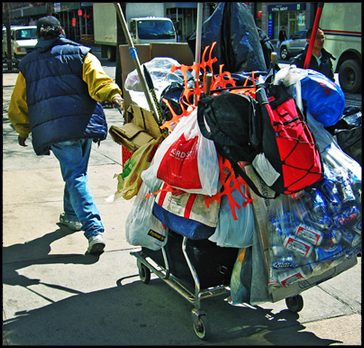
A solid citizen who needs four pieces of luggage for a weekend vacation will get all upset about a person experiencing homelessness, whose total possessions fit into a jumbo-sized trash bag. Whether stuff is worth having is not for somebody else to judge. People should be able to have the stuff they need, or think they need. (Within certain limits. No dead animals, for instance. But housed people are not supposed to have those either.)

What happens when you suddenly (or slowly and painfully) become a family experiencing homelessness? What happens to all your special things? The knickknacks that relatives gave you, the beautiful objects from friends and lovers, family photo albums, the kids’ school projects. With any luck, you can talk a friend or relative into keeping a few boxes in their garage, where your stuff may or may not be stolen or watersoaked, or eaten by rats.

If a family loses its housing in warm weather, the cold will eventually come again. You really need to keep the kids’ winter clothes. Surely some day you will have a kitchen again, and need your pots and pans. If you’re lucky enough to have a computer or a decent stereo system, trying to hang onto those should not be an unreasonable desire. Of course, many people facing homelessness sell everything. If they don’t, critical people think they should. Even if it means settling for 10 cents on the dollar, for things that will be an expensive hassle to replace.

To maintain any kind of hygiene, social acceptability, and personal pride, there is a certain irreducible amount of possessions a person needs. To maintain any kind of civilized existence, you just plain need stuff, and a place to keep it, either short-term, long-term, or both. Families need stuff, single people need stuff, and even if you can’t use it right now, someday you might once more have a living space to use it in. How can you let that stuff go? You can’t carry it around. Sometimes, if there is any money at all coming in, you can rent storage. Do you buy storage or food? There are a million Sophie’s Choices to make, a million stories out there. The homeless are not an amorphous mass.

There used to be lockers in bus stations and train stations, but no more. Another casualty of the drug war, no doubt. Horrified by the idea that somebody might keep a stash in a locker, the people in charge would naturally want to remove any opportunity for anyone to leave anything, no matter how innocent, in a locker. Between that and the 9/11 paranoia, lockers are disappearing from the public scene, if they haven’t already.

A few days ago we talked about former basketball star Ray Williams, who now has a job and an apartment after a long spell of homelessness. One of his misfortunes was that a storage facility auctioned off his furniture and other belongings — though it apparently gave him a nine-month grace period to pay back rent, which is unprecedented generosity.

Back in July, it was reported that, aside from the found wreck that Williams slept in, he actually owned a roadworthy Chevy Tahoe. Unfortunately, his working vehicle was being held by a repair shop that needed its $550 bill paid. In October, when Williams was about to leave Florida for Mt. Vernon, Tim Povtak published a followup story. By the time this story appeared, the repair shop bill had escalated to $2,900. That’s how it is to be destitute. Even when you don’t buy anything, stuff costs you money. Even when you don’t have access to your stuff, it costs money to hold onto it.

This comes (with permission to share) from Sam Crespi of Women Who Dare, a note about when she lived in Los Angeles:

There was a young man who’d worked for the Peace Corps. He rented an abandoned gas station downtown, across the street from the homeless theater… I can’t quite remember what he called it, but I think it was Planet Earth. He realized that there were homeless men who could pick up jobs unloading trucks in the neighborhood, and that what kept them from doing it was they’d likely lose their belongings, which they’d to try to hide somewhere, usually unsuccessfully.

So he found a bunch of school type lockers on the cheap and installed them around the station and that solved that problem. Someone gave him some furniture (chairs and some sofas, small tables), someone else game boards (chess, checkers, etc). We brought an old oil drum so they could have a fire at night. Sometimes we brought hot food. A small boy from Salvador with his mother, both of whom were living in a cardboard box, came by sometimes. By then there was a TV, and I started renting films for him.

What I remember is how much it meant for these people to be respected — talked with as they were more than someone without a face. They felt nourished by that theater, by the games, the conversation. It gave them a chance for a short time to leave behind all the rest.

Reactions?

Source: “About Us – Newsroom,” A1FirstClass.com, 01/10
Source: “The Nomadic Life of Former Knicks Captain Ray Williams,” Fanhouse.com, 10/11/10
Image by moriza (Mo Riza), used under its Creative Commons license.
0