


Our Mission

Founded in 1989, HtH is the oldest all volunteer, action, homeless organization in the state of Texas. The mission is Education and Advocacy around the issues of ending and preventing homelessness.

Urgent Issues

Re-Criminalizing Homelessness — Speak up now!

HtH supports the direction being taken by the City of Austin’s relatively new Homeless Strategy Office, led by a very committed and responsive David Gray, and with the commitment of Charles Loosen and other staff. We further strongly advocate ALL positions below that preceded The vote to basically criminalize homelessness — especially:

reinstating a camping ban must consider that those with disabilities, the aged, and in fact anyone with no place to go. The no sit/no lie ordinance is absolutely inhumane and unconscionable we must have at least 15 minute respites particularly for those with disabilities and make other provisions.

Mayor Kirk Watson, elected in 2023, is working to secure funding for homeless services from the State and within the City Budget.

2025 interests:

City Council approved a resolution making homelessness a top financial priority.

Increase the capacity of the Homeless Strategy Office to address and implement a comprehensive approach to strategic advancements in homelessness response. (Plan detailed in a 50-page memo from David Gray, June 2025).

Examples:

1. Expand HOST (Homeless Outreach Street Team) support including team members:

APD officers, EMS paramedics, behavioral health clinicians, social workers, peer support staff.

2. Support for Marshaling Yard operations.

3. Rapid Response housing and safe housing, especially for families.

4. Increase shelter beds with support; and more.


The Austin city council recently voted to put on its May 2021 ballot a vote to reinstate the no camping ban including the no sit/no lie ordinances. Now is the time to contact your mayor and council members particularly those who have supported decriminalizing homelessness, such as Mayor Adler, Kathy Tovo, Ann Kitchen, Greg Casar, Sabino Renteria, and others, we pray.

First call to action is cold weather shelter. Anyone that reads this, our urgent plea is to email our mayor and city council in this urgent time of cold weather. House the Homeless is encouraging to use the Convention Center or other alternatives sites that are already over burdened due to Covid-19 or at capacity.

A second call to action is to not displace unsheltered neighbors from bridges and the four major camp areas without having an immediate plan for alternative shelter/housing.

Finally, advise your mayor and council members that the wording for the May ballot regarding reinstating a camping ban must consider that those with disabilities, the aged, and in fact anyone with no place to go. The no sit/no lie ordinance is absolutely inhumane and unconscionable we must have at least 15 minute respites particularly for those with disabilities and make other provisions.

Federal Minimum Wage Debate

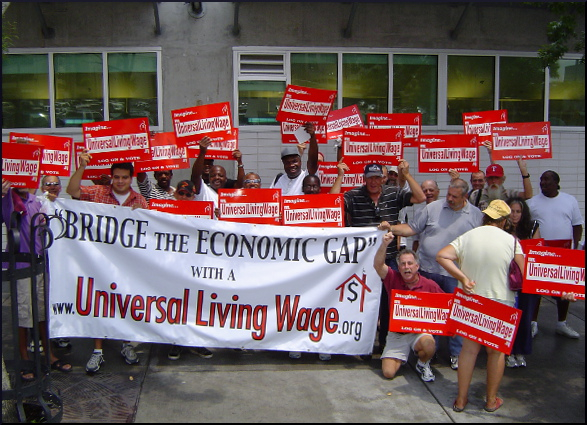
Federal resolve is insufficient; highly recommend Universal Living Wage formula indexed on the cost of housing wherever the person lives and works. 

How Austin’s Annual Homeless Memorial Service Began

Coming up next week, November 14-21, is National Hunger and Homelessness Awareness Week, observed throughout the country. In Austin, Texas, the week starts off with the Homeless Memorial Sunrise Service, an opportunity for friends and anyone who cares to pay their respects to those who are no longer with us. At House the Homeless, you can find complete information about this year’s memorial, along with the recollections and photos from last year’s Memorial Sunrise Service.

Yesterday, November 11, was the official publication date of Looking Up at the Bottom Line by Richard R. Troxell. This book tells us why we should all be fighting for the Universal Living Wage, and gives the history of Richard R. Troxell’s commitment to housing the homeless. It includes many stories commemorating members of the homeless community who have been lost.

Some say the most moving story in the book is that of Diane Malloy, who sought a temporary roof over her head at the Salvation Army shelter with her fiancé, Jim Tynan. Diane had suffered from a persistent cough for weeks, but couples weren’t allowed at the facility, so they were turned away. Somebody told them about a dry creek bed that would be a semi-protected place to stay in.

But rain came, bringing a flash flood, during which Diane had disappeared. Jim looked for her all over town, and, by the time he met Richard, the sick woman had been missing for three days. Richard got his kayak and the two men searched the creek, and found Diane’s drowned body. Then followed some unpleasant hours with the police. Richard says,

Apparently, Jim Tynan had made yet another judgment error. When he had reported Diane’s disappearance, he had been honest and told the detective that they were homeless — big mistake. Had he left that one detail out, the police would have been looking for her. We would have heard that the boy scouts, the girl scouts, the water rescue team, and the police had been searching for a young woman who may have become a drowning victim… Instead, they never looked.

Diane Breisch Malloy had been an employed citizen, working for 10 years with the phone company, but after using up all her sick leave she was let go. Two months later, she was dead.

Richard writes that since his tour of duty in Vietnam, he had been concentrating more on life than on death. But Diane’s death was a “wake up and smell the coffee” moment. Thinking back, he realized that in the last three years, he knew of 23 people experiencing homelessness who had died. And that was the beginning of the Homeless Memorial Sunrise Service, first held in 1992. This is its 18th year, with more names added every year to the roll of the deceased.

This was told to me as an example of homeless humor. It’s a joke a with a real punchline:

‘What does the street person do when he gets sick?’
‘He dies.’

In an effort to prevent as much needless death as possible, House the Homeless carries out an annual health survey in Austin. The 2010 survey was filled out by 85 females, 408 males, and 8 transgender persons. The results were not good. In this group of people experiencing homelessness, over 200 had high blood pressure, more than 120 had diabetes, more than 100 suffered from arthritis, and nearly 50 were subject to seizures. More than 80 had cancer, and more than 80 were brain-injured. Among the respondents, there were 175 diagnosed cases of mental illness. That is a lot of care needed, in just one city. And a lot of human misery.

If the National Hunger and Homelessness Awareness Week is an unfamiliar concept, maybe you will feel inspired to start preparing for next year’s Week in your town. The National Coalition for the Homeless and National Student Campaign Against Hunger and Homelessness offer a downloadable 31-page PDF file called “Resolve to Fight Poverty.”

Reactions?

Source: “Looking Up at the Bottom Line,” Amazon.com
Source: “HTH Health Survey Results 2010 for Austin, Texas,” HousetheHomeless.org
Image by jurvetson, used under its Creative Commons license.
A Book to Help Homeless Veterans

This is the official publication day for Looking Up at the Bottom Line: The Struggle for the Living Wage! by Richard R. Troxell, from Plain View Press. Troxell is in Philadelphia, visiting at the University of Pennsylvania, where the School of Social Policy & Practice is hosting a lecture and booksigning today only. If you’re in the area, it’s at 3601 Walnut St., University Sq., and the event is from 2:30 to 4 PM.

Looking Up at the Bottom Line is largely about veterans. How could it not be, when one-third of the people experiencing homelessness are veterans? Among the unhoused population, the military, as a profession, is woefully over-represented. The homeless vets are the lucky ones. The unlucky ones are dead.

Aaron Glantz, an investigative journalist, studied veterans in the state of California and reported in The Bay Citizen on an appalling situation. He says,

An analysis of official death certificates on file at the State Department of Public Health reveals that more than 1,000 California veterans under 35 died between 2005 and 2008. That figure is three times higher than the number of California service members who were killed in the Iraq and Afghanistan conflicts over the same period.

To make a broad generalization, it looks like the after-effects of having been in the war are killing more service members than the actual war. To make another broad generalization, the government really needs to pay attention to Post Traumatic Stress Disorder (PTSD) and take it seriously.

These guys come back from combat and just jump the track, becoming the poster children for self-destructiveness. Some die in motorcycle wrecks and car crashes, others OD or commit suicide in a variety of more direct ways. Glantz says,

Suicides represented approximately one in five deaths of young veterans, the data showed. Many other deaths resulted from risky behaviors that psychologists say are common symptoms of post-traumatic stress.

Glantz is the author of three books, including The War Comes Home: Washington’s Battle Against America’s Veterans. His recent report is replete with both cold, factual graphs dealing with statistics, and several human-interest stories of individual veterans.

Apparently, the government is not doing a good job on any level, from intervention all the way down to mere record-keeping. Glantz interviewed the director of Veterans for Common Sense, Paul Sullivan, who deplores the attitude shown by the Veterans Administration and the Department of Defense. He told the reporter,

V.A. and D.O.D. appear to have a policy for veterans called ‘Don’t look, don’t find.’

The veterans who die of compulsive risk-taking behavior or outright suicide are called “stateside casualties,” and we can expect a lot more of them, partly because of the delayed impact peculiar to PTSD. Often, it takes a few years for the full effects of PTSD to develop. People can even seem fine… for a while.

Of course, this is nothing new. A vet named Daniel G. Dumas has gathered together some statistics on Vietnam veterans that are just as disheartening. Unfortunately, he doesn’t give the sources of his information, but makes such claims as, “The suicide rate for Vietnam vets is 86% higher than the national average of peers of the same age group.”

Probably nobody can really know these numbers, but there is no doubt that Vietnam veterans experienced unemployment, divorce, incarceration and homelessness at statistical rates out of proportion to their numbers. The claims about Vietnam vets have been contested, but the more careful analysis now being done of the fates of Iraq and Afghanistan veterans indicates that even the wildest guesses about their Vietnam war counterparts might not be too far off the mark.

Reactions?

Source: “After Service, Veteran Deaths Surge,” The Bay Citizen, 10/16/10
Source: “What is a Vietnam Veteran?,” CAPVeterans.com
Image by Tony the Misfit, used under its Creative Commons license.
0

Maria Foscarinis Tells It Like It Is

Today’s interesting person is Maria Foscarinis, Founder and Executive Director of the National Law Center on Homelessness & Poverty, who says,

[…] I’ve spent the past 20 plus years working for policies to prevent and end homelessness in America. In my experience, neither party has embraced our cause with vigor, but we’ve had strong individual allies and supporters in both major parties.

On the other hand, Foscarinis suggests that “bipartisan” is too often just another word for “compromise that leaves nobody happy.” She has little interest in whether something is or is not bipartisan, and great concern about whether it is or is not sane. Foscarinis says,

Rather than bipartisanship, what we should strive for is rational, sensible policy, supported by the best evidence available, consistent with our fundamental values… In an environment that favors sanity or even just reason and common sense, ending homelessness would be at the top of the agenda.

Being poor and homeless means more than just lacking a living wage and a roof, although those conditions are bad enough in themselves. It also means being without a voice. A person with the same address and phone number for 20 years can run into a hassle trying to register as a voter. Can you imagine how difficult it is for people experiencing homelessness?

Foscarinis brings up some unpleasant truths that few people think about. Some of us think about them. Even for a healthy person, it’s difficult to, for instance, get enough water to stay hydrated, a minimal and inescapable need. (And unfortunately, drinking any kind of liquid leads to another inescapable need, which is often difficult to meet without breaking the law.)

But what if you don’t have a place to live, and you’re on some kind of medication that needs to be refrigerated? What if you have to monitor your insulin levels, or replace your colostomy bag? What if you need daily, costly eye drops to keep from going blind? For people experiencing both homelessness and health problems, life must be hell.

Foscarinis cites a recent poll indicating that 53% of the American people are not sure if they will make their next mortgage payment or rent. It’s official: We are the Nervous Majority. She mentions such societal costs as the astonishing emergency room bills that one homeless person can rack up, and the amount of law enforcement resources wasted on hassling street people. She asks a question that gets down to the nitty-gritty:

Does anyone really believe it’s acceptable for people to be living without a home in the 21st century in the United States of America?

Foscarinis also speaks of the Universal Declaration of Human Rights, which is over 50 years old but doesn’t seem to have caught on as well as its drafters hoped. This document is also very important to Richard R. Troxell, who quoted extensively from it in his 1997 document known as the Protected Homeless Class Resolution. Here is an excerpt:

Whereas, the United States Government has adopted and is party to the United Nations Document referenced as the Universal Declaration of Human Rights, which ‘confers on every member of society a right to basic economic, social, and cultural entitlements, that every (nation) state should recognize, serve, and protect, of which food, clothing, medical care, and housing are definitive components of the right to a minimum standard of living and dignity’…

The Protected Homeless Class Resolution can be found in its entirety in Looking Up at the Bottom Line. Reactions?

Source: “Sanity, bipartisanship and homelessness: The impact of this week’s elections,” The Huffington Post, 11/05/10
Source: “Looking Up at the Bottom Line,” Amazon.com
Image by garryknight (Garry Knight), used under its Creative Commons license.

Big-City Sheriff Halts Evictions

When dog bites man, it isn’t news. But when man bites dog, that’s news. Fresh examples of this old saying appear every day.

For instance, if you saw a headline that seemed to mean a sheriff was halting evictions, you would think it was a misprint, right? Evictions are what sheriffs do, sometimes backed up by whole squadrons of armed goons.

And, of course, homelessness follows evictions like night follows day. But let’s pause for a short digression. There is a quaint old American political theory called Posse Comitatus, an extreme form of localism which holds that the county sheriff is the highest law in the land. (Furthermore, if the sheriff doesn’t follow the people’s will, they can take him out and hang him, literally, with rope, in the middle of town, at high noon, and leave the body there until sundown.)

But Sheriff Thomas Dart, who just said “No” to a stack of 1,500 eviction notices on his desk, is not some backwoods lawman with a Posse Comitatus fixation. His jurisdiction includes Chicago, the nation’s third-largest city.

Bloomberg Businessweek article tells us,

Dart said his office reviewed 350 foreclosure cases and only 17 had complete paperwork to justify an eviction.

The Sheriff of Cook County, Illinois, held a press conference last month to announce his decision to hold off on carrying out the foreclosure evictions until he could be convinced of their legality. The lenders, Bank of America, JPMorgan Chase, and Ally Financial Inc.’s GMAC have admitted that there may be “deficiencies” in some of their work product, and Dart is holding out for better documentation. Even more remarkable, he has done this before:

This is the second time since 2008 that Dart has halted Cook County evictions over concerns about foreclosure practices and procedures.

In an interview conducted by Kai Ryssdal of Marketplace Public Radio, Dart talked about the stand he took two years ago, when…

[…] it was absolutely clear that the banks were not notifying people that were physically in the houses that they wanted me to empty out… I’ll never forget the one family… there were three little kids, a mother and a father, and then all of a sudden, here I am, standing next to seven deputies, all dressed in black with battering rams, in their living room. The children are crying, and I’m sitting down with these people, and they’re showing me paperwork after paperwork showing they’ve paid all their bills, they’ve paid everything… the injustice was unbelievable.

The experience caused Dart to hire a social worker to meet with families on the brink of eviction and help them figure out how to get some other kind of housing. In the current situation, Dart is not saying he will never throw anybody out again. But he is telling the banks,

[… A]ll I’m asking is just send me an affidavit that you’re willing to put your name on saying that these foreclosures that you’ve given me, that you’ve done them properly.

For a while there, it looked like he was going to run for mayor of Chicago, but then he decided not to. There is more than one reason why a politician might let such a rumor get started. For instance, just for the fun of throwing a scare into the other contenders. Tom Dart has certainly shown himself a sheriff to be reckoned with.

Note: The originator of the “man bites dog” meme was, according to Wikipedia, either Alfred Harmsworth, John B. Bogart, or Charles Anderson Dana.

Reactions?

Source: “Bank of America, JPMorgan Chicago Evictions on Hold,” Bloomberg Businessweek, 11/04/10
Source: “A sheriff temporarily halts evictions,” Marketplace.PublicRadio.org, 10/20/10
Source: “Man bites dog (journalism),” Wikipedia
Image by Matt C. (Matt Crampton), used under its Creative Commons license.
People Experiencing Homelessness are Vulnerable Always

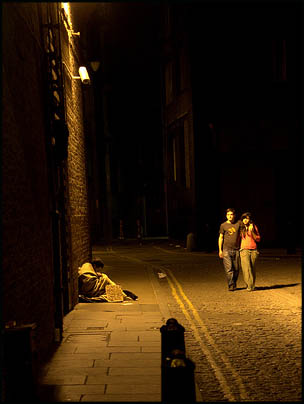
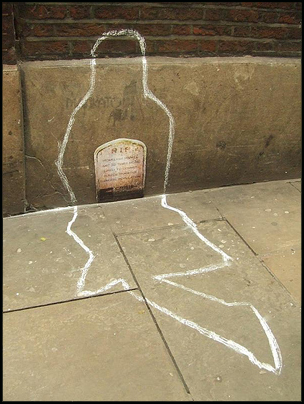
Here is a news item by reporter Jack Encarnacao, about a body found in Quincy, Massachusetts. The deceased was assumed to be a person experiencing homelessness:

A 47-year-old man thought to be homeless was found dead in a Quincy Center alley. The Norfolk County district attorney’s office is investigating the death of Robert Aldred, who was found on the ground shortly after 9 a.m. Monday behind 1534 Hancock St. Investigators do not suspect foul play. Aldred was known to police, Quincy police Capt. John Dougan said. The state Medical Examiner’s Office will determine the cause of death.

What’s so special about this story? Nothing. It could be a piece of boilerplate. No disrespect is meant to the reporter, who was just doing his job, and passing along as much information as was available at the time. But really, it’s like a form, with the name and age filled in, and the location of the body. They probably all say, “______ was known to the police.” How many similar notices have appeared in American newspapers this year? Like Bob Dylan sang, “He was only a hobo, but one more is gone.”

It’s good to know that no foul play is suspected in the demise of Robert Aldred. Unless, of course, we examine the root causes of homelessness, and detect a whiff of foul play in the policies and practices that force so many Americans into the streets.

All too often, the play is foul. Associated Press reporter Michael Graczyk reports from Houston, Texas, that the police are looking for whoever has been strangling women, and that the Houston police are investigating murders of three women since this summer. They might have all been killed by the same person.

Twenty-four-year-old Raquel Mundy was not homeless herself, but in June her body was found by a homeless man, as the writer relates, in “an overgrown lot on a dead-end street leading to railroad tracks.” Mundy had dropped off her mother and her two kids at the bus station. Then her car was towed from a restaurant parking lot, so she was stranded. There is an additional heart-rending detail:

On Monday, police would not confirm reports from the time of her disappearance that her mother received two text messages from her suggesting she was with [a] Hispanic man and in danger.

We don’t know the facts, but the scenario is easily imagined. People who depend on Greyhound for their transportation are in a low socio-economic group. Bus terminals are usually downtown. Downtown parking lots charge exorbitant rates. This poor woman probably couldn’t afford the fee, and didn’t want to just dump her mom and kids in front of the bus station. No doubt she wanted to do something frivolous and irresponsible, like, for instance, kiss them goodbye and see them safely onto the bus.

So she took a chance, and left her car in a restaurant parking lot bristling with signs threatening to tow away all non-customer cars, and her car was towed. Apparently, Raquel Mundy then accepted “help” from the wrong man. Imagine the grandma, on the bus wending its way out of the urban center, two children in her care, getting text messages from their frightened mother, her imperiled daughter. What a horror.

Was Raquel Mundy’s killer the same man who also strangled two certifiably homeless women, more recently? On September 30, Reita Long, age 52, was found dead not far from the same bus station. Then, a little over a week later, the body of a 62-year-old woman named Carol Elaine Flood was found near the old YMCA, also downtown.

The police department is leaning toward the theory that it’s the same killer in all three cases. They’re advising homeless people not to sleep alone on the streets. It’s not the most helpful advice ever given, but they’re doing their best. The city is asking for help from the public, and there is a $15,000 reward for the right information.

Here is a statistic from the National Association of School Psychologists:

The suicide rate for homeless males between the ages of 18 and 24 is 10.3 times higher than the national average.

There are a lot of statistics to choose from, depending on which part of the U.S. we’re talking about, and it varies according to age group, sex, military status, etc. Let’s just say there is more suicide, proportionately, among the people experiencing homelessness than among the housed. And consider Japan, where suicide is a commonplace cultural tradition. For the same reasons, poverty and homelessness, the numbers there are really grim.

The Homeless Memorial Sunrise Service in Austin, Texas

The week of November 14-20 is designated as National Hunger and Homelessness Awareness Week. In Austin, Texas, there will be prayer, song, and fellowship as we remember the lost friends of the past year and all the years before.

There are huge human costs involved when a society maintains a population of extremely vulnerable and disempowered people. An elected official is always invited to speak at the Homeless Memorial Sunrise Service, insuring that at least one public servant has the opportunity to raise some awareness of those costs. The ones who do are heroes.

Here is the information on the November 14 event, in case you are anywhere in the area and need to plan ahead. The time is 6:30 in the morning — to catch the sunrise. The place is Auditorium Shores at South First Street and Riverside Drive, Austin, TX. The Homeless Memorial & Tree of Remembrance is located on Auditorium Shores at South First Street and Riverside Drive. It is just 75 yards east of the Stevie Ray Vaughan statue and just west of the Fanny Davis Gazebo.

No sad event would be complete without a Call to Action, and the recommended action in this case is the implementation in this country of the Universal Living Wage. The guidebook for this movement is Richard R. Troxell’s new book, Looking Up at the Bottom Line. After the Memorial, Richard will sign copies of the book, whose proceeds all go to ending homelessness. Coffee, cocoa, orange juice, and breakfast tacos will be served.

Come to think of it, why would a person even need to be in the area to take an interest in this event? Why not make a road trip of it? Wouldn’t it be interesting if about 50,000 people showed up for the Homeless Memorial Sunrise Service in Austin, and then the next day, 75,000 people showed up for the homeless memorial service in another city?

Reactions?

Source: “Man found dead in Quincy thought to be homeless,” The Patriot Ledger, 11/02/10
Source: “Houston police investigating murders of 3 women,” Associated Press, 11/01/10
Source: “Helping Homeless Students,” NASP Online
Source: “Memorial,” House the Homeless
Image by Matt From London (Matt Brown), used under its Creative Commons license.
Washington, D.C., Homeless in a World of Hurt

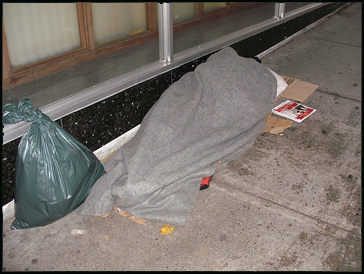
Washington, D.C., is the capitol of the greatest country on Earth. (Anybody who disagrees, don’t get excited. That’s kind of like saying America is the healthiest patient in the hospital — in other words, sick, sick, sick.) In the metropolitan area constituting the capitol of the greatest country on Earth, around 12,000 people are experiencing homelessness.

Say what? Don’t they mean 1,200? No, they mean 12 thousand, give or take. People who don’t possess addresses are notoriously difficult to count. What we know for sure is that the District of Columbia has one of the highest homelessness rates in the country.

We’ll get back to that, after starting with the good news. On November 23, 100,000 caring Americans turned out to peacefully demonstrate on the National Mall. The occasion was the annual “Help the Homeless” walk, and Khadijah Norman tells us about it in The Hoya, which is the student newspaper of Georgetown University:

The walkathon raises money for the more than 12,000 people in the District who are living without shelter of their own. Since its beginning in 1988, the walk has raised $80 million toward relief efforts.

The university sent two busloads of folks from the Hoya Outreach Programs and Education (HOPE) and other student groups. Victoria Glock-Molloy, who is the co-chair of HOPE, told the reporter that Georgetown students raised at least $1,500 for the cause.

So… what else is going on in the capitol of the nation that wants to show every other country on Earth the right way to do things? For starters, the concept of a living wage has gone the way of the unicorn and the zoot suit. Washington, D.C., has more people than anyplace else in the country getting along at less than half of the “poverty level.” Imagine that, not even making enough money to qualify as poor. What a sorry condition for the capitol of the greatest country in the world to be in.

And now it’s winter, compounding all the problems. Kathryn Baer of Change.org explains the tangle of difficulties and proposed solutions for people experiencing homelessness in Washington, D.C., and is it ever complicated. Okay, the local government is more progressive than some. That’s a plus. Another plus is having Tommy Wells of the Interagency Council on Homelessness on the case. That’s about it for the positive aspects. Because even the most well-intentioned and determined councilmember cannot make the available limited resources stretch to meet the need.

So lines have to be drawn, and that’s where the truly sticky problems start. What the Council wants to do is get everybody in out of the cold, and there just aren’t enough places to put them. There is an emergency shelter for families, called DC General, and it’s not a good place. It’s better than outdoors, but only marginally. Baer says,

Many families sleeping on cots in what was supposed to be the recreation room. Families sleeping in hallways. Some in closets. Other extraordinarily unhealthy conditions due at least in part to the overcrowding — rats, roaches, mold, etc… The downsides to communal housing for families should be obvious. Children at risk of abuse from strangers. Conditions in which communicable diseases can spread — a significant risk not only for children, but for adults with diseases like AIDS that impair their immune systems. No private, quiet space where children can study and families as a whole maintain some facsimile of normal life.

Because Washington is trying harder than some surrounding areas, it’s catching the overflow from other places within traveling distance. Which means that stricter documentation requirements have to come into play. It’s hard for people to prove that, although they don’t live anyplace, the noplace where they don’t live is the bureaucratically correct noplace. Yet these restrictions have to be made, in fairness to the taxpayers in the area where help is being offered.

The mass of people experiencing homelessness includes some subgroups with even more serious concerns, such as women and children escaping from domestic violence. They don’t want the person they have fled from to be able to find out where they are.

Meanwhile, the temperature outside is dropping. If you’re particularly interested in the Washington, D.C., area and want a crash course on what’s going on there, please consult Kathryn Baer’s blog, “Poverty & Policy,” which celebrates its second birthday today. It’s no-frills and fact-packed, and Baer is wonderfully adept at delineating the issues and making sense out of official information.

Reactions?

Source: “Students Hit Pavement for Homeless,” The Hoya, 11/23/10
Source: “Washington, D.C. Homeless Endangered by Proposed Restrictions,” Change.org, 11/27/10
Image by quinet (Thomas Quine), used under its Creative Commons license.
0

Humor as a Tool for Social Change

Jim Schutze has been writing for the Dallas Observer about every conceivable topic for freakin’ ever, and he’s LMAO funny. Now he asks whether a case can be made for killing the homeless. His article is called “We’ve Banned Their Shopping Carts, Outlawed Panhandling, Provided Homes For The Homeless — And Nothing’s Worked. There May Be One Modest Proposal That Solves The Problem.”

The scene is Dallas, Texas, but the idea could spread. Controversy has been hot in Dallas lately, just like anywhere else that has more than one homeless person per square mile. An institution called The Bridge is operating downtown. Disguised as a homeless services center, it has a hidden, sinister purpose, which Schutze reveals:

The city has been using The Bridge as a kind of training camp to teach the homeless how to pass for home people. Then the city finds them homes.

This is awfully sneaky. If some urbanites can’t tell the difference between the housed and the homeless, how will they know whom to hate? This kind of confusion can only be expected from an administration whose efforts to make a difference have been “stubbornly ineffectual.”

For instance, in 2004, Dallas outlawed shopping carts, and apparently some residents were surprised when that didn’t solve any problems. Those people experiencing homelessness are so cunning and crafty, they just switched to baby carriages. Schutze outlines the only possible conclusion:

The lesson for me has been that the homeless situation is one of those fundamental manifestations of the human condition that can never be ‘solved’ in the sense of making it go away, unless you make the humans go away. Anything short of actually killing the homeless is going to fail to truly resolve the issue…

Schutze does not insist that we decide on the methods right now, but does advise getting good legal advice first. This is, of course, all humor of the darkest kind, and anybody who was paying attention in English class would recognize the genre.

In 1729, when Jonathan Swift anonymously published one of literature’s most famous works of social protest, Ireland had been a land of famine for centuries. It was accepted as historical fact that starving people had sometimes resorted to cannibalism. In Swift’s time, most of what we now know as Ireland was owned by the English absentee landlords, and the Irish were a bunch of subsistence-level serfs.

Swift’s pamphlet was titled “A Modest Proposal for preventing the children of poor people in Ireland, from being a burden on their parents or country, and for making them beneficial to the publick.” The word “modest” had a different meaning in those days. It wasn’t a person with low self-esteem saying “Aw, shucks.” A modest proposal would be a simple plan, something easy to do and not likely to meet with objections.

Oddly, it is an American who suggests to the author that a one-year-old child is “a most delicious, nourishing and wholesome Food, whether Stewed, Roasted, Baked or Boyled.” The whole thing is pretty outrageous, as humor generally is when used as a weapon. There is a lot more about Swift’s famous satire in this study guide written by Andrew Moore.

Homeless activists have employed humor as a tool in many times and places. In Looking Up at the Bottom Line, Richard R. Troxell recalls the time in Austin when a group took a gosling named Homer as a hostage, and threatened to kill and eat the baby goose unless the city would allow a legal camp ground. People working for change, such as a living wage, often find they can have a little fun at the same time.

“Humor as a Tool” Bonus: a few panels by homeless cartoonist Ace Backwords of Berkeley, California.

Reactions?

Source: “We’ve Banned Their Shopping Carts, Outlawed Panhandling, Provided Homes For The Homeless — And Nothing’s Worked. There May Be One Modest Proposal That Solves The Problem,” Dallas Observer, 09/02/10
Source: “A Modest Proposal — study guide,” Teachit, 2002
Source: “Looking Up at the Bottom Line,” Amazon.com
Image by jswieringa, used under its Creative Commons license.

English Grocery Chain Sets a Good Example in Training the Homeless

Today, we’re looking at an announcement from England and the comments it has attracted. Taken together, they pretty much capsulize the larger debate about society’s obligations to people experiencing homelessness.

In the United Kingdom, the fourth largest supermarket chain called Morrisons plans to open several new stores in which it will employ the homeless. The projected number of employees it will be needing is 10,000, and the plan is to fill 10% of those openings (1,000 jobs) with homeless people.

Rowena Mason writes about energy and financial matters for the Telegraph. In her brief article, we learn that Morrisons’ plan came about through cooperation with a nonprofit organization called Create, and with the Salvation Army.

The food chain promises to provide not just low-level jobs like cleaning, but to train people for more skilled positions, under an apprenticeship program. Apparently, the pilot program is already underway, and the first five people who went through the pre-employment academy have just started work at a store in the West Yorkshire city of Leeds. A spokesperson said the corporation believes in “a hand-up rather than a hand-out,” and even bigger long-range plans are underway.

Mason writes,

Morrisons claims to operate the biggest supermarket apprenticeship scheme in the UK, and it aims to train 100,000 employees with basic qualifications by 2011 — from shop floor staff to cleaners. Last month, the company also said it would fund 20 undergraduates through a salaried three-year degree course in food manufacturing at Bradford University.

At Inside Housing, Emily Twinch adds some technical details about exactly how this plan to help the homeless will be carried out:

The food retailer will give new employees three months training in the classroom and on the job, leading to a Qualifications and Credit Framework Level 1. They will then become fully employed by Morrisons and given the opportunity to work for a QCF Level 2 in retail skills or take up an apprenticeship to learn a craft, such as fishmongering.

The Qualifications and Credit Framework (QCF) is the United Kingdom’s system for recognizing the qualifications of workers and granting accreditation in various commercial areas. It was developed with the help of the government and the organizations and companies that provide job training, with plenty of input from employers.

Training people to be employable is, of course, not a new concept. What’s new is the structure of the program to recognize smaller steps in the learning process, and allow people to build up qualifications bit by bit. Another purpose is to allow the various skill levels of the participants to be honored nationally, so that a worker who earns certain credentials in Wales, for instance, will be recognized as eligible for a job requiring those credentials in London.

Of course, once the Morrisons plan was publicized, it drew both praise and criticism from the public, as exemplified by the “Comments” sections of the two news stories cited here. One person wants to know what, exactly, is this organization called Create? Another wonders why there is no mention of how much taxpayers’ money is involved. One commentator notes that not having an address has always been a major barrier for job-seekers, and this is a good step forward.

Someone mentions that he doesn’t not want the food he is about to buy and take home to be handled by employees whose health and hygiene are questionable. Will they be tested for communicable diseases? Someone else replies tartly that some of the dirtiest people he knows are people with jobs and homes, homes with washing facilities that they don’t choose to use. He mentions office workers who don’t cover their mouths when they cough, or wash their hands after using the restroom.

And, of course, someone writes in to slam Morrisons: “They remain, by a long margin, the worst employer I have ever had.” The most troubling comments concern the same problem we have in the United States: Even when employed, most of these new members of the workforce will still be homeless, because of the high cost of renting a place to live.

Richard R. Troxell writes in Looking Up at the Bottom Line,

With 42% of the visibly homeless working every week, then why are they still homeless? They are still homeless because it takes twice the minimum wage to get a one bedroom apartment in Austin. A person could work a full time job at McDonald’s and a full time job at Wendy’s and still not make enough to rent a one bedroom apartment.

Not in Austin, not in Leeds, and not much of anywhere else, is a full-time, minimum-wage worker able to afford housing for herself or himself, and that’s not even considering the dependents. So while Morrisons and other companies are trying to better the situation, and are to be greatly congratulated for their civic-minded spirit, the dismal truth is that it’s a very small drop in a very large bucket.

Reactions?

Source: “Morrisons to hire 1,000 homeless people,” Telegraph, 11/01/10
Source: “Supermarket takes on homeless workers,” Inside Housing, 11/02/10
Source: “Looking Up at the Bottom Line,” Amazon.com
Image by reverses (meenakshi madhavan), used under its Creative Commons license.
0

Canada’s “At Home/Chez Soi” Program

Canada has always had its own way of doing things. Check out this radical plan for not only getting people experiencing homelessness off the streets, but turning their lives around:

At Home runs with a housing first philosophy, so residents aren’t required to abstain from using drugs or to comply with their medications to keep their housing… The building, which is staffed by nurses, mental health and social workers, will be served by a psychiatrist, and offers three meals a day, art classes… yoga and acupuncture.

Acupuncture? Drugs? Yes, and journalist Cheryl Rossi quotes the site coordinator, Catharine Hume, who says,

It’s meeting people where they’re at, providing them with a space where they can actually breathe a little bit and actually consider options that maybe they haven’t considered for years.

One resident interviewed by Rossi, for instance, reported that his cocaine habit has decreased drastically since he has moved into the Bosman Hotel Community in Vancouver. Located in the province of British Columbia, this facility was created through the joint efforts of the Mental Health Commission of Canada (MHCC) and the PHS Community Services Society that have renovated the old hotel. It opened in the summer of 2010.

The Bosman Hotel Community includes residents whose ages range from 25 to 74, and about a quarter of them are women. The residents, some of whom have been on the street for as long as 20 years, have not only private rooms, but their own bathrooms. Most importantly, they receive help under a philosophy called “housing first.” In other words, the goal is to get them under a roof first, and then address their other problems, whatever those problems may be. All the residents suffer from some kind of mental illness.

Could people in the United States benefit from a similar program? Absolutely. In Looking Up at the Bottom Line, Richard R. Troxell says of the miserable failure of de-institutionalization in the States:

In 2010 it has been conservatively estimated that a third of our nation’s homeless are suffering serious mental health problems. They now live under bridges.

In Vancouver, the Bosman Hotel is one of several single-room occupancy (SRO) facilities either already open or in the process of renovation. The program under which these are administered is called “At Home/Chez Soi.” (In bilingual Canada, the dual name is standard.) Old hotels are bought by the provincial government, get fixed up, and are run by nonprofit agencies. “At Home/Chez Soi” is a research and demonstration project that involves five cities and is funded through March 2013.

The “At Home/Chez Soi” philosophy is spelled out in an Open Letter written by Janet Yale,
chairperson of the Leadership Table on Homelessness (PDF) in Ottawa, a participating city in another Canadian province, Ontario. She outlines the goals and beliefs of Destination Home, a massive 10-year plan that involves numerous government agencies and community organizations. Yale points out the pragmatic side of the solution: Studies have shown that the taxpayers can house the homeless for about one-fifth the cost of maintaining the status quo.

Ottawa’s homeless shelters generally help people through difficult transitional periods, but it was noticed that a small percentage of the most vulnerable population are unable to escape the condition of chronic homelessness. Yale explains how somebody did the math:

[… I]t costs us about $100,000 per person per year to keep them exactly as they are versus the $18,000 per person per year it would cost to find them real homes and provide them with the supports they need to help them stay housed. Beyond costly shelter per diems, allowing this revolving door to remain open means we are also paying for unchecked visits to hospital emergency rooms, mental health stays, incarcerations and police and emergency responses.

When mentally ill, chronically homeless people are transformed into housed people with a support system, everyone benefits. The city is safer, the business owners are not inconvenienced by raggedy folks sleeping in their doorways, the tourists are not turned off by the sight of them, and the entire community feels better about itself for knowing that it is doing the right thing.

Source: “New social housing project to study mental illness and homelessness,” The Vancouver Courier, 08/23/10
Source: “Destination Home/Chez Soi” (PDF), DestinationHome.ca, 10/07/10
Source: “Looking Up at the Bottom Line,” Amazon.com
Image by quinet (Thomas Quine), used under its Creative Commons license.
People Experiencing Homelessness Need Underwear and Outerwear

In mid-November, on the California coastline, Mount Carmel Lutheran Church continued its 15-year-long tradition of hosting the San Luis Obispo County Band at an event to raise money for the needs of people experiencing homelessness. As reported by Danielle Lerner, they support the particular requirements of the Maxine Lewis Homeless Shelter, which this year is concentrating on supplying socks, underwear, and bedding.

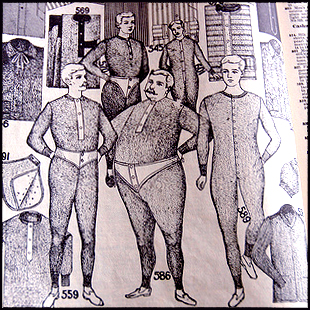
In Lincoln Park, Illinois, around Thanksgiving time, St. Clement’s church takes up an annual collection of hats, underwear, gloves, and socks. You will have noticed that the first letters of those words conveniently spell the friendly acronym H.U.G.S., so you wind up with the name H.U.G.S. for the Homeless.

In fact, plenty of faith-based groups and community organizations across the country have concentrated their efforts on hats, underwear, gloves, and socks. We have mentioned before the importance of wearing hats in cold weather. The human body throws off a lot of heat from the skull. A hat goes a long way toward keeping a person warm.

The extremities at the other end need warmth too. In Surviving on the Streetshomeless
cartoonist/memoirist/activist/musician Ace Backwords reveals that socks and underwear are the only articles of clothing that he buys. For anything else, used is okay. But even a street person has to draw the line somewhere. (Especially if he’s a cartoonist. You can laugh now.) Actually, Backwords has quite a lot to say about footwear in general. For instance:

If you’ve got a hole in your shoe and your socks get wet, you are very likely going to be walking around in cold, wet socks for the next few days. You might have all the other warm gear you need, but with wet socks you are going to be cold and shivering and miserable and very possibly sick… Keep in mind, you are not a normal person; you will very likely be living with your boots on, sometimes up to 24 hours a day… No point in dying with them on, too, at least not just yet.

Then Backwords goes on to tell some stories that would make your lunch try to get away from you. There is nothing glamorous about street life. There is certainly nothing glamorous about frostbite or even a runny nose. Which brings us back to Texas, which people think of as hot, but parts of it can get pretty cold on occasion.

In Austin, the annual Thermal Underwear Drive is underway. It will culminate in a January 1 blowout when all the collected clothing items will find their new owners. Plans are afoot, and funds need to be raised. Richard R. Troxell says,

This will be the 10th Annual House the Homeless Thermal Underwear Party. I’ve gotten the Rockin’ South Austin Gospel Band to again participate. Joanne will help us gather hams, turkeys, pies etc. Sylvia will run the kitchen.

Richard speaks for sponsoring organization House the Homeless, and many others support the event, including KXAN, Channel 36. News 8 posted a clip featuring reportage by Jenna Hiller and introducing Homey-too, the Thermal Underwear Drive‘s mascot, who wears a set of long johns to set a good example.

Going from underwear to outerwear, there is exciting news from Detroit, Michigan, where a 21-year-old industrial design major named Veronika Scott has invented a coat that converts into a sleeping bag. Free Press staffer Bill Laitner wrote about it, and his story was picked up by the Chicago Tribune.

Depending on who you ask, there are between 18,000 and 32,000 people experiencing homelessness in Detroit, and Scott hopes her idea will keep some of them alive and relatively comfortable throughout the winter. She went broke creating prototype coats, bringing each version closer to the vision. (Industrial trivia: James Dyson has engineered 5,127 vacuum cleaners, each one slightly different, before settling on the production model.)

The “Element S(urvival) coat” is made from Tyvek HomeWrap insulation, lined with synthetic fleece donated by the Carhartt company. Imre Molnar, dean of the College for Creative Studies, endorsed Scott’s project. Journalist Laitner captured a quotation from this patron, who used to work for the outdoor gear company Patagonia. Molnar said,

This is extraordinary. If this garment is successful in Detroit, it’s going to work across the country and around the world for homeless people, to say nothing of the relief industry.

Another ally is Rev. Faith Fowler of Cass Community Social Services, which has the people and the space to start putting coats together. A local company is providing sewing machines. Clients of the Neighborhood Service Organization shelter, who over the past months have gotten to know the “coat lady,” will do the, so to speak, road testing.

Reactions?

Source: “SLO County Band uses music to help the homeless,” KSBY-TV, 11/14/10
Source: “H.U.G.S. for the Homeless,” St. Clement Church, 11/20/10
Source: “Surviving on the Streets,” Amazon.com
Source: “Thermal Underwear Drive,” HouseTheHomeless.com
Source: “College student hopes her coat will save homeless people’s lives,” Freep.com, 11/18/10
Image by mricon, used under its Creative Commons license.