Thermal Underwear Drive
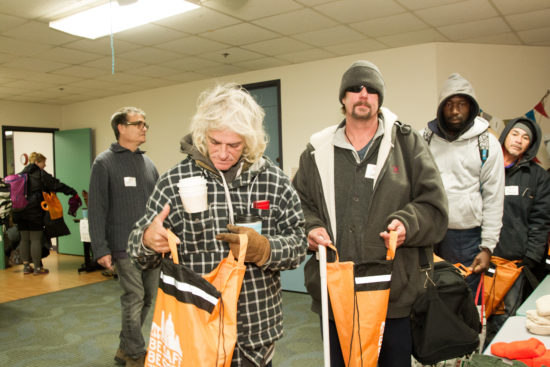
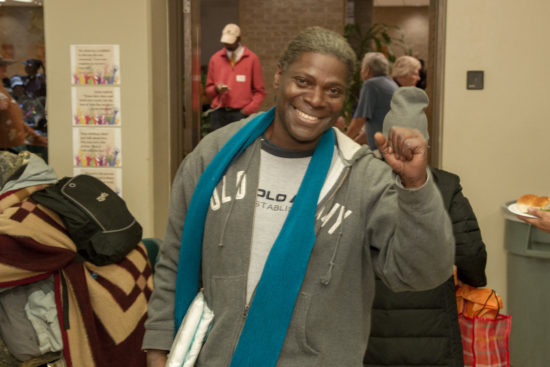
View 2022 KXAN Coverage of this years event.
Every year, House the Homeless conducts a Thermal Underwear Drive to provide thermal underwear, hats, gloves, scarves, and ponchos for homeless men, women and children in Austin. The drive begins at the House the Homeless Memorial Service and concludes at the Thermal Underwear Party on New Year’s Day.
The 2012 drive resulted in more than 3,500 thermal tops, bottoms, scarves, hats, gloves, etc. that were handed out to more than 600 homeless men, women and children in Austin. Each year it gets bigger.
Please help keep some of Austin’s homeless men, women and children warm this winter by contributing to the Thermal Underwear Drive.
We welcome donations of any amount. We use the donations to buy in bulk to maximize what we can get.
$10 = one thermal top and one thermal bottom.
$35 = one thermal top, one thermal bottom, one hat, one pair of gloves, one scarf and one poncho.
So you can see how just a few dollars can make a big difference!
Click the button below to donate online!
Or, please send a check payable to House the Homeless, Inc to:
House the Homeless
P.O. Box 2312
Austin, TX 78768
Thank you for your never ending support for the folks living on our streets.
Together we can end homelessness.
Richard Troxell
Check out the Event
Counting and Sentencing the Homeless
Last time, House the Homeless looked at some of the erratic ways in which people experiencing homelessness are counted during the annual attempt to define the extent of this social disaster. A question that might come to mind is, “Who says erratic is bad?”...
2013 HtH Civil Rights Survey Summary
On January 1, 2013, House the Homeless (HTH) held its 13th annual Thermal Underwear Giveaway Party. While there are between 4,000 and 6,000 people experiencing homelessness in the Austin Metropolitan area, there are only 607 emergency shelter beds for every man,...
Counting the Homeless, Sort Of
Back in 2005, the Department of Housing and Urban Development (HUD) activated a plan that would attempt to get a handle on the number of Americans experiencing homelessness. Each community would be responsible for counting and reporting their totals. These...
Young and Homeless in New York
House the Homeless has been looking at the ongoing mess in New York City, bad enough before the catastrophic weather events hit, and not getting any better. To suggest that conditions are worse for any particular demographic group is specious, because human...
New York City Gets Worse
Let’s recap. In New York City, there was a program that helped employed, formerly homeless parents to pay rent, and the city terminated the program. Then, they tried to make a rule requiring single homeless people to document the fact that shelters are their...
People Experiencing Homelessness in New York City
In the fall of 2011, New York City’s “Advantage” program was running out of money because the state quit paying, and the city didn’t want to pay, and a judge said okay, the city didn’t have to. It was predicted that the number of homeless families in New...
Unstable Housing Is Contemporary Slavery
As in the days of Les Miserables, people who lack wealth or property tend to be marginalized, disenfranchised, and dehumanized. Last week — and nothing has changed since then — House the Homeless discussed how, in America, poverty and homelessness are...
Homelessness — It’s About Green
In Richard R. Troxell’s exegesis of Dr. Martin Luther King Jr.’s 1963 book Why We Can’t Wait, he compares today’s “quality of life” laws, which promise the very opposite of quality for people experiencing homelessness, to the discriminatory Jim Crow...
Why We Can’t Wait: Wages As a Civil Rights Issue
House the Homeless marches in the 2013 MLK Day Parade A Book Review With Reflections on Society Over 50 Years After MLK Why We Can’t Wait Wages As a Civil Rights Issue Imagine my delight routing through the 25¢ bins in west Texas when I came across a gem by the late,...
Living on the Shifting Sands of Affordability
What the U.S. Census bureau calls a “conventional” amount of money to pay for housing (PDF) is 30%. According to economics experts, a family is considered financially responsible if it spends just under one-third of its income on housing costs. More than...