Our Mission

Founded in 1989, HtH is the oldest all volunteer, action, homeless organization in the state of Texas. The mission is Education and Advocacy around the issues of ending and preventing homelessness.

Urgent Issues

Re-Criminalizing Homelessness — Speak up now!

HtH supports the direction being taken by the City of Austin’s relatively new Homeless Strategy Office, led by a very committed and responsive David Gray, and with the commitment of Charles Loosen and other staff. We further strongly advocate ALL positions below that preceded The vote to basically criminalize homelessness — especially:

reinstating a camping ban must consider that those with disabilities, the aged, and in fact anyone with no place to go. The no sit/no lie ordinance is absolutely inhumane and unconscionable we must have at least 15 minute respites particularly for those with disabilities and make other provisions.

Mayor Kirk Watson, elected in 2023, is working to secure funding for homeless services from the State and within the City Budget.

2025 interests:

City Council approved a resolution making homelessness a top financial priority.

Increase the capacity of the Homeless Strategy Office to address and implement a comprehensive approach to strategic advancements in homelessness response. (Plan detailed in a 50-page memo from David Gray, June 2025).

Examples:

1. Expand HOST (Homeless Outreach Street Team) support including team members:

APD officers, EMS paramedics, behavioral health clinicians, social workers, peer support staff.

2. Support for Marshaling Yard operations.

3. Rapid Response housing and safe housing, especially for families.

4. Increase shelter beds with support; and more.


The Austin city council recently voted to put on its May 2021 ballot a vote to reinstate the no camping ban including the no sit/no lie ordinances. Now is the time to contact your mayor and council members particularly those who have supported decriminalizing homelessness, such as Mayor Adler, Kathy Tovo, Ann Kitchen, Greg Casar, Sabino Renteria, and others, we pray.

First call to action is cold weather shelter. Anyone that reads this, our urgent plea is to email our mayor and city council in this urgent time of cold weather. House the Homeless is encouraging to use the Convention Center or other alternatives sites that are already over burdened due to Covid-19 or at capacity.

A second call to action is to not displace unsheltered neighbors from bridges and the four major camp areas without having an immediate plan for alternative shelter/housing.

Finally, advise your mayor and council members that the wording for the May ballot regarding reinstating a camping ban must consider that those with disabilities, the aged, and in fact anyone with no place to go. The no sit/no lie ordinance is absolutely inhumane and unconscionable we must have at least 15 minute respites particularly for those with disabilities and make other provisions.

Federal Minimum Wage Debate

Federal resolve is insufficient; highly recommend Universal Living Wage formula indexed on the cost of housing wherever the person lives and works. 

Unaccompanied Youth in California

“If you’re going to San Francisco, be sure to wear some flowers in your hair,” went the refrain of a once-popular song. California was Shangri-la, a land of magic and hope, the preferred destination for the abandoned and disaffected youth of our entire nation.

These days, it’s a good place for homeless teens and young adults to steer clear of. With facilities stretched to their limits, helping organizations work harder than before, trying to accomplish more with ever-shrinking budgets. Housed people fall prey to compassion fatigue, and there is a steady increase in laws designed to make life unpleasant for the peasant.

Currently, the golden state contains more homeless youth than any other state, and they are more likely to be unsheltered than in most other states. Among the nation’s cities as rated by their “mean streets,” California has three of the top ten spots.

The last two decades have seen the creation of numerous restrictive ordinances, and over the past five years, the pace of anti-homeless legislation has picked up, according to Shahera Hyatt and Jessica Reed, the credited authors of “Adding Insult to Injury: The Criminalization of Homelessness and Its Effects on Youth.” Though only two names are on the cover, this 16-page report utilized all the resources of the California Homeless Youth Project, with help from the National Law Center on Homelessness & Poverty.

Things Are Tough for Unaccompanied Youth

Many of the offenses that people experiencing homelessness are charged with have nothing to do with age. They may be forbidden to sit, stand, rest, or sleep in public places; or to set up a tent or lean-to shack anywhere. They may not be allowed to ask for contributions or sort through trash receptacles for food or recyclable materials. Organizations that want to serve them food may be told they are not allowed to give away so much as a sandwich.

Then there is another layer of legal difficulty known as selective enforcement, when homeless people are not allowed to do things that are apparently okay for others. The most well-known example is sidewalk camping. People who wait in line all night to buy concert tickets or the latest model phone are allowed to set up tents or sack out in sleeping bags while homeless people, of course, would be breaking the law.

The things that unaccompanied youth most often get in trouble for are, the report says, “sleeping in public or private spaces at night, or sitting in public space during the day.” The other big problem is traveling to places where help is available. Kids often sneak rides on public transportation and get nailed for theft of services.

Age-Related Crimes

Then there is the problem of “status offenses,” or things that are illegal for a person under 18 to do unless a court has previously deemed her or him an “emancipated minor.” Curfew violations get kids in trouble while not affecting adults. Kids are supposed to be enrolled in school until a certain age, and not showing up makes them truant. Truancy is a crime even for the homeless. Young people have been locked up for that crime, which makes no sense whatsoever. Incarcerating a kid for skipping school has got to be one of the most irrational government actions ever. The report says:

Homeless students are much better served by community-based organizations, which have been shown to be more developmentally appropriate, cost effective, and humane than the juvenile justice system.

For an adult, running away from home may not always be the wisest choice, and can even cause problems to multiply, but at least it isn’t illegal in and of itself. But for a minor (which in California means under 18), mere existence is a status offense, because kids that age are not supposed to be anywhere else except under their family roof. Here is what the authors say:

Youth who run away do so for their own survival, often fleeing their homes due to abuse, extreme poverty, and/or rejection of their sexual orientation and/or gender identity and expression. Yet in many jurisdictions, runaway youth may be apprehended by law enforcement and returned to their home of origin, even if that home is dysfunctional and/or abusive.

Reactions?

Source: “Adding Insult to Injury: The Criminalization of Homelessness and Its Effects on Youth.
September 2015
Image by Senia L
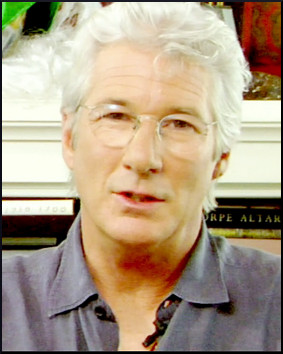
Richard Gere in Time Out of Mind

There were rumblings and inklings of this for months—of actor Richard Gere feeling his way into a movie role by going out incognito and blending in with people experiencing homelessness in their daily pursuits. For instance, a French tourist gave him some pizza but remained clueless until a picture of the two of them showed up in a newspaper.

Last month the film, Time Out of Mind, was released. It’s about a man trying to survive in New York, a tough city in which to be homeless (not that anyplace is easy). For those accustomed to appreciating Gere playing romantic leads or “shifty power mongers,” this performance is unsettling. National Public Radio’s Ella Taylor says:

George scrambles to keep body and soul together, shuttling between welfare offices, an overwhelmed homeless shelter in Bellevue hospital, and the streets. There, enraged and frustrated at being alternately ignored and ringed around with rules and red tape, he conducts himself like a man trying to bargain without chips.

From Taylor’s review, it sounds like a movie worth seeing, with several great characters, like other street people played by Ben Vereen and Kyra Sedgwick. For aficionados of cinematic technique, the writer mentions how the 66-year old Gere is in every scene, but hardly ever at the center of the action. She says director Oren Moverman…

…shoots Gere in very long shots through wire fences and glass doors and windows, down hallways, up and down the streets he roams aimlessly, into the shelter where he retires to bed down for the night…a man for whom the simple business of feeding himself and finding a bed for the night requires constant, unrelenting effort.

This review makes the film seem very layered and nuanced, with plenty of psychological and emotional kinks, just like real life. It ends by saying, “it’s the finest portrait of homelessness I’ve ever seen.” The comments garnered by the piece are interesting too, like the one from a person who credits the Salvation Army for—true to its name—making a save.

HuffingtonPost.com offers a 25-minute video segment in which Gere discusses his connection with the Coalition for the Homeless and his longtime determination to make this film whose script he first read in 1988. He discusses the history of how the movie came to be made, and many aspects of the homeless scene including the crucial difference between housing and warehousing.

Gere also references Land of the Lost Souls: My Life on the Streets, a book by a fellow known as Cadillac Man, who at one time was the most famous homeless person in Northern Queens. It made a deep impression on Gere and greatly influenced the contributions that he made to the Time Out of Mind script.

Reactions?

Source: “Richard Gere Plays homeless Man Convincingly
NPR.org, 04/29/14
Source: “Richard Gere Shines In The Bleak ‘Time Out Of Mind’
NPR.org, 09/10/15
Source: “’Time Out Of Mind’ Star Richard Gere LIVE
HuffingtonPost.com, 09/09/15
Image by arincrumley

When Pope Francis Came to Town

When Pope Francis visited Washington, D.C., recently, there had been a tentative plan for him to stop by the sculpture installed on a bench outside the headquarters of Catholic Charities. Sadly, this viewing of “Jesus the Homeless” did not fit into the schedule—but the Pope had, of course, already seen a smaller version of Timothy P. Schmalz’s touching work of art last year when it was brought to the Vatican to receive his blessing

At St. Patrick’s Church, the Pope spoke to about 250 people experiencing homelessness who currently depend on Catholic Charities. One does not need to be the least bit religious to grasp the basic idea behind his strong words:

We can find no social or moral justification, no justification whatsoever, for lack of housing. The Son of God came into this world as a homeless person. The Son of God knew what it was to start life without a roof over his head.

Outside, a tent had been set up where 300 lunch guests waited. They included residents of the Catholic Charities shelter and the Harriet Tubman Women’s Shelter, all of whom had signed up and then been vetted by the shelter managers. Laurie Goodstein of the New York Times reported:

A few minutes later Francis came out the church doors to cheers and applause from the lunch guests. He gave a brief blessing, then said “Buen apetito,” to loud laughter. He himself did not eat, but he waded through the tables, stopping to lay his hand on the heads of children…

The Pope’s next stop was New York, where custom-designed metal spikes were installed to prevent homeless people from lingering or sleeping within the pitiful shelter of alcoves in the walls of buildings near Madison Square Garden. At the same time, 18 “seating pods” disappeared from a nearby pedestrian plaza, and the property management company responsible for their removal told a reporter that these “homeless magnets” would not be replaced.

Hiding the Homeless in Philadelphia

In the City of Brotherly Love, preparations for the papal visit included the displacement of people experiencing homelessness from any chance of encountering him. According to Amy S. Rosenberg, all was peaceful in the Parkway area as authorities established the Secure Pope Perimeter. She provides many heart-warming anecdotes to illustrate how incident-free the process was, as the people who usually sleep in the park simply made alternate arrangements. But other reports differ, relating how the police threw everyone’s belongings in the trash. The city’s local CBS affiliate quoted outreach worker Amir Robertson:

If you’re homeless, the best thing I can suggest you do is stay off the streets because you’re either going to go to jail or they’re going to put you in the worst part of the neighborhood where you’re going to end up getting killed.

Nearly two weeks before the Pope’s arrival, six families who were unable to obtain either emergency housing vouchers or shelter beds set up housekeeping in an empty lot. Photos went out via social media, and next thing you know, television crews showed up. While the city spent millions of dollars to prepare for the pontiff’s visit, the homeless continued to suffer. Organizers pointed out the bitter irony of this, especially in the face of the Pope’s demonstrable affinity for the homeless.

The protestors challenged the city to figure out how to turn unused buildings into livable places and put people into them. At last count, there were something like 40,000 abandoned houses, commercial structures, and empty lots in Philadelphia. (As House the Homeless has discussed, HtH President Richard R. Troxell initiated the Philadelphia Stabilization Program here back in the 1980s.) Coverage of the campsite proved that poverty is no respecter of race, and that the public cared enough to bring food donations to the “pantry” tent. It also proved that public shaming can be effective. The Philadelphia Housing Authority stepped up and found public housing vouchers for the six families.


Source: “Pope Francis to See Statue of Homeless Jesus During Visit to DC,” CBSLocal.com, 09/18/15
Source: “Pope Francis’ Most Welcome Words to Homeless: ‘Buon Appetito’,” NYTimes.com, 09/24/15
Source: “Photos: Sharp Anti-Homeless Spikes Have Been Installed Near Pope’s Route,” Gothamist.com, 09/25/15
Source: “Outreach workers get homeless to leave the Parkway.” Philly.com, 09/25/15
Source: “Homeless People Being Relocated In Preparation For Papal Visit,” CBSLocal.com, 09/25/15
Source: “Six Homeless Families Living in Tents in Philly Lot,” NBCPhiladelphia.com, 09/16/15
Image by Mike Maguire

Breathing While Homeless – in the News Again

To speak of the crime of “Breathing While Homeless” is no joke any more—not that it ever was. In the late 1880s, singly and in groups, thousands of jobless, impoverished people roamed the countryside. The homeless wanderers were called tramps, and in Wisconsin Death Trip, Michael Lesy quotes a local newspaper’s report on what happened when 250 tramps approached the settlement. “They were marched to the river, made to wash themselves, given something to eat, and rushed out of town.” That can be looked at as an unconscionable violation of Americans’ rights, or as a relatively benign intervention.

On the other hand, what were the untold stories? Scores of people were herded to the river and—what? Made to strip down and wash their clothes by pounding them with rocks? Or were they forced to just wade into the river in what they wore, regardless of the ambient temperature, their state of health, the precious identity papers and photos they might have held onto…There is a lot we don’t know. At least the tramps were fed, but again, we don’t know exactly what that means.

Anyway, such an incident could provide opportunity for many kinds of abuse and even assault. It would not occur to the news editor to mention it, because everyone would assume it was business as usual. Nothing to see here, folks, so move on. Does our romanticized view of the country’s past throw a rosy glow over atrocities?

The point is that America has never rewarded those who just can’t make it. Adding insult to injury, the people who most despise the homeless are, often, the very ones who caused the dire and desperate financial conditions against which the rest of us struggle. Because the misery is so widespread, many journalists have done stories about its manifold aspects. In so many places it is either de jure or de facto illegal to sit, sleep, eat, or eliminate. But people have to do those things. This is the basis of the currently controversial Bell v. City of Boise legal case. A judge once said you can’t punish people for what people can’t help doing. The Justice Department, which appears to have sat mute on this question for a couple of decades, has decided to take an interest. Change may come. Only last month, Alan Pyke wrote:

Any community that makes homelessness illegal may soon find it harder to obtain Department of Housing and Urban Development (HUD) funding for building shelters and staffing outreach positions.

The criminalization of homelessness enriches certain industries and provides better employment opportunities for certain workers (like police and prison guards). For a person experiencing homelessness, every encounter with law enforcement is potentially lethal. When a community legislates against non-violent non-crimes like sitting on the sidewalk, the frequency of interaction goes up, and so does the fatality rate. Listen to what Allen Arthur said, also last month:

Nearly a third of those living in New York City homeless shelters are employed—at jobs that obviously don’t pay them enough to afford rent….Around 12 percent of homeless are veterans –their job deified when wartime profits call, but left for dead in the streets when their usefulness is exhausted…Both politically and economically, for the ruling class, the problem is more profitable than the solution.

Arthur has a great deal more to say, and does it clearly. He points out that 18 million housing units are empty in the United States. Some critics would wander off into the woods, arguing the exact amount of theoretically liveable space, or why it shouldn’t be lived in anyway. This writer breaks it down for us in terms of exactly who has benefited from the impoverished and homeless condition in which so many Americans find themselves. We can’t say “jobless” because today’s homeless and inadequately housed people are unlike those displaced people who entered and exited a Wisconsin town so long ago. Today, many of the people experiencing homelessness are working, and even working full-time. Richard R. Troxell of House the Homeless says:

For me, the issue is simple. If someone is prevented from pursuing a basic act of survival, then the fault lies with the entity that is disrupting the individual’s ability to survive unimpeded, be it another individual, a government, a system or a community.

Thanks to Richard and many, many other hard-working and highly-principled people, the city of Austin has been, in some areas, a pioneer. Please do visit “No Sit/No Lie: Troxell’s Testimony,” or one of our several other posts about this hot-button topic.

Reactions?

Source: “ Wisconsin Death Trip”
Source: “Local Officials Have Pushed To Criminalize Homelessness For Years. The Feds Are Starting To Push Back,” ThinkProgress.org, 08/18/15
Source: “Homelessness is the crime, not the homeless,” SocialistWorker.org, 08/09/15
Image by Christiaan Triebert

Bell v. City of Boise – History and Implications

Homeless in Jerusalem

Are anti-camping ordinances constitutional? This question has lain dormant with occasional ominous tremors like those that precede an earthquake. It is a question with the potential to change the landscape literally, figuratively, and extensively. There was a big rumble in 2006, when Ninth Circuit Court of Appeals Judge Kim M. Wardlaw made what seemed like a groundbreaking legal decision that turned out not to be. We discussed why Jones v. City of Los Angeles kind of fizzled out.

But recently, the Ninth Circuit case became a factor to be reckoned with when the federal government turned its attention to Bell v. City of Boise, a case brought by Idaho Legal Aid Services and the National Law Center on Homelessness and Poverty. The Justice Department’s “statement of interest” quoted Judge Wardlaw, who said:

The Eighth Amendment prohibits the City from punishing involuntary sitting, lying, or sleeping on public sidewalks that is an unavoidable consequence of being human and homeless without shelter in the City of Los Angeles.

Here is the same news event, presented from the vantage point of a different mindset. The NY Post‘s Betsy McCaughey believes that living on the street is not acceptable. About that, we agree—but the meaning we assign to the words is vastly different. We would like clean, safe and affordable living conditions for all humans. McCaughey seems to wish that large segments of the population could somehow magically be made to disappear.

When a homeless advocate says that people should not be punished for their status, McCaughey characterizes that basic human decency as a “wacky ideology.” In our view, if people have no choice but to live on the streets, they should at least be legally protected.

McCaughey, on the other hand, is all about criminalizing survival, and sees the Justice Department’s interest in the Iowa case as the Obama administration “siding with vagrants against local governments.” We wish we could tell you the upcoming quotation was found in The Onion or some other satirical publication, but alas, we cannot. The outraged McCaughey says of people experiencing homelessness:

Their insistence on street living punishes the rest of us. We have to endure the heart-wrenching sights of human beings in rags lying on sidewalks.

Jones v. City of Los Angeles was vacated because of a compromise deal, but the analysis provided by Judge Kim M. Wardlaw was solid, which is why it is being called upon in Bell v. City of Boise. Writing for Slate.com, Mark Joseph Stern mentions other cases that influence the judiciary’s thinking in this matter. Robinson v. California and Powell v. Texas were both ruled on by the nation’s Supreme Court. Stern says:

In Robinson the court struck down a California statute that criminalized addiction—not just use or possession—of narcotics. California, the justices explained, could outlaw the conduct of drug use, but it could not criminalize the status of being addicted to drugs. Powell dealt with a similar law, one that criminalized public intoxication in Texas.

Since homelessness is a status, not a conduct, it seems reasonable to assume that the Supreme Court would also say that the Constitution forbids cities to arrest people for sleeping rough when shelters are full. Stern doubts that Bell v. City of Boise will reach that far, but it might slow down or partially reverse the criminalization of homelessness. Even if it doesn’t go to the Supreme Court, the lower-level resolution of Bell v. City of Boise will create a precedent that can be called upon in similar cases elsewhere, for better or worse. Stern adds:

It’s quite depressing to see the DOJ defend homeless people’s right to sleep by analogizing them to drug addicts and alcoholics. But its brief is really an indication of just how profoundly America has failed its homeless communities.


Source: “Team Obama’s fight to keep the homeless living on the streets,” NYPost.com, 08/18/15
Source: “Justice Department Tells Cities to Stop Criminalizing Homelessness,” slate.com, 08/14/15
Image by Albert Ter Harmsel

Bridge the Economic Gap Day

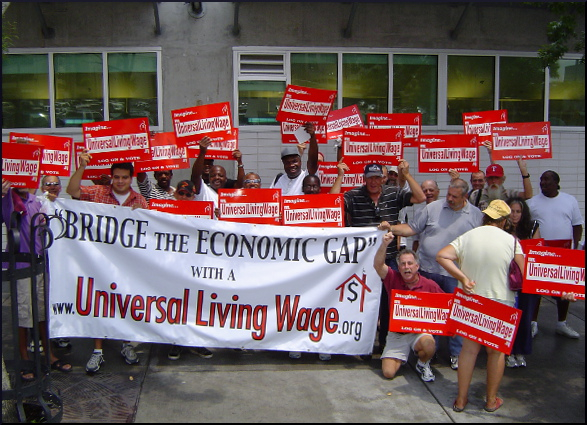
“Bridge” is a loaded word in the homeless community, because for so many people it is the definition of home (as in living beneath a bridge). Sometimes, a communal meal or a church service may take place under a bridge, but the picture is still grim. Several years ago, House the Homeless opened up the meaning of bridge to include the highway overpass, and redefined a bridge as a podium, a pulpit, a stage, a platform, a grandstand. The bridge became the medium through which America learned of the Universal Living Wage.

The economic gap can be bridged, and one of the most practical and sensible ways to begin is through the Universal Living Wage, through recognition that the minimum wage should be tied to local conditions. The dramatic and inspiring story of how Bridge the Economic Gap Day started is all there in Richard R. Troxell’s book, Looking Up at the Bottom Line.

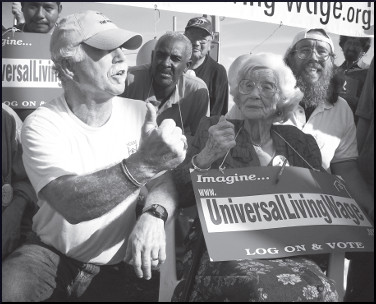
What follows is only a brief summary of a story packed with drama. Someone ought to buy the film rights and make a movie. The picture on this page, taken at one of several Austin action sites, is from the book. Richard is on the left, and the exuberant woman next to him is Eve Adams, who was 100 years old at the time.

For four years, volunteers tirelessly worked to spread the ULW idea and collect endorsements from organizations throughout the country. In 2005, the time seemed right for the first ULW National Day of Action. The chosen date was “Labor Day Plus 1” (which this year falls on September 8—today.) Richard’s goal was to have at least one Bridge Action in every state, so his plan concentrated on width. The Call for Leadership went out. Richard says:

I explained that Bridge the Economic Gap Day would be a great local/national organizing event that would require very little work on their part. We would send our endorsers and participants blank press releases in which they could tout their own organizations and their own local living wage issues. On top of that, we offered to send them the banner for free, and encouraged them to fly their own organizational banner.

Three weeks into the effort, there were commitments from 39 Bridge Captains in 32 states. Donations paid for banners, postage, hardware, and other necessities. The first banner order was optimistic but not splashy. The supplier, J.D. Moore, graciously lowered the price for the second round of banner orders, and lowered it again for the third batch. In the book, Richard discusses his press strategy, and the last-minute need for several hundred dollars for media, and how a more-than-generous donation from his friend and advisor Tom Holmes saved the day. The people who did the phone work each faced unique struggles in their personal lives, but somehow it all got done. The day came when each and every state had at least one Bridge Captain.

Of course, complications emerged, such as the 22,000 refugees from Hurricane Katrina who arrived in Austin, requiring the earnest attention of House the Homeless and every other organization of its kind. Some of those displaced survivors helped to represent the ULW on five of the city’s bridges. Police department guidelines were carefully observed. It was, by the way, 120 degrees in Austin that day. Some participating groups were:

  • Saint Edwards Universal Living Wage Warriors
  • University of Texas School of Social Worker students
  • Americorps VISTA volunteers
  • Gray Panthers
  • NAACP
  • Casa Marienella

The Bridge Actions generated media attention and, more importantly, new allies and connections for House the Homeless and the ULW idea. After that first Bridge the Economic Gap action, the participants gathered at a park where Mobile Loaves and Fishes fed everybody. Richard says:

We shared hot dogs, cold drinks, bridge stories, and our dreams for a kinder, gentler world where economic justice is the norm, not the exception. I closed with a few thoughts and the observation that all across the nation, folks just like us had been on bridges, sharing similar experiences, and the same dream. It felt good.

Bonus Capsulized History of the Universal Living Wage:
Katie McCaskey’s timeline on the House the Homeless News Page

Bonus Atrocity:
Three Rich Treasury Secretaries Laugh It Up Over Income Inequality


Source: “Looking Up at the Bottom Line
Image by House the Homeless
Bridge Action
0

The Roots of Bell v. City of Boise

In Colorado Springs, the mayor is working hard to change an existing ordinance (which forbids anyone to lie down anywhere) so it will criminalize sitting down anywhere in the city. In San Francisco, the mayor doesn’t care whether people experiencing homelessness are sitting, lying, standing straight up, or kneeling in prayer. Whatever their posture, he vows to chase them all out of there before the Super Bowl. Currently, one-third of American cities have laws against sleeping outside. Last week, House the Homeless talked about the “statement of interest” filed by the Department of Justice regarding a current case brought by Idaho Legal Aid Services and the National Law Center on Homelessness and Poverty.

At the core of this topic is the question of whether anti-camping ordinances are constitutional or not. It is a “currently unsettled area of the law” about which various courts disagree. That is what Bell v. City of Boise is about, and the outcome will have massive policy implications throughout the system.

This started 9 years ago, with a Los Angeles ordinance under which people experiencing homelessness could be arrested for sleeping on the street even when no shelter beds were available. Since there were twice as many homeless people as shelter beds, this meant that, on any given night, half the homeless population of LA was vulnerable to arrest.

Jones v. City of Los Angeles

The ACLU and the National Lawyers Guild filed suit against the City of Los Angeles. Judge Kim M. Wardlaw of the Ninth Circuit Court of Appeals ordered that the draconian ordinance should no longer be enforced, stating:

The Eighth Amendment prohibits the City from punishing involuntary sitting, lying, or sleeping on public sidewalks that is an unavoidable consequence of being human and homeless without shelter in the City of Los Angeles.

At the time, there was great rejoicing. Mark Rosenbaum, the ACLU attorney who had argued the case, called Judge Wardlaw’s decision “the most significant judicial opinion involving homelessness in the history of the nation.” Sadly, it didn’t turn out that way. But thanks to more recent developments such as Bell v. City of Boise, that bold prediction might still come true.

A year and a half after Judge Wardlaw’s ruling, Los Angeles and the ACLU finally quit arguing about what would happen next, and reached an agreement that no one was really happy with—in other words, a workable compromise. As long as they stayed 10 feet away from entrances and driveways, homeless people could sleep on city streets between the hours of 9 p.m. and 6 a.m. But the police could start enforcing the no-lying ordinance again as soon as the city built 1,250 units of supportive housing. Not shelter beds, but actual places where a person could settle in and get help to set her or his life on track.

And, says journalist Evan George, they went on to quibble about whether housing units that were already in the process of construction would count. The police department complained about “shelter-resistant” street people who refused to claim available beds. A law professor did a study and found “a median of just four shelter beds available on a given night when the LAPD was counting more than 1,000 people sleeping on the street.” Homeless advocates pointed out that, even if there had been enough shelter beds, it’s not the same thing as supportive permanent housing.

Several years later, when street people were allowed to return to a physically cleaned-up Skid Row, Councilman Bill Rosendahl was called upon by his constituents to explain the situation:

On October 15, 2007, the City entered into a legally binding settlement, agreeing not to enforce the law prohibiting sleeping on the streets, between the hours of 9 p.m. and 6 a.m. until it builds 1,250 units of permanent supportive housing. The City entered this agreement after the Ninth Circuit Court of Appeals…found that the law against sleeping on the streets amounted to cruel and unusual punishment in violation of the 8th Amendment…,

In the words of Evan George, these were the consequences:

By agreeing to the settlement, the ACLU has given up any claim of using the Ninth Circuit court ruling as precedent for future lawsuits. However…attorneys for the homeless may still cite the decision in future lawsuits.

In other words, even though Judge Wardlaw’s ruling was vacated, the reasoning behind it was sound, and valid enough to use in Bell v. City of Boise, which is why the Justice Department recently wrote:

The statement of interest advocates for the application of the analysis set forth in Jones v. City of Los Angeles, a Ninth Circuit decision that was subsequently vacated pursuant to a settlement. In Jones, the court considered whether the city of Los Angeles provided sufficient shelter space to accommodate the homeless population. The court found that, on nights when individuals are unable to secure shelter space, enforcement of anti-camping ordinances violated their constitutional rights.

Reactions?

Source: “ACLU of Southern California Wins Historic Victory in Homeless Rights Case,” ACLU.org, 04/14/06
Source: “City, ACLU Settle Street Sleeping Case,” LADowntownNews.com, 10/15/07
Source: “Skid Row Homeless Say LAPD Is Trying to Bully Them off Their Freshly Cleaned Turf,” LAWeekly.com, 06/22/12
Source: “Justice Department Files Brief to Address the Criminalization of Homelessness.” Justice.gov, 08/06/15
Image by Sascha Kohlmann

Will Nationwide Change Start in Idaho?

Faceless force: police officers strut between Austin’s homeless shelter and Salvation Army building.

On August 6, something interesting and potentially very significant happened. A federal court case filed in the District of Idaho in 2009 is just now being considered, and the Department of Justice filed a “statement of interest” based on the premise that people experiencing homelessness are being unconstitutionally punished for sleeping in public places, even when no shelter beds or any other alternatives are available to them.

The case, titled Bell v. City of Boise et al., was brought by several homeless plaintiffs who were convicted of violating a Boise ordinance that forbids “camping” in public. In this instance, camping does not mean setting up a tent and a barbecue pit and a gravity shower and a volleyball net. It means sleeping, an activity that every human being has to engage in, which means the law makes as much sense as convicting people for breathing.

The Justice Department calls sleeping “conduct that is a universal and unavoidable consequence of being human,” and references the Eighth Amendment to the Constitution, which says that Americans should not be subjected to cruel and unusual punishment. In effect, anti-camping ordinances criminalize people for being homeless. These days, it is certainly not unusual, but it is undeniably cruel.

Who Are the Criminals?

The parties responsible for the economic meltdown have not spent a single night in jail, or for that matter, a single night sleeping behind a dumpster. The parties responsible for starting and perpetuating wars for the further obscene enrichment of billionaires have not attended a single Veterans Stand Down looking for a toothbrush or a pair of socks. Yet thousands of Americans have acquired criminal records because they have to sleep someplace, and thousands more live in daily fear of being punished as criminals because of the human physiological imperative known as sleep. Vanita Gupta, head of the Justice Department’s Civil Rights Division, wrote:

Criminally prosecuting those individuals for something as innocent as sleeping, when they have no safe, legal place to go, violates their constitutional rights…Needlessly pushing homeless individuals into the criminal justice system does nothing to break the cycle of poverty or prevent homelessness in the future. Instead, it imposes further burdens on scarce judicial and correctional resources, and it can have long-lasting and devastating effects on individuals’ lives.

The lawsuit that is finally getting its day in court was originally filed by Idaho Legal Aid Services and the National Law Center on Homelessness and Poverty (NLCHP), which issued a report last year announcing the result of a three-year survey that gathered information from 187 American cities. They found that 34 percent (a solid one-third) of these municipalities have laws that ban public camping (also known as sleeping). Almost half—43 percent—prohibit sleeping in vehicles, which is about as senseless as a law can be. Who in their right mind believes that sleeping in a vehicle is worse, for either the homeless person or the general public, than the other alternatives?

Criminalizing Homelessness

As of last year, the agencies responsible for counting people experiencing homelessness came up with 153,000 to represent the number of unsheltered homeless people in the United States on any night of the year. In the main, these unsheltered sleepers are Americans. Some are very young children, whose chances of actually learning anything in school are gravely reduced. Some are teens, who are at risk for more kinds of damage than the average housed person can even imagine. Some are fathers with intense and undeserved feelings of personal failure. Some are mothers whose desperation occasionally makes sordid headlines.

Some are women escaped from domestic situations so violently abusive that even the streets seem like a better deal. Some are mentally ill people for whom the world is a vast unrelenting puzzle. Some are sick and disabled people who would barely be able to take care of themselves even indoors, much less out in the wild. Some are veterans who made a good-faith bargain with the government that was only kept on one side. Some are elderly people who worked hard all their lives and ended up with less than nothing.

And we call ourselves the greatest country on earth.

(…more on this court case next time…)


Source: “Justice Department Files Brief to Address the Criminalization of Homelessness,” Justice.gov, 08/06/15
Source: “It’s unconstitutional to ban the homeless from sleeping outside, the federal government says,” WashingtonPost.com, 08/13/15
Image by Richard R. Troxell

How to Become Homeless—Yes, Even You

The Weingart Center is a venerable Skid Row institution that offers shelter, job training and counseling. Los Angeles Times writer Sandy Banks interviewed Maxene Johnston, who was in charge of it for 10 years, and learned this:

Her time in the trenches taught her that most people with nowhere to live fell into one of three groups: the derailed, the disabled or the dysfunctional. The derailed are ordinary people hobbled by bad luck…The disabled have mental or physical issues that make it hard to live on their own…The dysfunctional are chronic street dwellers, with limitations that can’t be addressed with short-term help… There are as many back stories as there are broken and desperate people.

The point Johnston makes is that all the people in these subdivisions are still part of the public, the citizenry whose safety and wellbeing the civic authorities are charged with protecting. The derailed, of course, are the easiest to help, and also the easiest to become one of. Life is so precarious that just about everyone is at some degree of risk for becoming homeless. Today we look at a few random ways in which this can happen.

A Davenport, Iowa, mother of five was shown a rental house by “the most wonderful man I ever met in my life” and gave him a $1,300 deposit—all the money she had. Then he disappeared, and even a local news station was unable to help her trace the thief.

An article by Senior Advocate Liza Horvath outlines some of the many ways in which the elderly can be scammed out of their homes and savings, and prefaces the list with strong words:

A rapacious, marauding predator is taking hold in America and it is growing stronger, smarter, meaner and more aggressive each passing minute… If left unchecked it will take everything they have earned and saved throughout a lifetime and dump them—homeless and destitute into the mean streets.

A Rhode Island couple bought a house, sold their old house, and wound up out in the cold. At the last minute, their Realtor told the would-be buyers that “because [a law firm] had failed to provide proper notification of foreclosure, we’d be unable to obtain title insurance.” The firm’s branches in a nearby state had already been under investigation because their practices looked very much like those of a “foreclosure mill,” a well-known variety of illegal enterprise. Yet the error in this case could so plausibly have been an honest (and still unconscionable) mistake, it gave the Attorney General’s subsequent inquiry very little to work with. And the couple, of course, could not get their old house back.

In Milwaukee, Wisconsin, the Andrews family learned the hard way that when the city condemns a building, the tenants have to leave immediately. It wasn’t Robin Andrews’s fault that the balcony of a 4th-floor apartment collapsed, or that everyone in the building had to get out right away. His employer paid for the initial week in a motel room for the couple and their three children. Andrews expected to get his $900 security deposit back from the old landlord, but instead was cheated out of it. The result? No resources and nowhere to go.

Everyone has a story, and listening to too many of them at once can have an impact on the hearer. But now, the theme takes a turn. As we have seen, in Florida many volunteer teams of military veterans search the urban areas and the wilderness for their lost brothers. Last year a survey was taken—and bear in mind, this was just one county, Hillsborough, which includes the city of Tampa.

Of the 236 veterans counted…109 said they didn’t know exactly why they were homeless.

Reactions?

Source: “Garcetti, City Council throw homeless problem to the police,” LATimes.com, 07/03/15
Source: “Davenport mom and kids homeless after internet scam,” WQAD.com, 10/14/13
Source: “Scammers can leave seniors homeless,” MonteryHerald.com, 10/31/14
Source: “I-Team: Law firm mistake leaves couple without home,” turnto10.com, 10/28/13
Source: “Family left homeless after balcony collapse,” 620wtmj, 10/10/13
Source: “Number of homeless veterans in the area spikes,” Tbo.com, 05/11/14
Image by Pedro Ribeiro Simões

Minimum Wage Matters

That’s exactly what the bosses want! They want us fighting over who has the bigger pile of crumbs so we don’t realize they made off with almost the whole damn cake.

Jens Rushing wrote those words, as part of a larger message that could be condensed even further into the popular warning, “Check yourself before you wreck yourself.” In writing his manifesto, Rushing’s aim was to implore workers to wake up and stop complaining about other workers getting a raise. Someone in his own field, for instance, could easily feel resentment about a fry-basket jockey making the same hourly wage as a paramedic. Rushing and his colleagues are highly trained, extremely competent, and responsible for life-and-death decisions. But he asks everybody to stop and analyze the situation.

Among professional comics, one school of thought divides humor into “punching up” and “punching down.” Some consider it improper to make jokes at the expense of anyone who is perceived as less fortunate than the comic and the current audience. Only the powerful can be attacked: only punching up is cool.

But the corporate CEOs and politicians who own everything hope for the opposite. They want us all to punch down. They want us to form warring clans along every possible divisive line—gender and race being the most obvious, but also American-born or newly arrived; white-collar or blue-collar; tech-savvy or future-shocked; housed or experiencing homelessness. Sometimes it seems that we peasants of the “99%” enjoy finding or inventing any reason to fight amongst ourselves. Meanwhile, the Big Bosses are delighted because all the strife diverts our attention from their machinations. As Rushing says:

Why are you angry about fast food workers making two bucks more an hour when your CEO makes four hundred TIMES what you do?

On the subject of bosses that keep the whole damn cake, could there be a more perfect example than Walmart? The CEO makes more than a 1,000 times what the average “associate” makes. And the family that owns a large portion of the company? The six wealthiest members hold more wealth than the combined entire bottom 40 percent of Americans. Four of the Waltons are worth more than $30 billion apiece. Last year, the Walmart shareholders made $7.2 billion.

Walmart is America’s largest private sector employer, and if it were a country, it would have the 26th largest economy in the world. It has 2.2 million employees, which is more than the population of Houston, TX. Just because 25 people apply for every job opening, Walmart feels justified in practicing piracy. People who specialize in figuring out these things say that Walmart could pay workers $14.89 per hour without needing to raise prices. Of course, the notion that the family or the stockholders might take less of the pie is too unlikely to even consider.

But wait—there are even more shameful numbers. Apparently, each store costs the taxpayers more than $900,000 per year in public assistance for its employees. Out of all employers, Walmart is the one where the largest number of workers and their families use taxpayer-funded health insurance programs.  And what about that shady, dicey, sketchy merry-go-round where almost 20 percent of the food stamps in America are redeemed at Walmart AND, coincidentally, a huge percentage of the employees need food stamps to survive. In the comment section of a Walmart-busting website, a worker wrote:

When I started, they actually have a routine to sign you up for Food Stamps and all government assistance during the orientation process. Which is really messed up to take a job to get you away from Government assistance, only part of their plan is to help you get it… I was disgusted at the fact it was part of their written orientation.

Please read the House the Homeless document, “The Fight for $15!” and learn about the Universal Living Wage formula. Universal Living Wage also has a Facebook page. As Jens Rushing said:

Look, if any job is going to take up someone’s life, it deserves a living wage.

Reactions?

Source: “Paramedic Shares Awesome Facebook Post About Minimum Wage Increase,” good.is, 08/03/15
Source: “14 Facts About Wal-Mart That Will Blow Your Mind,” BusinessInsider.com, 06/06/14
Source: “19 Facts That Show Just How Massive Walmart Really Is.” buzzfeed.com, 06/06/14
Source: “Top Reasons the Walton Family and Walmart are NOT “Job Creators”,” walmart1percent.org, March 2014
Image by Mike Licht