
Our Mission

Founded in 1989, HtH is the oldest all volunteer, action, homeless organization in the state of Texas. The mission is Education and Advocacy around the issues of ending and preventing homelessness.

Urgent Issues

Re-Criminalizing Homelessness — Speak up now!

HtH supports the direction being taken by the City of Austin’s relatively new Homeless Strategy Office, led by a very committed and responsive David Gray, and with the commitment of Charles Loosen and other staff. We further strongly advocate ALL positions below that preceded The vote to basically criminalize homelessness — especially:

reinstating a camping ban must consider that those with disabilities, the aged, and in fact anyone with no place to go. The no sit/no lie ordinance is absolutely inhumane and unconscionable we must have at least 15 minute respites particularly for those with disabilities and make other provisions.

Mayor Kirk Watson, elected in 2023, is working to secure funding for homeless services from the State and within the City Budget.

2025 interests:

City Council approved a resolution making homelessness a top financial priority.

Increase the capacity of the Homeless Strategy Office to address and implement a comprehensive approach to strategic advancements in homelessness response. (Plan detailed in a 50-page memo from David Gray, June 2025).

Examples:

1. Expand HOST (Homeless Outreach Street Team) support including team members:

APD officers, EMS paramedics, behavioral health clinicians, social workers, peer support staff.

2. Support for Marshaling Yard operations.

3. Rapid Response housing and safe housing, especially for families.

4. Increase shelter beds with support; and more.


The Austin city council recently voted to put on its May 2021 ballot a vote to reinstate the no camping ban including the no sit/no lie ordinances. Now is the time to contact your mayor and council members particularly those who have supported decriminalizing homelessness, such as Mayor Adler, Kathy Tovo, Ann Kitchen, Greg Casar, Sabino Renteria, and others, we pray.

First call to action is cold weather shelter. Anyone that reads this, our urgent plea is to email our mayor and city council in this urgent time of cold weather. House the Homeless is encouraging to use the Convention Center or other alternatives sites that are already over burdened due to Covid-19 or at capacity.

A second call to action is to not displace unsheltered neighbors from bridges and the four major camp areas without having an immediate plan for alternative shelter/housing.

Finally, advise your mayor and council members that the wording for the May ballot regarding reinstating a camping ban must consider that those with disabilities, the aged, and in fact anyone with no place to go. The no sit/no lie ordinance is absolutely inhumane and unconscionable we must have at least 15 minute respites particularly for those with disabilities and make other provisions.

Federal Minimum Wage Debate

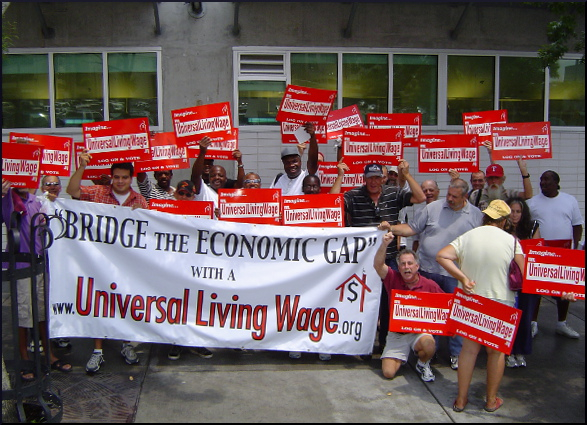
Federal resolve is insufficient; highly recommend Universal Living Wage formula indexed on the cost of housing wherever the person lives and works. 

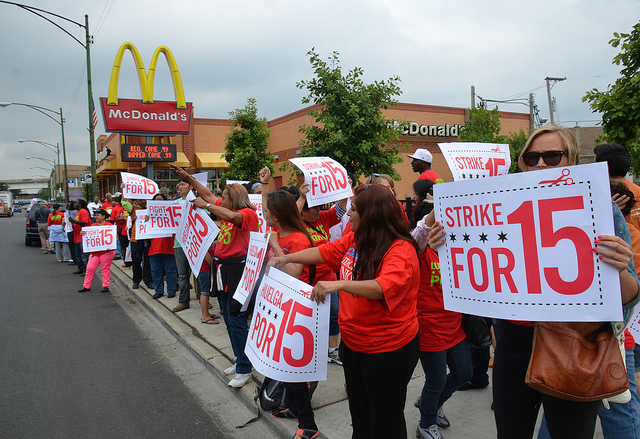
The Fight for $15!

Fight for $15! This is the battle cry for higher wages. Seemingly awesome. It is now taking hold on both sides of the nation. At this point, Los Angeles, San Francisco, Berkley, Oakland, Seattle, and now New York, have wage agreements that when eased in over time (3-6 years) will result in higher minimum wages!

For a decade, between 1997 and 2007, Congress failed to raise the Federal Minimum Wage at all. This set workers’ wages (coupled with normal inflation) on a trajectory that was so negative and so severe it resulted in putting the basics of life, including housing, beyond the reach of millions. In fact, the ever shrinking minimum wage relative to the cost of daily necessities has become so extreme that even such things as basic rental housing have moved beyond the reach of full time, 40 hour a week, minimum wage workers. Inaction on the part of Congress has only added to the 3.5 million people now experiencing homelessness in this nation. When the federal government failed to act, the people in desperation, jumped into the fray pushing for higher wages in their areas.

This is the very core of our American Dream…a fair wage for a fair day’s work! If you work hard, keep your head down, eventually you can get ahead, get married, and raise a family.

New York Governor Andrew Cuomo has indicated his support for recent economic changes. In fact, at a recent rally celebrating the NY wage proposal, he was noted as saying, “This is just the beginning. We will not stop until we reach true economic justice.” Awesome! Finally, we will acknowledge that the minimum wage worker, the janitor, construction laborer, hotel worker, bank teller, fast food worker, theater attendant, farm worker, receptionist, nurse’s aide, maid, poultry processor, child care worker, home care aid, garage attendant, etc. make up the socio-economic base of our society and that they all need living wages.

But wait a minute! Did we just mention farm workers? These are strictly rural workers. What about all the other minimum wage rural workers? While 80% of Americans live in urban areas according to the 2010 census, 20% of all workers are scattered throughout rural America. How will they and others in their situation, ever attain income-equity if they aren’t unionized and are too few in concentrated numbers to affect change? And by the way, ten states have passed laws that prevent local minimum wages to rise about the Federal Minimum Wage (currently set at $7.25 per hour or $2.13 per hour for agricultural workers).

And while we’re at it, when we examine the $15.00 for those who are organized and in states where it is OK to have a minimum wage above the federal minimum wage, we find that even $15 per hour falls significantly short of what is needed to become housed and to get by on a daily basis. Then we examine the common sense of the Universal Living Wage (ULW) formula, we see that it is based on three existing government guidelines:

  1. spend no more than 30% of your income on housing,
  2. work a full 40 hours per week,
  3. index the wage to the local cost of housing.

We calculate that the wage required to afford a one bedroom apartment using the HUD Fair Market Rents in a few notably cities with high costs of living-

City/StateHourly wage for an efficiency apartmentHourly wage for a one-bedroom apartment
New York, NY$23.00$24.02
Los Angeles, CA$17.56$21.21
Seattle, WA$18.69$22.12
San Francisco, CA$24.15$31.44

$15 per hour is a far cry from any of these basic requirements, and as we have seen in the past, when some of these $15 amounts go into effect as much as six years away, their value will be highly degraded due to inflation and we will be right back where we started. At the same time, currently in rural America we see that in areas such as found in a few sample cities in the table below-

City/StateHourly wage for an efficiency apartmentHourly wage for a one-bedroom apartment
Chico, CA$9.92$12.63
Little Rock, AR$10.31$11.90
Cumberland, MD$8.83$10.42
Asheville, NC$9.81$13.90
Decatur, IL$7.92$10.12

This again is a significant distance from the $15 per hour bench mark in the opposite direction. We cannot destabilize small business throughout rural America as we work to stabilize our minimum wage workers.

What we need to do is act smart and address these two major concerns right up front. First, we have all learned by now that one size (or one wage amount) does not fit all. In fact, we have learned that we are a nation of 1,000 plus economies. Each population area throughout the nation has its own cost of living. We’ve all traveled; we know this to be true. We all know it costs much more to visit/live in Washington DC than it does to visit/live in Rapid City, South Dakota. The ULW formula takes this very real concern into account. We realize that by simply ascribing $15/ hour in an area that only requires $10 per hour would seriously hurt small business in that area. We must not saddle them with a one size fits all $15 per hour wage when it’s unnecessary and destructive to small business. Instead, we can use the HUD Fair Market Rent values to determine what a person should reasonably expect to pay for an apartment and other living necessities throughout the nation in areas about the size of counties. Then by simply making the wage relate to the cost of housing by indexing it to the local cost of housing, we ensure that no matter what that housing cost rises to, if we put in our 40 units of work per week, we’ll be able to afford basic housing and the core necessities of life without hurting small business. This is also a reason for people to be drawn away from welfare and back into work.

We need to keep the federal standard created in 1938 after the Great Depression that established The Federal Minimum Wage, in play for the entire nation. We need to be able to afford the basics in life: food, clothing and shelter (now transportation is added with the ULW formula) but we must tweak The Federal Minimum Wage so it is based locally. By using the same principle throughout the nation, but by indexing it locally, we find that over time, we are able to make the wage relate to even the most costly of housing markets in urban America without hurting small businesses in rural America.

This approach finally solves the problem of wage inequality at the minimum wage level while ensuring that a full time minimum wage worker is able to afford a roof over their head, (other than a bridge), and without adding to the existing homeless population. Finally, it gives businesses the opportunity to plan ahead by knowing exactly what the wage of employees will be now and in the future.

Photo: Steve Rhodes
Hidden Costs of Homelessness

When calculating the civic price of homelessness, communities think about how much it costs to build and maintain shelters; to staff agencies that match available housing and jobs with people experiencing homelessness; and to pay landlords and motel owners for housing that is meant to be transitional. If the community is enlightened, it even factors in the costs of hospitalizing and jailing people who would not need to be in either facility in the first place, if they had somewhere to live.

But there are other, seldom-mentioned categories of expense that taxpayers often don’t even realize have become part of their financial liability. Less than a year ago in Denver, Amy Goodman reported on what has been called an “historic police brutality case”:

Marvin Booker was a homeless street preacher from a prominent family of Southern preachers. In 2010, he was killed by deputies in the booking room of the Denver jail.

It was all on video. The coroner ruled a homicide, the sheriff’s department personnel went totally unpunished, and the citizens of Colorado were handed a bill for $4.65 million to pay compensation and damages to Booker’s family. On the other side of the country, a court told New York City to pay $2.25 million to the mother of a man who was left to die in an oven-like cell at Riker’s Island.

When a hospital does something wrong, the cost of making it right may not come from the tax coffers, but community members pay just the same, as every subsequent patient contributes to cover the deficit. In Southern California, local reporter Sarah Parvini noted:

Over the course of a decade, former patients have been found on Skid Row in hospital gowns or wearing hospital ID bracelets around their wrists. A case of a paraplegic man found crawling with a colostomy bag spurred public outrage and led to investigations as well as criminal charges.

One Los Angeles hospital was fined $200,000 in civil penalties for discharging a patient to nowhere. Sure, they kindly gave the sick homeless person a ride downtown, but still a court took a dim view of such heartless “dumping.” Another local hospital that habitually dropped off patients on Skid Row was ordered to pay $500,000 to homeless service providers, and one suspects that money will not come from the hospital’s profits, but on the backs of future patients.

Also in Los Angeles, the County-USC Medical Center mishandled a homeless woman’s labor and delivery process, resulting in the birth of a severely disabled child who needs institutional care. The story is full of heartbreaking details, not the least of which is a $7.5 million settlement that will come from the pockets of other Californians.

LA’s Skid Row has become less convenient for “patient dumping” for another reason. The city would like to push everyone out of the area, and attempted to start a diaspora by implementing a very aggressive policing program. When a lawsuit was filed by several long-term street people, the power structure agreed to suspend the overnight police sweeps until the city could build 1,250 permanent housing units, which are a long way from becoming reality. Meanwhile, the city (taxpayers) paid for $725,000 worth of the civil rights attorneys’ professional time.

In Dallas, eight years of litigation ended with the city agreeing to pay a quarter million dollars to two organizations with whose feeding of homeless people it had interfered. The story says:

Of the settlement, $166,666.66 will go to Big Heart Ministries and Rip Parker Memorial Homeless Ministry and $83,333.34 will go to the lawyers from National Law Center on Homelessness & Poverty who represented the plaintiffs.

Legal representation costs an awful lot, and cities are paying for prosecutors to go after the violent criminals who beat and kill homeless people, and for their public defenders. The bills for hate crimes land in everyone’s mailboxes. Another incidental budget item is the cost of constantly re-arresting offenders for not reporting to the authorities where they live, because they don’t live anywhere. And the cost of putting out fires that are started accidentally by homeless people trying to cook or just to avoid freezing. Really, listing all these miscellaneous expenses could become a full-time job, and they are all expenses that would not exist if everyone had a place to live.

Reactions?

Source: “In Historic Police Brutality Case, Family of Homeless Denver Pastor Killed
in Custody Awarded $4.6M,” Democracynow.org, 10/17/14
Source: “L.A.’s Homeless Patient Dumping Law Leads to $500,000 Settlement With Hospital,” KCET.org, 05/29/14
Source: “Formerly Homeless Woman Awarded Medical Malpractice Settlement Against L.A. Hospital,” LegalExaminer.com, 11/07/13
Source: “City to Pay $250000 Settlement to Homeless Support Groups,” DallasObserver.com,12/08/14
Image by David Shankbone

Open Letter to the City of Austin

August 18, 2015

Mayor Steve Adler

City Manager Marc Ott

PO Box 1088

Austin, TX 78767

Dear Mayor Adler and City Manager Ott,

In 1995, as the City of Austin prepared to pass the No Camping Ordinance, House the Homeless made it clear that arresting people who are homeless for sleeping in public places when full-time minimum wage workers are paid so little that they cannot afford basic housing or when there is insufficient emergency shelter beds, is in violation of the 8th amendment of the U.S. Constitution and therefore criminalizes poverty and the condition of being homeless.

Our continued efforts at the national level through our involvement with the National Coalition for the Homeless coupled with the efforts of the National Law Center on Hunger and Homelessness has resulted in the Justice Department’s issuance of the attached document in which it addresses the criminalization of homelessness when people have no alternatives but to sleep in public.  Note- The City of Austin’s battle for/against the No Camping Ordinance is well chronicled in the book Looking Up at the Bottom Line: The Struggle for the Living Wage.

Presently, in the city of Austin, two things occur.  The Federal Minimum Wage, currently at $7.25, is the Federal wage standard.  This is well below the same government guideline (see

Secondly, the primary emergency shelter for single homeless men is the Austin Resource Center for the Homeless, ARCH.  The number of people experiencing homelessness in Austin has been counted in the thousands. Each night they are invited to enter a lottery every evening for the possibility of securing one of the 100 emergency beds, 20-40% of which are already allocated for case-managed occupants.  A second lottery for one of a limited number of mats on the floor occurs two hours later.  Failure to win a mat at the second lottery results in the applicant needing to leave the shelter to find lodging elsewhere.  It is then hours later and usually dark outside, leaving the applicant to look for shelter out of doors where it is illegal to “camp,” leaving the individual subject to ticketing and then arrest for failure to pay, and subsequently to be saddled with a criminal record that only serves as a further barrier to escaping homelessness. Note- Failure historically to have a corresponding adequate number of beds has had a chilling effect on the number of those even seeking housing.

In view of the Justice Department’s statement … “that making it a crime for people who are homeless to sleep in public places, when there is insufficient shelter space in a city, unconstitutionally punishes them for being homeless.” Therefore, House the Homeless makes the following recommendation: That the No Camping Ordinance be struck down entirely and removed from the books.  In the meantime, effective in the next 30 business days (October 1, 2015)  that people experiencing homelessness when being turned away from any emergency shelter be logged in a permanent record book and given a receipt indicating that they have attempted to secure shelter but none was available on that date.  Police officers should be instructed to not issue “No Camping” tickets to anyone producing a receipt or to anyone on any day where the ARCH or any other City of Austin based shelter has issued such receipts.  The Community Court, Municipal Court and the Police Department must also be apprised on an ongoing daily basis.

            Additionally, all “Quality of Life” ordinances such as the “No Sit/No Lie” ordinances should immediately come under review regarding their constitutionality.

Thank you for your attention to this matter.

Sincerely,

Richard R. Troxell

President/CEO


CC:  Mayor Pro Tem Kathie Tovo

All City of Austin Council Members

All Public Safety Commissioners

Margot Frasier- Office of the City Monitor

Community Court Judge Michael Coffey

Community Court Administrator- Peter Valdez

Municipal Court Judge Sherry Statman

COA Police Chief Art Acevedo

COA Police Association- Howard Safir

National Coalition for the Homeless- John Parvensky

National Law Center on Hunger and Homelessness- Eric Tars

Judge Phil Sanders- retired

Gary Bledsoe- Texas NAACP

Nelson Linder- Austin NAACP

David Hall, Robert Doggett & Fred Fuchs- Texas Rio Grande Legal Aid

Jim Harrington-Texas Civil Rights Project

Austin American Statesman- Andrea Ball

Austin Chronicle- Louis Black

KUT/NPR- Joy Diaz

Large-Scale Efforts to Stop Food Waste

How much food goes to waste each year? One source gives the global figure as 200,000 tons, another source claims the same amount is wasted each year in the United Kingdom alone. Obviously, we’re dealing with a lot of educated guesses. In the United States, a somewhere from 30 to 40 percent is wasted, depending on which authority is speaking. Allegedly, 30 million tons of food wind up in American landfills each year.

Komal Ahmad asks us to imagine a football stadium filled to the top like a gigantic bowl—because that’s how much food goes to waste in America in a single day. While a student at UC Berkeley in California, she forged a connection between the school’s dining halls and local homeless shelters, initiating a program that, within three years, spread to 140 colleges across the country.

Now, Ahmad is CEO of Feeding Forward, a nonprofit organization that uses a website and a mobile app to connect all kinds of businesses with shelters in their area. When a company hosts a big event, it can summon volunteers to come and package the leftovers, and deliver them to food banks and venues that feed people experiencing homelessness. Since its inception in 2013, Feeding Forward has recovered more than 600,000 pounds of food and provided almost that number of meals.

A similar program was started by Jean-François Archambault in Montreal, Canada back in 2005, and has spread to other Canadian cities and even taken a leap down to Mexico City. As a hotel management student, Archambault was appalled by the waste his classes generated, and told reporter Karon Liu:

We were preparing so much food and they threw away a lot of it because there were only 20 students, but we were practicing to cook for 80 to 100 people.

Later, working in major hotels, he observed that between a quarter and a third of the food prepared for banquets and buffets would be thrown away. Now, La Tablée Des Chefs matches the places that have food with the places that need it, and provides aluminum and plastic containers and bags. When the Montreal Canadiens play at the city’s Bell Centre, between 700 and 900 homeless people are fed the following day.

From one major hotel alone, as many as 10,000 meals can be recovered in a year. With more than 60 food distribution organizations and 50 hospitality establishments involved, La Tablée Des Chefs has been responsible for serving a total of about half a million meals.

Plan Zheroes, which feeds thousands of people experiencing homelessness in the United Kingdom, aims to expand into Wales and Portugal. Volunteers remember how it was in the old days, before Plan Zheroes was founded in 2009. Each potential donation triggered a confusing flurry of phone calls to discover the place where food was needed most and to gather people and vehicles to move it from Point A to Point B.

Determined to make better use of time, food, and all other resources, a consulting firm called Keytree developed the new social network as a pro bono project. In this case, the donors are not hotels but retail grocery outlets whose products have reached their mandated “sell-by” date.

Often, change is met with resistance, because people who are used to doing things a certain way rarely welcome change. But continuing advances in technology promise that such compassionate sharing systems will continue to improve and spread.


Source: “Surplus food for the homeless is just an app away.” CNET.com, 06/21/15
Source: “Your Uneaten Hotel Breakfast Is Now Feeding the Homeless,” vice.com, 05/12/15
Source: “This Homeless Charity Got Smart And Built Own Social Network,” forbes.com, 05/22/15
Image by Kurman Communications, Inc.

The “Functional Zero” Fallacy

Bob Erlenbusch is Executive Director of the Sacramento Regional Coalition to End Homelessness and, like House the Homeless founder Richard R. Troxell, he sits on the board of the National Coalition for the Homeless. Currently, in a paper called Homelessness & “Functional Zero:” a Critique, Erlenbusch challenges the validity of the bedrock principles of homelessness policy. (We received the piece from Erlenbusch; it is not, as far as we know, available online.) It appears that some underlying notions seriously need to be re-thought.

The author points out that, lamentably, ten-year plans that started so boldly are now “in their second decade or abandoned altogether.” Strategies that were originally mapped out might need remodeling. For example, when authorities set the triage standards, and prioritized the various arbitrarily-named subgroups, it was decided that the chronically homeless would be dealt with first, then veterans, families, and youth. Of course, any person could belong to more than one of those groups. Anyway, the idea was to eliminate homelessness among one group, then move on to the next. By and large, that plan is not working out as advertised.

Why have things gone so wrong? For one thing, there’s the minimum wage, which Erlenbusch says “keeps people shackled to poverty.” What does poverty do? The stress of it makes people sick. A chronic shortage of money tempts them to a criminal path. Financial distress breaks up families. Grownups wind up in a hospitals, jails and prisons. Kids wind up in foster homes.

Every year, those institutions discharge thousands of people into homelessness—people who are vulnerable because of poor health, youth who are at risk in many ways, and men and women who are perhaps perfectly capable of supporting themselves, except for being unemployable because of their criminal records. All too often, those jackets are acquired in the first place through crimes directly connected with being homeless—sitting on the wrong bench, panhandling, public urination, and so forth. The vicious cycle that connects prison and the streets (and the foster care system) creates a revolving door that rotates so fast it would make your head spin.

Going farther back, the Reagan administration set the stage for all this in 1980 by making three-quarters of the federal affordable housing budget disappear. Also at some point the mental health system took a dive, which can be blamed on either Reagan or the ACLU, depending on who tells the story. (It might have been both.) All these factors, and more, add up to what Erlenbusch describes as:

…systems and policies that have created three decades of mass homelessness.. Prisons and jails have become the housing for people experiencing homelessness, especially people of color and those with mental health issues.

So now, how do we handle the fallout? For starters, we try to “arrest our way out of homelessness,” and one of the results has been the de facto criminalization of mental illness. (It would be a cliché to invoke the name of a certain World War II military dictator, but his thoughts were on the same wavelength.)

Something else happened, too— what Erlenbusch calls “defining our way out of homelessness.” This trick has been used extensively by bureaucracies full of number-massagers with statistics degrees and flexible principles when discussing, for instance, the unemployment rate. Even when well-intentioned (but ill-advised) people set to work on the definition of homelessness, things can really get ugly.

The Fatal Flaw in Functional Zero

The big fallacy is a concept called “functional zero” and Erlenbusch hopes to inspire a major shift in the thinking behind it. Here is the gist of his argument:

Basically, a community can still have 10,000 homeless people, for example, but if that community can say the number of people entering homelessness is equal to the number exiting, they have reached “functional zero”—forget the 10,000 languishing on the streets and in shelters…

An analogy: say a person weighs 800 pounds. If he ingests 2,000 calories worth of food per day, and moves around enough to burn 2,000 calories in a day, you could say his intake/output ratio is at “functional zero.” Yeah, but he still weighs 800 pounds! This falls under no one’s definition of health. Erlenbusch goes on to say:

It is harmful because when politicians and community members hear “zero”—they hear we have ended homelessness… Then when it is time to allocate scarce public resources it would not be unreasonable for the public and/or elected officials to argue we don’t need as many resources for homelessness because we have solved it! Yet we know nothing could be further from the truth.

Philosophical Background

One excellent point made by the author is that, just like “no means no,” zero should mean zero. In order to grasp the insidious damage done by the “functional zero” doctrine, we relate one of Erlenbusch’s statements to a few other quotations and ideas. He says that because of this convention, “…hundreds of thousands of people experiencing homelessness have remained invisible to our leaders at all levels.” He quotes Marc Uhry:

When people are invisible, you can’t find a solution because you don’t see them.

In The Transformation, George B. Leonard wrote:

One of the most powerful taboo mechanisms is simply not providing a vocabulary for the experience to be tabooed.

The venerable Illuminatus! Trilogy gave us the word “fnord,” which has to do with things that are apparent but indefinite; and the ability to see truths that most people can’t; and being forcibly conditioned to fear that seeing. It might even bear some relationship to what Obi Wan Kenobi famously said: “These aren’t the droids you’re looking for.” It’s about mental judo. Community Solutions defines functional zero like this:

At any point in time, the number of people experiencing sheltered or unsheltered homelessness will be no greater than the current monthly housing placement rate for people experiencing homelessness.

Our minds can be clouded to think that makes sense. But it doesn’t. That definition merely describes homeostasis, or maintenance of the status quo. In any case, those things are not necessarily good, and in this case, they are definitely bad. The definition is, at best, meaningless jargon, and at worse an evil gimmick. It signifies no more than treading water, or running in a hamster wheel—with the appearance of activity but no real progress.

Of course, that’s not entirely fair either. Even when the math is from Alice in Wonderland, every time an individual or family receives help from any agency, it’s a step in the right direction. As in the oft-repeated starfish story, “It made a difference for that one.”


Source: “Topic: Reagan kicked people out of institutions,” Snopes.com, 02/05/06
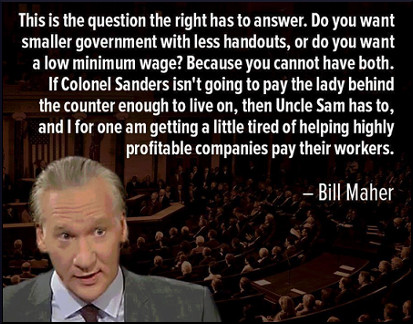
Image by Bill Maher

The Individual Versus Hunger

People often wonder, “What can one person do?” House the Homeless is in the process of saluting a number of one-person operations that have collectively fed thousands of hungry people in many places.

In London’s fabled East End, the Crisis Cafe teaches culinary skills to people experiencing homelessness, and to recently re-housed people who are getting back on their feet. Of course many dedicated volunteers are behind this project, but the program received some well-deserved publicity when Sophie Thompson, who had a role in one of the Harry Potter movies, stopped by. In addition to cinematic star power, Thompson brought her reputation as the 2014 Celebrity MasterChef winner and her recipe for pumpkin soup.

In Hail, Saudi Arabia, a man set up a commercial-sized, glass-fronted refrigerator outside his home, where he and his neighbors place food for hungry people to come and get. Of course, probably anywhere in America such a gesture would be forbidden by zoning laws, anti-litter ordinances, “eyesore” abatement programs, and health department rules. It is a nice idea, though.

Feeding the Hungry in the U.S.

Every Thursday, a woman who works in Chicago’s business district spends her lunch hour distributing sandwiches purchased from a fast food outlet, whose owner also contributes a few freebies. Kasonja Holley is often accompanied by her friend Darlene Green, and the pair sometimes carry along toiletries and blankets. Holley started a nonprofit called Love in Motion, whose volunteers recently celebrated its third anniversary by serving 300 meals.

Mason Wartman quit his lucrative Wall Street career to make a difference in the city he loves, Philadelphia, by opening a pizza parlor. The restaurant’s unique meal-sharing system is based on sticky notes. A paying customer can choose to give a dollar, write a friendly message, and post it on the wall, and somebody who needs it can take one of those sticky notes and redeem it for a free meal. In a one-year period, Wartman’s business served 14,000 partially subsidized pizza slices.

Moved by a similar sentiment for his home town, Baltimore, restaurant owner Michael Tabrizi is skipping the annual promotional week during which restaurants offer great deals to attract customers who can afford to eat out. Instead, he is setting aside five days to serve three meals a day to the homeless.

In Allan Law’s Minneapolis apartment, 17 freezers run at all times. Over the course of a year, about 800 groups (business, civic and faith-based) take turns stocking them with food. A retired teacher, Law now works nights for free, driving a van through dark streets to distribute the necessities of life. Boyd Huppert reports that in one year, Law handed out “more than 700,000 sandwiches, 7,000 pairs of socks and 75,000 bus tokens.” He also makes the rounds of local businesses to pick up food that would otherwise go to waste.

In Hartford, Conn., Sister Patricia McKeon recently let go of the executive director reins after 50 years of feeding the homeless via Mercy Housing and Shelter. Edible calories are only one of the blessings dispensed by the organization, which also is instrumental in finding homes for around 250 people every year. Sister Pat told a reporter:

This wasn’t just a job, it was a ministry to help people….You know, it’s been a wonderful ride. It really, really has.

Feeding People in The Golden State

California keeps up its reputation as a forerunner in societal improvement, thanks to such caring citizens as Donna Dolgovin, the retired nurse from Pomona who one day gave a cup of soup to a homeless man and went on to found a nonprofit called Helping Hands, Caring Hearts, which feeds as many as 150 people every Sunday.

In Monterey, Sarah Luiz Chandler was homeless for more than a year before receiving a sizeable inheritance that allows her to do things like host community meals. She describes helping others as “the greatest, most satisfying, electric experience you can ever imagine,” and says:

Homelessness doesn’t have to be a lifestyle. It can be just a moment in time.

Reactions?

Source: “Harry Potter star Sophie Thompson weaves her magic to help homeless people,” Mirror.co.uk, 01/31/15
Source: “Saudi Man Finds Innovative Way To Feed Homeless,” Ecorazzi.com, 05/12/14
Source: “Kasonja Holley is feeding the Loop’s homeless on her lunch break,” ChicagoReader.com, 12/09/14
Source: “How to Quit Wall Street and Crowdfund Pizza for the Homeless,” HuffingtonPost.com, 07/02/15
Source: “Baltimore Restaurant Owner Opts Out Of Restaurant Week To Feed The Homeless
Instead,” HuffingtonPost.com, 07/06/15
Source: “700,000 sandwiches later, this man is still helping the homeless,” USAToday.com, 04/20/15
Source: “After 50 years, Sister Pat passing the baton on feeding homeless,” WFSB.com, 03/09/15
Source: “Everyday Heroes: Pomona woman feeds homeless with regular Sunday meals,” DailyBulletin.com, 12/20/13
Source: “Homeless-woman-turned millionaire gives back,” KSBW.com, 07/07/14
Image by Mills Baker

Random Acts of Nourishment

America is full of people who feel called to feed others, whether sporadically or on a regular basis, and they do it in an astonishing number of ways. Every now and then, a celebrity will perform an impulsive act, as when comedian Russell Brand treated some West Hollywood street people to a café breakfast.

Non-celebrities don’t usually get as much attention. But the world does sometimes find out about people like Mary Younkin, who typically carries around a dozen or so sack lunches in her car, ready to give away. For others who might want to try it, her blog gave a list of items that work well for this purpose, and included the words:

I hate the empty feeling of seeing someone in need and looking the other way…My children get to see that they can help make a difference in someone else’s day and perhaps life.

Another good Samaritan, Kevin Quinn, has set up a GoFundMe page for his project, “Water for the Homeless.” His most recent updates report temperatures in Boise, Idaho, of over 100 degrees. He keeps contributors informed with reports like this:

I spent the last two days handing out iced waters and apples. Needing water bottles, apples and ice has added up. Sadly, a lot of the homeless do not have teeth and apples are not an option. I need to find a softer item for these people, to provide something to eat during the day.

A few years back, the Texas city of Lubbock planned to shut down a meal-sharing event in a city park. Apparently, the problem lay in some ordinance violations that could easily have been overlooked, but were seized upon by authorities who warned the volunteer cooks to end their weekly picnic.

When local business owner Alex Scarborough heard about this, he developed a feisty attitude and invited a bunch of friends to hold a potluck dinner in that same park, with plates for anyone who cared to show up. A couple of city council members supported him in the press, with one calling the ban a “vast overreach of city authority” and another remarking wryly that the city must have “bigger fish to fry,” meaning, of course, civic matters of higher priority. Scarborough told reporter Adam D. Young:

This surprised the living daylights out of me…I’m just wondering when we started regulating people’s kitchens…When you have to ask the officials for permission or a permit to gather and eat in the park—that’s not the country I grew up in.

Around the same time, in Detroit, Brother Al Mascia of St. Aloysius Outreach Ministries made news with the converted bicycle that helped him answer the daily needs of around 300 people experiencing homelessness. Patricia Montemurri wrote:

The food cart fits over the bicycle’s front end…outfitted with foldable countertops, insulation and a battery for lighting. It holds Thermos bottles of coffee and hot chocolate. Some days, Mascia dispenses muffins and cookies. On really good days, he has hot homemade breakfast sandwiches donated by church groups.

Perhaps inspired by Detroit’s Franciscan friar, the satire website GlossyNews.com published a story by Dan Geddes in which the city of Orlando was disturbed by a fellow who showed up at a local park with 12 friends and made a speech about love, forgiveness, and social justice. Of course critics called him “hippie scum walking around stirring up class warfare” and “domestic terrorist.” The fictional piece goes on to say:

After someone in the crowd shouted out “We’re hungry!” Christos reached into a picnic basket containing two loaves of Wonder Bread and a bag of Long John Silver fish filets. Christos instructed his friends to start sharing the food with the crowd.

In what many eyewitnesses described as a “miracle,” the bread and fish did not run out, and appeared to feed all 5,000 homeless people to their satisfaction.

Reactions?

Source: “Russell Brand Treats Homeless Group To Breakfast,” HuffingtonPost.com, 09/28/12
Source: “Barefeet In The Kitchen: Sack Lunches for the Homeless,” barefeetinthekitchen.com, 01/23/14
Source: “Local man passes out water, food to homeless,” KTVB.com, 07/02/15
Source: “Lubbockite plans public potluck after officials halt homeless picnic,” LubbockOnline.com, 07/20/11
Source: “Meals on bicycle wheels: Franciscan friar feeds, clothes homeless,” tdn.com, 04/15/11
Source: “Jesus Look-alike Arrested for Feeding 5000 Homeless People,” GlossyNewscom, 06/01/14
Image by Steve Cadman

People Who Feed People

A few days ago it was announced that in Knoxville, Tenn., a teen group is passing out something that people need even more than food—drinking water. They are participating in the Win Our World program, which only lasts for a week, but, with any luck, plants the seeds of the “pay it forward” notion in young minds.

Feeding the homeless is in the news a lot these days, especially when cities outlaw practice, as many seem to be doing. The results are lawsuits, adverse publicity, and huge expense. And those are only the stories that make the news. A variety of methods are used to discourage generous, caring people from trying to help others. Of course, those methods don’t always work.

Venice, Calif., has had a long and troubled history as a hotbed of homelessness. A couple of years back, an anonymous donor gave money to the Whole Foods store at a major intersection to host a weekly homeless breakfast program. Neighboring homeowners and tenants were not consulted beforehand, and did not want strangers to tromping through their yards on Sunday mornings, leaving trash and worse.

The locals were already burned out on the idea of feeding the homeless because of another food program operating a block away. There was vigorous debate, and after holding the event out back of its store the first time, Whole Foods began setting up its operation near the beach instead. A year later the program was still in effect at the alternate location, with complaints still rolling in for various reasons.

Not long afterward, in Pasadena Calif., Union Station Homeless Services expected to feed 5,000 at its annual Thanksgiving bash. Local residents had been sharing home-cooked meals with the homeless for 37 years—the same dishes they made for their families. Cooks would pop an extra tray of stuffing in the oven, or stir an extra quart of cranberry sauce, and deliver the surplus to a central location. According to the group’s CEO, Rabbi Marvin Gross, nobody had ever been sick.

Nevertheless, over the years, none of the homemade meals had been prepared in approved locations. When November 2013 rolled around, the Health Department stepped in and put its foot down. Going forward, helpers could only donate store-bought food (which in this fairy-tale scenario is totally, dependably safe and wholesome.) Undaunted, the charity took advantage of the opportunity to promote an approved location, and encouraged its supporters to donate pies obtained from a Los Angeles bakery owned by Mental Health America, which employs people with mental illnesses.

Feeding the Homeless Throughout the Country

A few months later, in New Orleans, Sister Beth Mouch delivered food to the St. Jude Community Center to prepare a meal for 200 people experiencing homelessness. She found a towing service preparing to remove her truck, without even a written ticket from the parking police. Though her vehicle was not even hooked up to the tow truck yet, and she was ready to drive away, the nun was not allowed to leave. Her truck was towed, and she had to pay a fine to recover it. Apparently, this was not the first time that Community Center volunteers had suffered such petty harassment in their efforts to nourish the hungry.

Around the same time, in Salem, Mass., a young convenience store clerk (whose own history included half a year of living in her car) gave a homeless man a small cup of coffee and was fired for it.Once word got out, Ava Lins received other job offers and soon posted on Facebook that she was working for Citizens for Adequate Housing. That story had a happy ending, but every time someone is retaliated against for trying to help, even on such a very small scale, it sends a bad message and teaches a bad lesson.

To offset those grim examples, a story appeared in the same week about a New Jersey couple, Mark and Anna Landgrebe, who were in their 23rd year of driving their minibus into Manhattan every Saturday night to deliver food and clothing to people in need. All over the country, alone or working together, good-hearted people are pushing back against the increasingly oppressive legal climate. Let’s hope that more people look for ways to contribute.


Source: “Teens give water to Knoxville homeless,” WATE.com, 06/23/15
Source: “Whole Foods: Free Meals for the Homeless on Sundays!,” Yovenice.com, 03/24/12
Source: “No more home-cooked donations at Thanksgiving meal for Pasadena homeless,” scpr.org, 11/26/13
Source: “Nun’s truck towed while delivering food to homeless,” TheCelebrityCafe.com, 3/23/14
Source: “7-11 Clerk Says She Was Fired For Giving Freezing Homeless Man A $1 Cup Of
Coffee,” ThinkProgress,org, 03/19/14
Source: “This Family Has Been Feeding the Homeless Every Weekend for 22 Years, and
They Have No …,” lansing.shine.fm, 03/24/14
Image by Ryan Vaarsi

The Exploitation that Turned Out Not to Be

Tampa

Last fall, Will Hobson wrote about one of the most extensive homeless programs in Tampa, Florida, and its connection to large public sports events:

For years, New Beginnings founder and CEO Tom Atchison has sent his unpaid homeless labor crews to work at Tampa Bay Rays, Lightning and Bucs games, the Daytona 500 and the Florida State Fair. For their shelter, he’s had homeless people work in construction, landscaping, telemarketing, moving, painting, even grant-writing.

At any given time, the program serves around 100 men, women, and young adults, many of whom are veterans. Many are also recovering addicts and alcoholics, and Atchison places great importance on work therapy. But the Tampa Bay Times, which undertook an investigation, believed that exploitation of the homeless was underway. Drug and alcohol recovery programs often supervise their residents’ financial lives because that way, it is harder to relapse. But Atchison was also accused of appropriating the residents’ Social Security payments and SNAP benefits, even when the total was more than what they owed the program for their housing and food.

Along with renting out the New Beginnings residents to other companies, Atchison has also started landscaping and telemarketing companies. Legally, each person is supposed to make $7.25 per hour, the federal minimum wage, but according to labor attorneys consulted by the Times, this did not appear to be the case. Hobson’s article compared it to an earlier case in New York State in which a federal judge made a program pay $800,000 in withheld wages to its former employees.

A Fresh Start For New Beginnings, With Proper Wages

By the second week of December, it was announced that the Buccaneers, Lightning, and Rays had all ended their relationship with the inadequately paid workers. Various media outlets flung around terms like indentured servitude and slave labor. Sources the Tampa Bay Times called “homeless advocates” might actually have been disgruntled n’er-do-wells. If someone was ejected from the program for breaking the no-substance pledge and other rules, “going to the media” would be a weapon of revenge.

At the same time, some residents were interviewed who had no complaints and said the program had saved their lives. Just before Christmas, the Tampa Bay Times published an eloquent letter by Brandon Jones that summed up the view held by defenders of New Beginnings and its founder.

Let me see if I have this straight. Pastor Tom Atchison of New Beginnings takes in drug addicts, criminals and sex offenders—basically the unemployable dregs of society whom no other institution will care for—and gives them free room and board, and probably clothing too.

In return he asks the men to pay for their costly care by working a few hours a week at jobs in the community for (at most) pocket money. Nobody is compelled to stay at his homeless shelter and as I understand it nobody is prevented from finding additional employment to earn a few dollars if they so choose. And while in Atchison’s care they are gaining basic job skills, and building a record of steady employment and sobriety that can help them to return to normal society.

At the end of the month a different newspaper, the Tampa Tribune, announced what seemed to be a win-win resolution of the problem, with the old contracting company (Aramark) out of the picture, a new company called All Team Staffing in the driver’s seat, and an even greater number of New Beginnings residents employed, under improved terms. There is more work to do because the new contract includes not just selling concessions, but cleanup after the sporting events. Mike Salinero reported:

The Rev. Tom Atchison, the Pentecostal preacher who founded New Beginnings, said the arrangement through All Team Staffing is better than the Aramark contract because the workers get paychecks with taxes and Social Security taken out.

In March of this year, the Tampa Tribune carried a piece by the New Beginnings leader, Tom Atchison. This is definitely worth reading in its entirety, but here are the main points:

New Beginnings has survived but has had to cut a lot of services because of the loss of income caused by the bogus articles. We will continue to rebuild our services as the truth continues to surface.

After the careful and extensive examination of the financial records of New Beginnings and the interviews of several employees and clients, federal investigators concluded that there were no violations of record keeping or labor laws.

New Beginnings makes no apologies for requiring clients to pay a part of their expenses by working. We want to teach them a work ethic and not to depend on the government and others to support them.

People who hit the streets, with intractable substance use problems, are often not angels. It would be foolish to pretend otherwise. Such difficult people tend to want everything handed to them, and react badly to rules like “work or move out”—an attitude that could account for the troubles that originally set them on the path to a last-resort rehab center. Everyone deserves a second chance, but people who answer the call to be in the second-chance business are allowed, on behalf of society as a whole, to set boundaries and enact real consequences.


Source: “Tampa homeless program uses unpaid, destitute residents as steady labor force, revenue source,” TampaBay.com, 11/29/14
Source: “Letters: Good work at New Beginnings is being punished,” TampaBay.com, 12/19/14
Source: “New Beginnings’ clients working at RayJay again after federal probe,” TBO.com, 12/29/14
Source: “The truth about New Beginnings of Tampa,” TPB.com, 03/28/15
Image by Walter

Homeless Exploitation Comes in All Sizes

A Vintage April Fools Day Meme

if u are homeless ill let you stay with me in exchange of helping me run my business.. I have a recording studio in my apartment so i will teach you how

Mature professional gentleman (35) seeks a very mature homeless female for a Serious Makeover. I am going to completely change your life …

I am looking for young homeless bi-sexual or gay guy that needs a place to stay….

Willing to provide housing to a homeless girl. Pregnant or single moms encouraged to reply. I’m a single employed father of 2. No drama no games

Hi I am looking to help a nice single homeless female under 35 with a nice place to live I have a very nice home.

Those quotations are from Craigslist ads, similar to probably hundreds that appear around the country every day. No doubt a certain proportion of them are earnest and sincere, and maybe some people have found a way off the streets through the kindness of strangers. Some ads of this kind are quite sinister, and the desperate person in need of housing must figure out which is which.

Recently, in Michigan, the owner of an auto repair business was arrested for “accosting and soliciting,” because he would let homeless men live in the shop, with video games to play, and an allowance, and even the privilege of borrowing a car—and all he demanded in return was sex.

Stunts Put Homeless in Danger

A different kind of exploitation caused eyebrows to be raised around Skid Row in Los Angeles when stunt bike riders were videotaped “bunny hopping” their vehicles over people asleep on the sidewalk. (It’s probably just a coincidence, but in the summer of 2012, in Austin, the dead body of Valerie Godoy was found along the Ninth Street BMX trail, which was frequented by local bicycle daredevils.) An LAPD officer said for the record, “Often the homeless are targets of stunts that go terribly wrong.”

The Skid Row cowboys displayed their disrespect and bad taste out in public, but gained nothing other than joy of being idiots. Behind closed doors, another level of exploitation goes on all over the country, all the time. Here is how a New Jersey street person was used, according to the Times of Wayne County:

The scam is relatively simple. Find a homeless man, a drug addict, someone expendable, someone who will keep quiet if caught. Give that person a bogus/stolen check and drop them off at a bank. If the person is successful in cashing the check, he/she gets to keep 10% of the ill-gotten money. If the scam keeps working, move to the next bank and repeat the process. If police are called and the scam falls apart, simply drive away leaving the ‘patsy’ to face the legal music.

In Kansas City, a ring of 10 crooks stole over $200,000 by haunting the dumpsters of business parks to retrieve paperwork that held banking information. As Brianne Pfannenstiel reported:

They then used a personal computer to print counterfeit checks before driving to shelters and halfway houses to recruit homeless people to pass the checks at banks.

Great financial gain can be had by bilking the system created to provide medical care for America’s citizens. In Orlando, Florida, a clinic owner and three accomplices recruited people experiencing homelessness to be fake patients in a scheme that defrauded Medicaid of over $200,000.

Similar thievery in New York involved (allegedly thousands of) homeless people who were paid in shoes, while a consortium of nine doctors got away with around $7 million. This cabal hired a guy whose job was to hang around shelters and soup kitchens, roping people into an elaborate hoax. Anybody with a valid Medicaid card could be transported to a clinic and pretend to receive extensive, costly tests and treatment. The New York Times reported:

The doctors, staff members and billing specialists, meanwhile, would rack up hundreds or thousands of dollars per recruit in false Medicaid claims, prosecutors said…The doctors in the group made money by, for instance, seeing a patient for four minutes and billing for 30 minutes, or claiming they had reviewed tests when they had not, or simply billing for procedures they had never done…

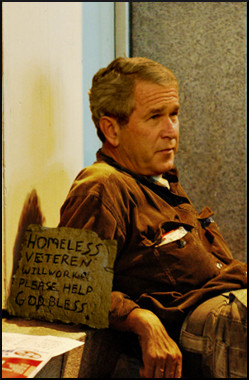
George W. Bush Taking Money From the Homeless?

Not long ago, former POTUS George W. Bush gave a speech at a fund-raising gala for a homeless shelter located in McKinney, Texas. Blogger Rob Groce commented:

Bush should be an expert on the topic of homelessness, after all. The number of homeless Americans grew 49 percent in the last two years of his presidency, peaking at 634,000 when he left the White House in 2009. And that surge was certainly aided by a quadrupling in the number of home foreclosures during his last term. Bush doesn’t have a record of compassion regarding the homeless…

But he stood up and talked on their behalf, right? He helped out Samaritan Inn…and also charged his full, customary $100,000 fee. Michael Kruse of Politico.com remarks:

Since 2009…Bush has given at least 200 paid speeches…The part-time work, which rarely requires more than an hour on stage, has earned him tens of millions of dollars.

Tens of millions, and what Kruse implies there is that Bush could afford to donate his fee back to the institution. However, that did not happen, and the shelter’s director expressed tactful joy about raising more than a million dollars. But just think. With a generous gesture from a man whose pockets are already filled to overflowing, the shelter could have had $1,100,000.

House the Homeless’s Experience With George W. Bush

Here is a perfect example of why life can be so confusing and so astonishing. Despite the bad press, it seems that Mr. Bush’s record is not all one-sided. Here is House the Homeless founder Richard R. Troxell:

When George W. Bush was governor of Texas, I designed a continuum of care delivery system to move people out of homelessness for the City of Austin. I pressed for the need for a jobs component and one that paid a living wage. As far as I know, House the Homeless was the only nonprofit to receive funding to aid people experiencing homelessness from Mr. Bush. He gave us $100,000 for my model, Project Fresh Start. Whether he did it for political purposes (I never heard it touted as such) or if he really did get my concept of living wages, I am sure of one thing, that he understood the concept of jobs that paid enough to put a roof over your head other than a bridge.

Read about this exciting episode and more in Richard’s book, Looking Up at the Bottom Line.

Reactions?

Source: “Police: Mich. auto shop owner took in homeless men, then demanded sex,” Newsandtribune.com, 05/22/15
Source: “People aren’t happy about the BMX riders who bunny hopped homeless people,” NetworkA.com, 03/14/14
Source: “Homeless man used as ‘pawn’ in check scheme,” WayneTimes.com, 06/13/15
Source: “Bank scam: homeless men, counterfeit checks, prison,” BizJournals.com, 12/01/14
Source: “4 Charged After Recruiting Homeless To Pose As Patients,” CBSLocal.com, 03/21/15
Source: “9 New York Doctors Are Accused of Defrauding Medicaid Using Homeless People,” NYTimes.com, 03/31/15
Source: “Want George W. Bush To Help Your Homeless Shelter? That’ll Be $100000, Please,” IfYouOnlyNews.com, 06/08/15
Source: “On talk circuit, George W. Bush makes millions but few waves,” Politico.com, 06/07/15
Image by κύριαsity