
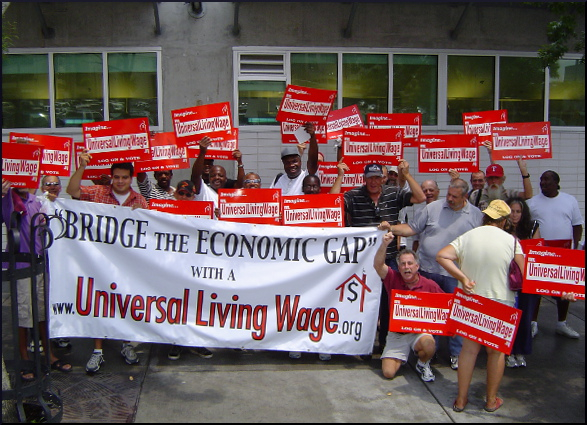

Our Mission

Founded in 1989, HtH is the oldest all volunteer, action, homeless organization in the state of Texas. The mission is Education and Advocacy around the issues of ending and preventing homelessness.

Urgent Issues

Re-Criminalizing Homelessness — Speak up now!

HtH supports the direction being taken by the City of Austin’s relatively new Homeless Strategy Office, led by a very committed and responsive David Gray, and with the commitment of Charles Loosen and other staff. We further strongly advocate ALL positions below that preceded The vote to basically criminalize homelessness — especially:

reinstating a camping ban must consider that those with disabilities, the aged, and in fact anyone with no place to go. The no sit/no lie ordinance is absolutely inhumane and unconscionable we must have at least 15 minute respites particularly for those with disabilities and make other provisions.

Mayor Kirk Watson, elected in 2023, is working to secure funding for homeless services from the State and within the City Budget.

2025 interests:

City Council approved a resolution making homelessness a top financial priority.

Increase the capacity of the Homeless Strategy Office to address and implement a comprehensive approach to strategic advancements in homelessness response. (Plan detailed in a 50-page memo from David Gray, June 2025).

Examples:

1. Expand HOST (Homeless Outreach Street Team) support including team members:

APD officers, EMS paramedics, behavioral health clinicians, social workers, peer support staff.

2. Support for Marshaling Yard operations.

3. Rapid Response housing and safe housing, especially for families.

4. Increase shelter beds with support; and more.


The Austin city council recently voted to put on its May 2021 ballot a vote to reinstate the no camping ban including the no sit/no lie ordinances. Now is the time to contact your mayor and council members particularly those who have supported decriminalizing homelessness, such as Mayor Adler, Kathy Tovo, Ann Kitchen, Greg Casar, Sabino Renteria, and others, we pray.

First call to action is cold weather shelter. Anyone that reads this, our urgent plea is to email our mayor and city council in this urgent time of cold weather. House the Homeless is encouraging to use the Convention Center or other alternatives sites that are already over burdened due to Covid-19 or at capacity.

A second call to action is to not displace unsheltered neighbors from bridges and the four major camp areas without having an immediate plan for alternative shelter/housing.

Finally, advise your mayor and council members that the wording for the May ballot regarding reinstating a camping ban must consider that those with disabilities, the aged, and in fact anyone with no place to go. The no sit/no lie ordinance is absolutely inhumane and unconscionable we must have at least 15 minute respites particularly for those with disabilities and make other provisions.

Federal Minimum Wage Debate

Federal resolve is insufficient; highly recommend Universal Living Wage formula indexed on the cost of housing wherever the person lives and works. 

Musicians and the Homeless

Everyone likes celebrity news, especially when it’s good, and House the Homeless has previously taken note of wonderful generosity from stars like Bruce Springsteen. We also mentioned Eminem’s patronage and mentorship of a homeless rapper called Yelawolf. The musician and activist known as Reverend Billy Wirtz supports the organization Picture the Homeless, whose motto is “Don’t talk about us, talk with us.”

Last May, it was announced that Lady Gaga would donate $1 million to homeless youth. Cyndi Lauper began the True Colors Fund in 2008, and the result is a shelter with 30 studio apartments specifically for lesbian, gay, bisexual, and transgender youth who are experiencing homelessness. Some of them anyway, for as the singer is quoted as saying:

In New York City, a very disproportionate number (up to 40 percent) of homeless youth identify as L.G.B.T. Even more disturbing are reports that these young people often face discrimination and at times physical assault in some of the very places they have to for help. This is shocking and inexcusable!

Back in 2006, Jon Bon Jovi started up the JBJ Soul Foundation, which feeds people and puts families into houses, and does a whole bunch of other stuff in several cities. Now the foundation has teamed up with the Department of Veterans Affairs and other agencies to create Project REACH.

It stands for “Real-time Electronic Access for Caregivers and the Homeless,” and it’s a contest with a financial reward for whoever in the “developer community” can figure out how to make a national platform that can be accessed by the Internet and smartphones. The assignment is to supply complete and current information on shelters, housing services, crisis hotlines, legal assistance, VA services, health clinics, food kitchens, and any other resources, anywhere, anytime.

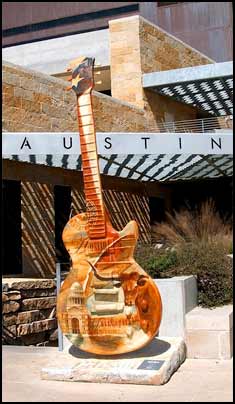
House the Homeless has often mentioned Austin in relation to its music scene, which has a long and impressive history, and the South by Southwest festival, and a whole lot more going for it. Among other things, the Austin Music Commission was supposedly represented on the Waller Creek Citizen Advisory Committee, but then whatever work that group did was apparently set aside to await the results of an international design competition. The ongoing project will greatly affect what is locally called the Red River music scene, and it will also have a huge impact on the area’s people experiencing homelessness.

Like many other cities, Austin has heard objections to the presence of homeless people downtown because of the trash problem, which in the public mind is inevitably associated with vagrants. But… If Austin is anything like other college towns, a big part of the trash on the streets is contributed by students with an overweening sense of entitlement and not much genuine connection to the city they temporarily inhabit.

Where there are bars and clubs, there is litter, vomit, and urine on the sidewalks and in the neighbors’ azalea bushes. What pulls customers to those clubs is the music. So the blame for urban squalor can’t be solely assigned to the homeless.

In many citizens’ minds, both show business and the homeless are responsible for urban crime. Live music = night life = booze = drunk-rolling = fights = prostitution = stolen cars = hard drugs = police sirens = litter = homeless people. In a downtown area, especially on weekends, they’re all mixed up together. And musicians write songs about the homeless, like “Only a Hobo,” “Tramp and the Young Girl,” and hundreds more. Often, musicians are the homeless, especially in old age — if they make it that far.

Sure, at a certain stage, with the world at your feet, being technically homelessness might be the best career move. If you plan to tour for 10 months, why pay rent for an apartment? The road can also make someone unwittingly callous. A 21-year-old guitarist who sleeps in a band’s tour bus might not understand how the rolling-stone life is not so much fun for a 45-year-old woman veteran with diabetes and PTSD. In many significant ways, musicians are just like everybody else — sometimes uninformed or thoughtless.

The music scene has always been an environment where thinking was a little more enlightened than in the general population. When musicians meet, age, race, creed, economic status, and all those other tiresome barriers are totally irrelevant. Sure, the music subculture has always had its problems, but discrimination generally hasn’t been one of them. That’s how much power the music universe holds, and one of the ways to use power responsibly is by looking after the interests of society’s least fortunate. An outstanding example of this is New Orleans, where in the wake of multiple disasters, the musicians took care of each other and a whole lot of civilians, too.

In Los Angeles, a band called Avenue 52 has a music video project called “Homeless,” whose profits will partly go to local helping organizations. In Berkeley, Ace Backwords, who is himself a homeless musician, organized and produced several compilations showcasing the work of numerous street musicians.

In Denver, David Adebonojo, performing at the 16th Street pedestrian mall, attracted the attention of musician/producer Tyler Ward, who got his career going. In one way, as the son of the Ivy League-educated parents (a doctor and a minister), Adebonojo doesn’t match the homeless stereotype. In another way, he does, with his history of being an auto mechanic, a Deadhead, and an ex-con. After writing a quantity of music in prison, he was released to the streets, where he spent enough years to have half a dozen guitars stolen.

Let’s hope for perfect weather in Springfield, Missouri, on May 12, for the second attempt at raising $10,000 for homeless causes with a concert called “Stomp the Blues Out of the Homeless.” The promoter, Jim Payne, whose day job has something to do with escrow and land titles, tried to launch this idea last year, but the weather was impossibly foul and he ended up losing all the money he had put up to get the thing going. Better luck this time!

Homeless Media Bonus Link
The late comedian Greg Giraldo — “Underwear Goes Inside the Pants” — featuring many of Venice Beach, California’s homeless residents.

Reactions?

Source: “Cyndi Lauper Opens Homeless LGBT Youth Center In NYC,” The New Civil Rights Movement, 08/25/11
Source: “VA Launches “Project REACH” Contest,” VA.gov, 03/19/12
Source: “Los Angeles Based Pop Rock Band Avenue 52 Raises Homeless Awareness,” SFGate.com, 04/12/11
Source: “Denver musician David Adebonojo (Dred Scott) strikes a chord,” DenverPost.com, 08/03/11
Source: “Fresh start desired for blues festival,” News-Leader.com, 05/05/12
Image by bartlec (Chris Bartle), used under its Creative Commons license.
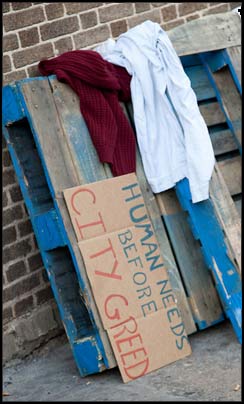
Income Inequality and Low-Paying Jobs

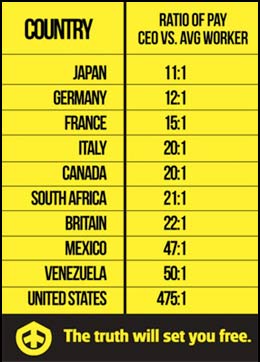
Many people have seen the chart shown here, which “went viral” not long ago. Now the site where it appears carries an afternote from Lisa Wade, who says:

Since posting this, I’ve discovered that the numbers do not accurately reflect the ratio of CEO vs. worker pay. I apologize for not vetting this more carefully.

What happened was, a website called PolitiFact discovered that the chart originated with three graduate students in 2005 who forgot to list sources for their data, which by now would be more than 10 years old anyway. Fair enough.

It appears that no official body keeps track of the comparative CEO/worker rates of compensation internationally, so that’s a dead end. But even without solid verification, PolitiFact admits:

We don’t doubt the chart’s underlying point that the ratio of CEO pay to worker pay is high in the United States, and is likely higher in our free-wheeling economy than it is in the historically more egalitarian nations of Europe.

They also warn that even in the best case, statistics can only be approximated, because of differences in surveying methods and subjective decisions like what counts as compensation. But the story really gets interesting when PolitiFact seeks out current numbers regarding the income inequality between the CEO of an American company and the average worker in that company.

Here is what they found:

The most recent chart from the Economic Policy Institute shows a ratio of 185 to 1 for 2009. According to the group’s calculations, the peak since the mid 1960s was almost 299 to 1… Meanwhile, the most recent ratio from the Institute for Policy Studies is also smaller — for 2010, it was 325 to 1. In previous years the ratio on two occasions has exceeded 475 to 1 — to be specific, 516 to 1 in 1999 and 525 to 1 in 2000.

So they imply that we should calm down about this income inequality thing, because it was worse in 2000. Sure, the pay differential was even more outrageous than the number shown on the chart, but this information “would be of questionable use to policy debates today.”

Who are they kidding? We’re supposed to shun this chart because it’s wrong — but it’s wrong in the wrong direction! When the big boss makes 525 times as much as the worker, that’s worse than the big boss making 475 times as much as the worker!

Maybe it’s true that the most conservative number is closest to being right. Maybe the average American CEO only makes 185 times as much as the worker, a number that PolitiFact says was “not generated by groups that might have an ideological interest in downplaying the gaps between rich and poor.” So we’re supposed to chill out and not be concerned about the fact that for every dollar a worker makes, the big boss makes $185 of them.

Eileen Appelbaum notes that there is a difference between the official national unemployment level of 12.7 million and the actual number of unemployed, which is 22.8 million, if you count people who have given up searching for work, and the part-time employed who would be working full-time if they could. She is suspicious of employers who claim to “have good jobs but can’t find workers with the right skills to fill them.” If such an urgent imbalance exists between supply and demand, she wonders, then why isn’t this reflected by a rise in pay for these jobs?

Appelbaum gives a summary of recent research about the aftermath of an economic recession. High-paying and low-paying jobs come back, but, she adds:

A new study attributes the jobless recoveries following recent recessions to such job polarization. The study’s authors argue that jobs in the middle of the skill and income distribution disappear during recessions and fail to come back during recoveries.

However, in some areas of the low-skill-and-income-sector, the job outlook is perking up. According to the Bureau of Labor Statistics, personal care and home health aides are the fastest growing categories of workers being sought.

Last week, House the Homeless discussed the “silver tsunami,” the demographic bulge of seniors and pre-seniors who will soon require the attention of many thousands of personal care aides and home health aides. They are honorable professions, but the pay scale is not tempting.

Since the financial reward is paltry, we had better hope that a whole lot of young people feel motivated to enter the caregiver business through their own natural good-heartedness. Where is all this good-heartedness going to come from? We’re raising a nation of kids whose families are fractured by homelessness, whose human ties are fragile and constantly broken by the necessity to move yet again.

These disadvantaged kids are proceeding to grow up into the very workforce that will be spoonfeeding oatmeal to the Baby Boom generation a few years from now. We’d better hope they learn about the milk of human kindness somewhere along the way.

Reactions?

Source: “Cross-National Comparison of Ratio of CEO to Worker Pay,” The Society Pages, 05/03/12
Source: “Viral Facebook post on CEO-worker pay ratio has obscure past,” PolitiFact, 10/10/11
Source: “Low-Wage Jobs to Blame for Slow Economic Recovery,” NationofChange, 04/10/12
Image of “Cross-National Comparison of Ratio of CEO to Worker Pay” is used under Fair Use: Reporting.

Demographic Bulge Casts a Shadow

In many ways, American cities are alike. In all of them, the post-World War II demographic bulge is in the process of creating what some call the “silver tsunami.” A sizeable group known as “pre-seniors,” age 55 to 64, will hit retirement age over the next few years.

The economy is enormously damaged, and retirees who have been careful all their lives, and who have made conservative financial choices and prudent investments, are caught short. Financial embarrassment is suffered even by people who started their savings accounts in grade school. Their reserves run out, and yet they live.

What happens then? Some universal issues are the need for transportation; more healthcare workers for seniors; and of course, affordable housing.

Of course, cities are also different. House the Homeless has been looking at Austin, Texas, as the proverbial “canary in a coal mine.” What happens there is probably predictive of what will happen in other cities — not randomly, but because Austin is the kind of place that other cities regard as an example. Austin distinguishes itself by the presence of folks like The Statesman staff writer Jeremy Schwartz, who investigates such matters as why so many seniors are falling into poverty, and even experiencing homelessness.

Schwartz devoted considerable time to interviewing seniors, their advocates and care providers, and various officials, and obtained the expertise of Christian McDonald, a database editor, to analyze statistics. They came up with some numbers worth knowing:

In 2010, just 7 percent of residents within the [Austin] city limits were older than 65, about half the national figure. But during the past decade, the city’s small elderly population grew by 27 percent, twice the national rate… The number of elderly residents living in poverty has increased 42 percent in Central Texas over the last 10 years, according to the U.S. census… The Central Texas graying trend is sure to strengthen in coming years because the number of so-called pre-seniors — those from 55 to 64 — grew 110 percent here in the past decade, a figure that led the nation.

Many seniors receive small amounts from Social Security, because they only held low-paying jobs, or because they were stay-at-home parents. Schwartz says, “Spousal benefits average less than half of full benefits for retired workers, according to the Social Security Administration.”

The SSI payment for extremely low-income seniors is, on average, just a tick over $400 a month. The waiting lists for federally subsidized low-income senior housing can run into years.

Every now and then, someone takes a stab at reckoning the value of work done by a stay-at-home parent, who is usually the mother. This year, calculations were done by Investopedia, and the breakdown is given by Porcshe Moran, who says:

We examined some of the tasks that a homemaker might do, to find out how much his or her services would net as individual professional careers. We only take into consideration tasks which have monetary values and use the lowest value for each calculation… These services could earn a homemaker a considerable wage if he or she took those skills to the marketplace.

Between the duties of private chef, house cleaner, child care expert, personal driver, laundry service, and lawn maintenance person, each with its proportionate number of hours, Investopedia figures that the average homemaker would, if paid, earn $96,261 per year. The number doesn’t even include the even more occasional part-time occupations, such as nurse, house painter, tutor, researcher, tax preparer, and numerous others. Even so, it’s creeping right up on $100,000.

Women in the baby-boom generation earned less than men during their working years, and many earned nothing at all because they were stay-at-home wives and mothers. A homemaker who reaches retirement age does not draw a monthly Social Security benefit appropriate to a $96,000-a-year job. A single mother who reaches retirement age, or who is disabled, has less to live on than someone who performed the same job, domestic manager, out in the working world for an actual employer. A widow is not paid benefits based on her work as a domestic manager, but based on her husband’s salary. This might be under $500 per month.

Women in general live longer than men, so the “silver tsunami” consists mainly of women, who tend to be paid at the lower end of the Social Security scale, and not so much of men, who in general would receive more. So the country will soon be full of people who are not only living on Social Security, but at the poverty end of its spectrum.

The maximum disability payment is $698 a month, or less than half of the federal minimum wage. According to the last several U.S. Conference of Mayors reports, no one working at a full-time, minimum-wage job can afford to get into and keep a one-bedroom apartment anywhere in the country. If a person employed at the minimum wage can’t afford an apartment, what does that say about the chances of an unemployed disabled person who makes half as much?

As a general principle, House the Homeless feels that any full-time job ought to pay enough to put a person in an apartment, and any subsidy paycheck for those who have to depend on the government should be enough to put them in an apartment. And then there’s the concept of the Universal Living Wage, which this would be a good time to think more about and get behind.

Reactions?

Source: “Austin not ready for ‘silver tsunami’ of poor seniors, experts warn,” Statesman.com, 04/08/12
Source: “How Much Is A Homemaker Worth?,” Investopedia, 01/16/12
Image by jxandreani, used under its Creative Commons license.

How China Opened My Eyes

I was in the sixth grade, and my new social studies book was entitled, The World Was Wide. John Glenn had just orbited the earth, twice. I remember thinking about that title and how exciting and yet how sad that it was that the days of Magellan and Sir Edmund Hillary, and Perry and Scott were behind us. At the same time, I wanted to go to the places that they had touched and written about.

I’ve been lucky enough to have found Eric, my best friend, who also likes adventure hiking, camping, and exploring other cultures and countries. My exposure to other people and other cultures opened my eyes to all aspects of the human condition: the joys, acts of bravery, and human suffering. It has been my search to explore and understand this planet that has shaped my course in life and desire to end the condition of homelessness.

Eric and I met at a time when we both wore the clothes of younger men. Our first trip ever took us over land into Canada in a paintless, eight-cylinder Chevy Biscayne that spewed oil and blew smoke. We were at the Canadian border and were almost refused entry because the authorities suspected we were driving the car into their country only to abandon it there.

The truth was, we were doing everything possible, including using duct tape and making cardboard gaskets, to keep it running. Our destination was Algonquin Park, 42,000 pristine acres of Canadian Wilderness, where we took the Polar Bear Express as far north as the train would carry us, and then into Inuit (often referred to as Canadian Eskimos) country.

Another trip took us up the Amazon River and into the Peruvian Andes, where we climbed Mount Sulkantay. Eric has been to Africa three times and had malaria as many times. He fooled me into thinking he had contracted another malaria strain when actually it was soroche, or altitude sickness. This condition can drive a person violently mad and, if not treated, can immediately end in death.

In 1983, Eric and I ended upon a shared expedition of our own device when we left the unauthorized borders of the Shawa Province surrounding Addis Ababa and delved into the forbidden Simien Mountains of Ethiopia, with 1,000-meter sheer drops, in search of the Falashas. They have been referred to as the Black Jews and purported to be people of the Diaspora, when, according to the Bible, they were scattered to the corners of the Earth.

Obviously, we “rough-travel,” which means we travel any way we can, and for as cheap as possible. We have also, for various reasons, attached ourselves to more organized treks or parts of organized treks as part of our travels.

One such trip was our foray into China in 2007. We joined an Earth Watch Expedition, when we became part of an exploratory team that went deep into China and Mongolia, and into the Gobi Desert in search of water. In a time when the true value of water is only just now being realized for its worldwide implications, I hope you will be fascinated with our journey into the land of nomads, camels, and the highest sand dunes in the world. Click here to read it.

“Quality of Life” Ordinances — the Way Forward

In the mid-1980s, homelessness had again begun to manifest itself in the United States. In 1988, the U.S. Congress declared it had reached a crisis level and passed the McKinney Vento Act in an effort to find funding solutions to end homelessness.

In 1989, Richard R. Troxell founded Legal Aid for the Homeless in Austin, TX, where he repeatedly went through an 18-month process to get disabled individuals experiencing homelessness disability benefits. It turned out that this benefit was about half the amount earned under the federal minimum wage.

At same time, the U.S. Conference of Mayors began issuing reports that concluded that no one can get into — and keep — basic rental housing anywhere in this country even when working full-time at a minimum-wage job. The federal government was setting standards so low that it was the single greatest manufacturer of homelessness!

In 1997, Richard R. Troxell set out to “fix” the federal minimum wage. To this end, he designed a three-pronged formula using existing government guidelines that ensures that if a person works 40 hours per week, be it from one job or two, he or she will be able to afford basic food, clothing, and shelter (including utilities), wherever that work is done throughout the United States. Clearly, this relates to people who can work.

In the 1990s, at the behest of the business communities across America who felt under attack by people experiencing homelessness, municipalities began to pass “Quality of Life” Ordinances and to share their success among themselves. These ordinances include: no camping, no panhandling/soliciting (aggressive or non-aggressive), no sitting/lying on sidewalks, etc.

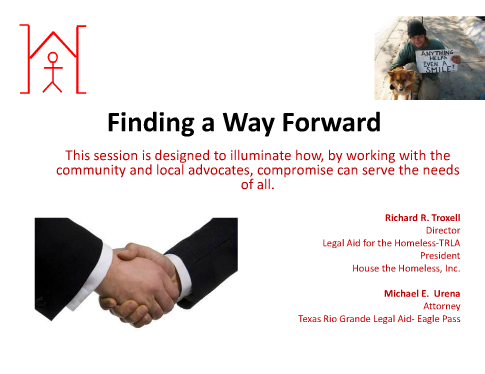
The following is the Power Point Summary of House the Homeless, Inc.’s efforts to bring the City of Austin’s “No Sit/ No Lie” Ordinance, as it relates to people who cannot work, in compliance with the Americans with Disabilities Act.

View and/or download the presentation by clicking below.

Finding a way forwardView more presentations from House the Homeless.

Austin Music Scene Is a Vital Cultural Force

Austin, Texas, gets a lot of coverage here at House the Homeless. The fact that the House the Homeless organization is located there and devotes a great deal of energy to the city is only a secondary reason. The main thing is, Austin is a city that will be legendary in the future, like Athens and Alexandria are now.

People keep an eye on Austin, just like they pay attention to what goes on in New York or San Francisco, where they don’t even live, and never will. Even though in some ways Austin is in a class by itself, it faces the same issues as any metropolis. The difference between cities is not in their problems, but in their responses. Austin is a beautiful microcosm of everything that’s great about America. It’s almost an ideal melting pot, where cultures do not compete, but embrace and mingle.

One example of true hipness is the music scene, which has been wildly eclectic since the 60s, and probably before. (If anyone would like to say how much farther back the musical precocity really started, please comment!) A mind-boggling number of musicians either came from Austin or migrated to Austin. Michael Martin Murphey’s “Alleys of Austin” is one of the most beautiful songs ever sung. It’s a unique, amazing music town, and the South by Southwest music festival has contributed enormously to that reputation.

During the most recent iteration of the festival, an entrepreneurial venture was launched which involved people experiencing homelessness, and it made international news. Another interesting business idea put into motion more than three years back, we learn from Mark Horvath, in a 3:42 video clip viewable at his Hardly Normal website, and every link on that page is worth following.

Here is Horvath’s brief description of the project he characterizes as “a brilliant idea,” launched by Alan Graham:

I have been telling everyone about his catering trucks and how he rapid houses homeless people in RVs. Well Alan is at it again, this time trying to create ways for our homeless friends to generate income… Mobile Loaves and Fishes new Street Treats program… Basically, Alan empowers a homeless person to make some money, with the intent to save up and restore housing, by selling ice cream around downtown Austin.

But, let’s get back to the music scene, which has a dark side. One of the long, hard struggles taken on by House the Homeless was to defend people against a harsh “No Sit/No Lie” ordinance. The embarrassing connection to the world of music is that the original ordinance, passed in 2005, included an exception for those who rest while in line waiting to pay for concert tickets. Someone hoping to buy a thing not necessary for life was allowed to sit on a sidewalk. Someone in poor health, and homeless, waiting for a medical appointment or a meal, was not allowed to sit on a sidewalk. That was a pretty inhumane situation.

The outcome of the struggle is described by Richard R. Troxell:

After a year, we forced a compromise giving people with disabilities up to 30 minute respites in deference to their medical needs. As a result, in 2011, Austin became the first city in the nation to bring our No Sit/No Lie ordinance in compliance with the Americans with Disabilities Act. Perhaps now we can simply install enough benches for folks to sit down in a civilized fashion and thereby inch closer to becoming the world class city that we aspire to be.

There is another unhealthy relationship between the music scene and the homeless scene. Music venues usually feature alcohol, and, by coincidence, alcohol is the downfall of a certain percentage of people who slide into homelessness. Nationally, Richard reminds us, the health care costs resulting from alcoholism run into the trillions. His article also includes many very interesting ideas we won’t attempt to summarize here. To explain them adequately and persuasively is, after all, why he wrote the article in the first place. But one more quote:

In overview, we can see that with clear vision, new perspective and collectively involving the city, the citizens of Austin, federal and state governments and the business community in a fair, equitable, balanced and profitable fashion, we can end homelessness as it exists today.

In Austin, this especially applies to the involvement of citizens and business in the Waller Creek project, which is inextricably related to the area’s thriving music “ecosystem.” The design plan for this massive project has been narrowed down to the suggestions of four semi-finalists. A year ago, Shonda Novak and Marty Toohey wrote for the Austin Statesman that the creek “has become a trash-strewn stream and a hangout for vagrants.” They quoted a property owner who said:

You can have all the dreams in the world of what Waller Creek is to be like, but it’s not going to happen if we don’t deal with the transient population. The City Council needs to step up to the plate and pass stronger laws and insist that the police enforce them and the judges back them up.

Since then, how much has been done to assure that people experiencing homelessness will get some jobs out of this costly project? How much has been said about them in any other context than of a nuisance to be gotten rid of? The answer is, not much. This is the time for musicians and venue owners to make some noise about alleviating homelessness.

Musicians are some of the world’s nicest people, who can be astonishingly effective when they get motivated. When a musician reaches a level of fame, the results can be awesome. When Willie Nelson signed on to sue the Monsanto corporation, that was big news, and there are many other examples of this beneficent wielding of personal power.

Recently, we talked about how author Richard Florida cited Austin as an example of the Creative City, defining the music scene as one of its big three forces. The music universe has so much energy and influence. Look what the New Orleans musicians have accomplished, not only for fellow musicians, but for their city as a whole.

Austin is another such city, the kind of place where magic can happen. This is a blatant request for comments from the Austin music community about its unsung heroes. Please brag here, about the ways in which you have helped the homeless.

Source: “Street Treats: The Other SXSW Homeless Campaign in Downtown,” Hardly Normal, 03/31/12
Source: “How to end homelessness in Austin: A plan,” CultureMap Austin, 02/08/12
Source: “Private conservancy outlines plan to rescue, revive Waller Creek,” Statesman.com, 04/27/11
Image by pixajen, used under its Creative Commons license.
Homeless: Some Personal Journeys

The prolific Huffington Post has a new columnist, William Laney, who published a book called Homeless Isn’t Hopeless. After three years on the streets, Laney himself is no longer homeless. The brief descriptions and reviews of his book mention such matters as living on a bus, knee surgery, getting around on crutches with no place to stay, having cash and ID stolen, the food storage problem, the sanctuary of the public library, and being homeless in a hurricane.

Laney also lived in a shelter for several months and is well aware of the phenomenon of economic homelessness — the situation people are in when they are working and still can’t make enough to afford housing. In Laney’s first Huffington piece, he discusses how the government avoids admitting the extent of the child homelessness problem, by not counting kids whose families are stashed in motels or doubled up with relatives.

Yes, technically, such children have a roof over their head. But the crowded conditions make it difficult to concentrate on homework or get proper sleep, and many kids ashamedly conceal their living conditions from peers and authorities.

They need to be officially acknowledged, Laney says, because:

Such a change of policy, such recognition, would open up, for countless children, HUD programs that are now unavailable to them. The fact that there is even a question about ‘motel’ or ‘doubled-up’ children being qualified is further evidence of a continuing lack of understanding of the homeless in general, and homeless families, in particular… They certainly qualify as homeless beings deserving of the aid given to the more visibly homeless.

Still, these kids are relatively lucky. Laney relates sightings of families camped by the roadside and in other distressing conditions that should never be seen or experienced in America.

In Santa Barbara, CA, Austin Rucker told a local newspaper the story of how, although employed, he ended up homeless because a subletting tenant has no rights under the law. The first night he slept under a bush. Should we ever find ourselves in this situation, we should prepare to get up early. Rucker says:

At around 4:30 a.m. when the first blue morning haze sets in, most homeless Americans wake up. First light means visibility, and visibility means police can give you tickets and passers by can throw harsh judgment your way… Illegal camping can get you fined… [Y]ou certainly do not want to get charged money to spend a cold night being bitten by bugs…

Robert Rashford, aka “Homelessrob,” has been blogging for several months, bringing readers along on his journey toward his destiny. He addresses such issues as when it may be a better choice, temporarily, to stay technically homeless, in pursuit of a particular long-term goal. Helping others has been a large part of his activity in recent years. The introductory paragraph says:

My day by day life as a homeless man. I give opinions about homelessness, tell stories, and offer homeless tips for surviving homelessness. Also, I share my plan on escaping homelessness. You get to watch my struggle.

How strange is it that the Daily Mail, a British newspaper, published an article commemorating the death last month of another narrator of homeless life, an American who lived in the subway tunnels underneath New York? Anthony Horton, 43, was killed by a fire in the abandoned communications office where years ago he set up living quarters after a history of parental abandonment, foster homes, and illiteracy.

For 20 years Horton scraped by, battling alcoholism and selling recycled items found in the trash. He also did volunteer work, teaching art and gymnastics classes for a church in Manhattan. Unlike many subterranean dwellers, Horton collaborated with another artist to produce a book about his life, which in 2009 the American Library Association named as one of the top 10 graphic novels for teens.

Titled Pitch Black, it is still available, and Youme Nguyen Ly (formerly Youme Landowne) has given interviews about her artistic comrade. She told a reporter:

He was incredibly gentle and chivalrous. He was an extremely talented writer with a great voice and sense of humor and he would draw everything all the time.

The pseudonymously published “Ex-homeless explains why life is worth living” does exactly that. It was written in response to someone who contemplated suicide, which the author, who spent part of his high school years living in a car, advises against. After describing the tragic circumstances of his earlier life, the author relates the changes that led to a more satisfying existence and encourages anyone in a bad situation to hold onto hope, and especially not to give in to the urge for self-destruction.

Now, with a 20-year-marriage to “the best person I’ve ever met,” two children of his own, and a career in which has the privilege of helping other people every day, the author says:

You can get a job. A menial job, sure. But I’ve had those. They don’t kill you. You can find a place to live temporarily. Shelters aren’t the best, but they’re a start. I’ve lived in worse. Food pantries can offer you food. And once you’ve stabilized your life, friends will come. Volunteer, go back to school, once you start working. Take things one step at a time and stop misleading yourself that the past is a mirror of the future. All these difficulties don’t have to last. I am proof they don’t have to last. I also am proof that life can change in an instant. But you have to be around to see it.

NOTE: The Foreword of William Laney’s book was contributed by Dr. Michael Stoops, and Richard R. Troxell of House the Homeless adds, “Michael Stoops has been the National Field Organizer for the National Coalition for the Homeless for over 30 years. For about two years he was the acting Executive Director. He is again the National Field Organizer and our nation is better off for it. I have few heroes… He is one. ”

Reactions?

Source: “Homeless With Children,” The Huffngton Post, 04/06/12
Source: “How I Became Homeless,” Santa Barbara Independent, 10/20/11
Source: “Homelessrob Has A Plan,” HomelessRobsHome.blogspot.com, 03/25/12
Source: “Homeless man killed when blaze ravaged,” DailyMail.co, 02/07/12
Source: “Ex-homeless explains why life is worth living,” GodlikeProductions,com, 04/04/12
Image of Pitch Black is used under Fair Use: Reporting.

Unaccompanied Homeless Teens

Recently, House the Homeless talked about a report called “When the Bough Breaks: The Effects of Homelessness on Young Children” (PDF). One of the points it made is that children without stable homes are more than twice as likely as others to repeat a school grade, be expelled or suspended, or drop out of high school.

There is an elementary school in Las Vegas with about 600 kids enrolled, of whom about 500 are homeless. This is happening in America! Stories of student homelessness come from Green Bay, Wisconsin; from Chillicothe, Ohio; New York, south Florida, Oregon. Everywhere.

Take Sacramento County, California, where in 2007, the number of children without stable housing was 5,120. By the time 2009 rolled around, they had 7,254 homeless kids. In one county. Which happens to be the county where the state capital resides. It’s very similar to Washington, D.C., capital of the nation. The metroplex that includes the District of Columbia and parts of Maryland and Virginia is populated by the truly astonishing numbers of people experiencing homelessness. And politicians, and lobbyists working against every right and interest of the average person.

A while back, Kevin Sieff wrote inspiringly about a program in that very part of the country. First, he explains that according to federal law, every school district needs to have a homeless liaison. There is some federal money for homeless students, but it’s for things like transportation and tutoring. If the kid has nowhere to live, that’s the business of some other agency.

But not the business of the bureaucracy known as Housing and Urban Development (HUD). In HUD’s book, if a kid is sleeping on a relative’s floor, that counts as being housed. HUD is only able to help a kid who lives in a shelter or a car, or the actual street.

Those in the greatest need are helped first. It’s not unfair, but it does get in the way of keeping track of how many young individuals are drifting around like flotsam. Looking at it this way, they can be divided into two sub-populations, the definitively homeless and the technically, but just barely, housed.

Sieff explains another reason why the numbers are tricky, when using a different lens or filter:

The statistics from each school system reflect only homeless teens who have managed to continue their studies despite a lack of permanent shelter. Those who have dropped out are not included in these counts.

So that’s another way of defining sub-populations — the kids who try to stay in school and the kids who gave up. A lot of other variables complicate each individual picture, too. Contrary to popular belief, many young people are homeless through no fault or desire of their own.

The reporter’s main story concerned the Homeless Youth Initiative, a program described as an “experimental partnership” between the schools of Fairfax County and a place called Alternative House, and $170,000 of federal grant money designated for the housing of students. The county contains about 2000 homeless students, and about 200 of those are what the state calls “unaccompanied.”

Sieff says:

Most of the students use a $450 monthly rental subsidy funded by the federal stimulus package to stay in apartments they find on Craigs-list.

Some of these emancipated teens live on their own, and some are placed with families. They go to school and work part-time. When Sieff wrote about the program, its future was in doubt. The federal stimulus dollars are only an emergency stopgap or bridge, set to expire. The funding is so important because it helps kids stabilize their situations. A young person needs firm ground to stand on, when getting ready for the battle to find the ever-elusive living-wage job.

Somehow, the Fairfax county program is still hanging on. HYI’s own website says:

The Homeless Youth Initiative consists of three parts:

— An Alternative House single family home where four young women reside;
— Private host homes; and
— Small rent subsidies to help students with renting a room in the community.

All of the youth participating in the Homeless Youth Initiative receive housing and community support, as well as case management services, individual therapy, life skills education, tutoring, and assistance with emergency food and supplies.

The program arranges matches between homeless high school students and families who offer living space and companionship, very much like what happens when an American family hosts a foreign exchange student. The program has won praise from the Interagency Council on Homelessness, but however great a model it might be, the odds against replicating it in other places are formidable.

Only two counties in the whole country have median household incomes of over $100,000 a year, and Fairfax is one of them. The government says there are about a million homeless students in the country, so all we need — in communities that are nowhere near as prosperous — is approximately several thousand more programs like this..

And the Universal Living Wage!

Reactions?

Source: “Number of homeless students in Sacramento County schools jumps 50%-plus,” The Sacramento Bee, 07/14/11
Source: “Schools cope with shelterless students,” The Washington Post, 12/26/10
Source: “Homeless Youth Initiative (HYI),” TheAlternativeHouse.org
Image by Franco Folini, used under its Creative Commons license.
Affording to Live

To rent a two-bedroom apartment in Hawaii, you need either a job that pays $31.68 per hour, or four minimum-wage jobs. Closer to 4.5, actually. In California, you need either a job that pays $26.02 per hour, or more than three minimum-wage jobs. And so on.

This is a much-simplified sample of the kind of information available from the report called “Out of Reach 2012,” compiled by the National Low Income Housing Coalition. You can download the entire report on its website, or various charts and graphs such as the one at the top left of the page, which is much easier to read in full size.

It would be interesting to have overlay maps, to see where all the empty foreclosed properties are, and the areas where the most people are away in jail, and where the largest concentrations of homeless people are, and several other variables, compared to these rent figures.

We learn from Aaron Sankin in The Huffington Post that the very most expensive place to live isn’t a state at all, but a metropolitan area which includes the District of Columbia and parts of Virginia and Maryland. By strange coincidence, this is the very area where the people who make the laws live, and also the ones who influence and reward the lawmakers on behalf of corporations. By another strange coincidence, Washington, D.C., our nation’s capital, contains an enormous number of people experiencing homelessness.

Across the nation, the rate of home ownership is the lowest since 1998, so, naturally, more people are looking for places to rent. Good luck with that, prospective renters! Reviewing the Out of Reach information, Sankin says:

The report notes that the number of low-cost rental properties around the country have shrunk as a growing fraction are converted into significantly more expensive units or left to fall into disrepair and taken off the market entirely. Between 2007 and 2010, the number of properties priced at under $500 per month dropped by one million, while those going for over $1,205 increased by two million.

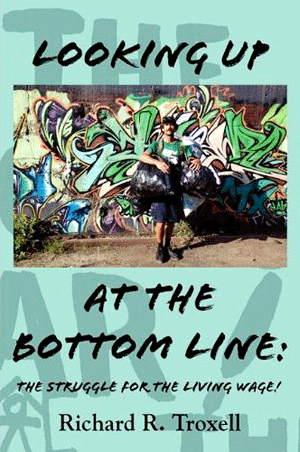
Economic homelessness is the concept introduced by Richard R. Troxell in Looking Up At the Bottom Line. The economic homeless are the working poor who have some kind of a job, but don’t make nearly enough to rent even the most rudimentary and utilitarian kind of apartment.

If you want to get your heart broken, read about Project Fresh Start. At one point, Troxell obtained funding for a program in which 20 adults went through a “continuum of care” program, and found work and housing. Within two years, all were homeless again, not through personal failings or lack of trying, but because people just can’t live on what they make. Richard writes:

We had gotten downtrodden people engaged, brushed off, detoxified, job trained, placed in jobs, and into housing only to realize that they were destined to fail as the wage, set by the federal government, would not sustain them. This was a powerful epiphany.

Like any epiphany worthy of the name, this one led to action: the proposal for the Universal Living Wage. The idea is to fix the Federal Minimum Wage by indexing it to the local cost of housing throughout the United States. The military already does this. In many places, not all military personnel live within the borders of the installations. When the government calculates their off-base housing and separate rations allotments, it goes according to the geography and the local cost of living. It’s not rocket science.

At least 40% of people experiencing homelessness, are working at some point during the week. Clearly, the work ethic is there, but the wage to afford basic housing is not. Richard points out that minimum-wage gigs used to be “starter” jobs, just a dip of the toe into the water, to learn what the world of work is all about, before a person would move on to a career or a real job and a union membership, something more solid. But now, an American is more likely to be trying to support an entire family on a minimum-wage job, that is, if a job can be obtained at all.

But why tell the whole story here? Please accept this invitation to the Universal Living Wage website, where there is so much more. It opens up a new world of possibility.

Reactions?

Source: “Out of Reach 2012,” NLIHC.org, 2012
Source: “San Francisco Rents The Highest Of Any City In Country,” The Huffington Post, 03/14/12
Source: “Looking Up at the Bottom Line,” Amazon.com
Image of “Out of Reach 2012” map (left) is used under Fair Use: Reporting.
Chart of the right is by Pat Hartman.

Homeless Hotspots at SXSW Cause Uproar

This year, the biggest news to come out of the SXSW festival had nothing to do with music or film. Even the technology angle was not the focus. No, it was the wording on the T-shirts of the 15 homeless people hired by BBH Labs to sell Internet access to visitors. (Some of their bios are available at the advertising company’s website.)

The problem is, each shirt proclaimed, for instance, “I’m Mark, a 4G Hotspot,” implying that Mark is a thing rather than a person. So the big complaint came from grammar wonks like TV personality Jon Stewart. Not from the people experiencing homelessness, who were delighted with the opportunity to be ambulatory “wifi hotspot managers,” even if it was only for a couple of days. They liked both the income and the chance to interact with the public in an unaccustomed way.

The “homeless hotspot” phenomenon was called shocking, disgraceful, shameful, dehumanizing, outrageous, undignified, demeaning, problematic, gimmicky, dystopian, and awful. BBH was accused of perpetrating a publicity stunt that used the homeless as a commodity or as vending machines.

Homeless advocate Mark Horvath came out in favor. Homeless advocate Maria Foscarini came out against. Newspapers as far away as Australia and Turkey picked up the story. The amount of media coverage is beyond belief. If Americans had paid a fraction of this attention to the multi-trillion-dollar bank bailouts, the entire political landscape might have been different.

First, reports from knowledgeable people on the ground, so to speak, in Austin itself. Mitchell Gibbs is on staff at Front Steps, the organization through which the participants were recruited. According to the Associated Press:

He was initially skeptical after being approached by BBH, but was won over by previous work they’ve done with the homeless. He put the offer to participants in the shelter’s Case Management Program, a step-by-step program to move people out of shelters and off the streets.

Melissa Gaskill, who writes about the city’s unique culture, points out that no one was forced to take these jobs, and no one appeared to be hurt by the experience. Her editor classified it as a “creative labor idea.”

Gaskill interviewed Alan Graham of Mobile Loaves and Fishes, who has worked with the homeless for years, and who characterized the whole thing as “brilliant.” He dismissed the charge of exploitation, because the workers were paid a fair wage, and besides, every commercial interaction in the world can be interpreted as exploitative.

The journalist recorded some very quotable words from Graham:

I thought it was a great way to call attention to the company and to people who really want to work. Every one of those guys doing it were having a great time, and none of them felt exploited… What people are really complaining about is that they don’t want to be faced with the homeless issue: not here, at an event that’s cool, hip, and fun and maybe a little elitist and materialistic.

Richard R. Troxell of House the Homeless saw mostly positive reactions, and noted that there was also an inadvertent side benefit for other people experiencing homelessness in Austin, who might have gotten a little WiFi for their own electronic devices. This was a small-scale, short-term experiment, whose effectiveness may have been impossibly skewed by the firestorm of publicity.

Richard reminds us that for him and the people he represents, any plan to employ the homeless should first be about dignity and fairness. Hiring the homeless is a good deal if the employer pays a living wage — sufficient to afford basic food, clothing, and shelter (including utilities). Using their homeless status to promote the product or issue, not so good.

For Technorati writer Lorraine Esposito, the old saying was applicable — “No good deed goes unpunished.” Here is her summation:

The Good Deeds:

— Provide the needed Internet access to thousands of SXSW convention goers. Responding to the calls for service, BBH New York found a solution with a heart.
— Offer homeless people the prospect of earning money, connecting with people, and feeling self-respect and hope again. BHH invested equipment, mentorship, training, and created the infrastructure of support and publicity to enable homeless people to profit in this opportunity.

The Punishment:

— Criticism levied upon BBH for duping the homeless with a “demoralizing” exploitation of their need to earn money.
— Deny the privilege of employment. Media pressure forced BBH to cancel the project three days early.
— Humiliation and victimization of the homeless at the hands of the media, not BBH.

Besides, she asked one of the participants, Hurricane Katrina victim Clarence Jones, who said:

Everyone thinks I’m getting the rough end of the stick, but I don’t feel that. I love talking to people and it’s a job. An honest day of work and pay.

BBH denies that the experiment was terminated early. If it was, it’s a pity for the people who were hired. Plus, the public reaction might have spoiled things for the homeless of New York, too, because the ad agency had planned to put the program into effect there, and now that plan is on hold.

In The Daily Beast, Lee Stringer, who has personally been homeless, offered a spirited rebuttal to critics:

This was an initiative of a for-profit corporate entity. No-one’s jaw need drop open when they do this, even if non-domiciled persons are involved… I took in an average of $40 a day digging refundable cans and bottles out of the trash. There were others on the street who panhandled for cash. Given a choice, I’d take toting a WiFi modem around over both, as far as dignity is concerned. Plus, five minutes at it, me being me, and my customers would know who I am and what I am about.

The Huffington Post writer Tanene Allison — who has also experienced homelessness — made some acerbic remarks:

I’ve never heard so many thought leaders talk about homelessness before! Definitely not as many people expressed such outrage over the newly proposed policy in NYC, which would make it incredibly hard for homeless individuals to have access to even basic shelter… If all the thought and technology leaders gathered in Austin want to pause to talk about homelessness — imagine the great potential of good if they put their smarts, their abilities and their passions into creating new solutions.

Perhaps the most cogent suggestion of all was made by Austin’s Craig Blaha, who totally nailed it when he wrote for Technorati:

If Homeless Hotspots really pisses you off, protest by donating directly to Front Steps Shelter, the National Coalition for the Homeless, or your local homeless organization. Put your money where your mouth is and leave a note in the comments section telling us just how much you donated, and to which organization.

Reactions?

Source: “’Homeless Hotspot’ stunt stirs debate at SXSW,” KHOU.com, 03/13/12
Source: “Homeless hotspots at SXSW: Opportunity or just exploitation?,” CultureMap Austin, 03/15/12
Source: “Punishing the Homeless,” Technorati, 03/15/12
Source: “Don’t Be So Quick to Condemn the Homeless Hot Spots Idea, Writes Lee Stringer,” The Daily Beast, 03/14/12
Source: “What Happens When SXSW Meets Austin’s Homeless,” The Huffington Post, 03/14/12
Source: “Austin Homeless Hotspots,” Technorati, 03/15/12
Image by Jorge Rivas of Colorlines, used under Fair Use: Reporting.