
Our Mission

Founded in 1989, HtH is the oldest all volunteer, action, homeless organization in the state of Texas. The mission is Education and Advocacy around the issues of ending and preventing homelessness.

Urgent Issues

Re-Criminalizing Homelessness — Speak up now!

HtH supports the direction being taken by the City of Austin’s relatively new Homeless Strategy Office, led by a very committed and responsive David Gray, and with the commitment of Charles Loosen and other staff. We further strongly advocate ALL positions below that preceded The vote to basically criminalize homelessness — especially:

reinstating a camping ban must consider that those with disabilities, the aged, and in fact anyone with no place to go. The no sit/no lie ordinance is absolutely inhumane and unconscionable we must have at least 15 minute respites particularly for those with disabilities and make other provisions.

Mayor Kirk Watson, elected in 2023, is working to secure funding for homeless services from the State and within the City Budget.

2025 interests:

City Council approved a resolution making homelessness a top financial priority.

Increase the capacity of the Homeless Strategy Office to address and implement a comprehensive approach to strategic advancements in homelessness response. (Plan detailed in a 50-page memo from David Gray, June 2025).

Examples:

1. Expand HOST (Homeless Outreach Street Team) support including team members:

APD officers, EMS paramedics, behavioral health clinicians, social workers, peer support staff.

2. Support for Marshaling Yard operations.

3. Rapid Response housing and safe housing, especially for families.

4. Increase shelter beds with support; and more.


The Austin city council recently voted to put on its May 2021 ballot a vote to reinstate the no camping ban including the no sit/no lie ordinances. Now is the time to contact your mayor and council members particularly those who have supported decriminalizing homelessness, such as Mayor Adler, Kathy Tovo, Ann Kitchen, Greg Casar, Sabino Renteria, and others, we pray.

First call to action is cold weather shelter. Anyone that reads this, our urgent plea is to email our mayor and city council in this urgent time of cold weather. House the Homeless is encouraging to use the Convention Center or other alternatives sites that are already over burdened due to Covid-19 or at capacity.

A second call to action is to not displace unsheltered neighbors from bridges and the four major camp areas without having an immediate plan for alternative shelter/housing.

Finally, advise your mayor and council members that the wording for the May ballot regarding reinstating a camping ban must consider that those with disabilities, the aged, and in fact anyone with no place to go. The no sit/no lie ordinance is absolutely inhumane and unconscionable we must have at least 15 minute respites particularly for those with disabilities and make other provisions.

Federal Minimum Wage Debate

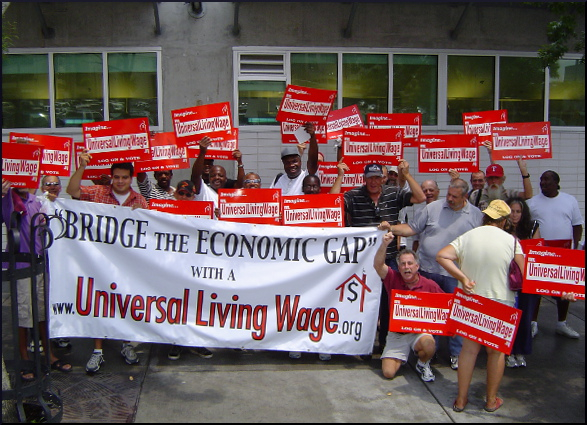
Federal resolve is insufficient; highly recommend Universal Living Wage formula indexed on the cost of housing wherever the person lives and works. 

The Minimum Wage and the Big Ideas

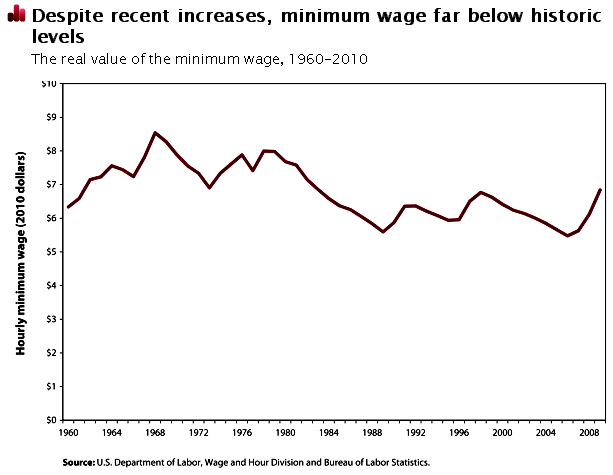
The Economic Policy Institute (EPI) points out the unsurprising fact that the minimum wage is worth much less than it previously was worth. Its graph illustrated the value of the minimum wage since 1960, adjusted for inflation and translated into 2009 dollars:

When adjusted for inflation, the minimum wage was worth $8.54 per hour in 1968, compared to the current minimum wage of $7.25 per hour. Based on a typical, 2,000-hour work year, the 1968 inflation-adjusted minimum wage would equate to an annual salary of $17,080 per year, versus $14,500 for today’s minimum wage.

In other words, the minimum wage decreasingly resembles a living wage. Historically, the peak of minimum wage value was in the 1960s, a long-gone era many people who are working today don’t even remember, because a lot of them weren’t born yet. The EPI also points out that raising the minimum wage stimulates the economy by giving workers more spending power. You’d think this would be obvious, but apparently many politicians overlook this basic fact.

We previously mentioned the very comprehensive interview that Richard R. Troxell of House the Homeless did not long ago. It’s worth mentioning again, because when Wayne Hurlbert of Blog Talk Radio conducts an interview, he skillfully leads his subject to lay out the most important principles, as well as explain things in detail.

Painting first with a broad brush, let’s review some of the big ideas. Changing people from tax-takers to taxpayers is one of them. If the working poor were making a fair, adequate living wage, it would reduce the tax burden, because there would be less need for food stamps and other sorts of government assistance. Even if it can’t happen right this minute, people need to know that there is hope, they need to see that pathway stretching out before them. They need to know opportunity exists, and to be inspired to take advantage of opportunity, rather than subside into hopelessness.

Another basic principle of Richard’s is, solutions that come from the grassroots are faster and more effective than those involving the government. Of course, for something big like the Universal Living Wage, the government has to be behind it. But if homeless veterans in your community need socks, an appeal to the local goodhearted people will get them a lot quicker than a request to an official bureaucracy. And we have to show the way, because the old saying is true — “When the people lead, the leaders will follow.”

The biggest idea of all is that homelessness does not have to exist. This situation we have today does not have to be the situation we have tomorrow. We’re in a mess, but it can be undone and fixed. Richard’s proposal for fixing it is implementing the Universal Living Wage. In the interview, Hurlbert asks how the ULW is different from the minimum wage already in effect, and the answer is, it’s not really that different. What we have now needs to be tweaked and perfected, and if it is done over a 10-year period, the shock for anyone need not be too unbearable.

As a background, Richard talks about when the federal minimum wage was instituted in 1938, to make sure every working American could afford basic shelter, food, and clothing. It was a humane, fair, and much needed measure, but it was based on an assumption that it costs pretty much the same to live anyplace in America, so it was not indexed to anything. Still, it worked acceptably until the mid-1980s, when extreme booms and busts in the economy had really messed things up.

Another thing happened too, that would impact the nation very adversely by increasing not only the number of people experiencing homelessness, but the number of such people who were truly incapable of taking care of themselves. By the ’80s, the whole structure of mental health institutions had become so abusive, it seemed better to integrate the mentally ill into society.

The first part of the plan worked fine, dumping thousands of seriously ill and disoriented people on the streets. The second phase didn’t work so well, and rather than getting “mainstreamed,” the people ended up drowning instead, denizens of the streets, free but so impaired that freedom became “just another word for nothing left to lose,” as Kris Kristofferson phrased it.

In the interview, Richard talks about how the minimum wage always falls behind the poverty line, and how it didn’t increase for a whole decade between 1997 and 2007. We ended up with a situation where one of the largest labor organizations, Service Employees International Union, was training people in how to apply for food stamps. At one point, the University of Texas had 200 staff members on food stamps. And because of the unrealistic minimum wage, the federal government had become a creator of homelessness.

Reactions?

Source: “State of Working America preview: The declining value of minimum wage,” EPI.org, 11/17/10
Source: “Richard Troxell: Looking Up at the Bottom Line,” Blog Talk Radio, 12/08/10
Image by EPI, used under its Creative Commons license.
0

Deadly Violence Among and Against the Homeless

If a person were inclined to really concentrate on the negative, it would be possible to spotlight quite a number of incidents where people experiencing homelessness are randomly slain by bands of townsfolk for apparent sport, or by a citizen with a twisted lone-avenger fantasy. Even worse are the reports of homeless people assaulted or killed by other homeless people. Add to that the incidents that are never reported. Plus, when the topic is police violence against the homeless, there are unfortunately many examples.

Last month in Northern California, guilty pleas were entered by two out of three teenagers accused of the 2009 beating death of a homeless man. They also agreed to testify against the third member of a murderous expedition, the purpose of which was to “kick a bum’s ass.” This they effectively did, using metal bars and a table leg as weapons to kill Timothy Lee Alcorn. Just a couple of weeks ago, a Northern California resident was found guilty of murdering Richard Seeger in order to steal the car in which Seeger had been living.

Fort Walton Beach, Florida, is likely a pleasant enough place, except for when the occasional citizen is set on fire, like Johnnie Roberts was. This happened about a week ago, under a bridge (of course), where the victim was found by a homeless veteran. Meagan O’Halloran reports,

Authorities say they found Johnnie Spencer Roberts tied to a pole by his shoelaces. He was unconscious and intoxicated, but, miraculously, he survived… Now other homeless people say they’re afraid they’ll be targeted next.

Speaking of homeless veterans, that is the category to which Thomas Higginbotham had belonged, before he was killed by police gunfire in Oregon. Maxine Bernstein reported on this January tragedy that took place in an abandoned car wash, where the victim and at least one other homeless man were indoor camping. The victim was 67, alcoholic, armed, and had been persistently threatening a security guard. The scenario, according to the witnesses, sounds like a determined effort to commit suicide-by-cop. If that was what Higginbotham intended, his plan was successful in achieving not only his death, but a stain on the careers of two long-time police officers.

St. Petersburg Times staff reporter Rita Farlow relates how in Florida, a resident of a homeless encampment was convicted of manslaughter last month, another suspect having already pleaded guilty last year. The two beat a fellow homeless man to death back in 2007. Apparently the victim, Michael J. Picciola, had attacked one of them first, and caused other problems, and the two wanted to convince him to leave the small colony. Instead, the troublemaker ended up dead.

Last year was also when three teenagers beat Joseph Ruba to death in Lakeland, Florida. Just last month, a homeless man was charged with the burning death of a 26-year-old homeless woman in Largo, Florida. What is going on down there in the lovely state that we are accustomed to thinking of as a retirement haven and amusement park heaven?

David Greisman reported on the deadly autumn season in Laurel, Maryland, where Pamela Myers, who had been living in the woods, died after being set on fire by her “boyfriend.” Then, within weeks, in an unrelated homicide, Flavio Garcia was killed by another homeless man near a local racetrack. Maryland also saw the death of a homeless man named Adeolu Adedgoke Otemolu, shot by a teenager.

The fall of 2010 was also a bad season in Houston, Texas, where several homeless women were murdered and rumors of a serial killer abounded. Then, in December, an elderly homeless man was killed by a fast-food restaurant employee in Detroit, Michigan. December was also an ill-omened month in Connecticut, where a homeless man was beaten to death by his tent-mate, who then asked a third person to help him bury the body.

Violence occurs among the homeless, as people lacking in social skills attempt to self-police their settlements and camps by what amounts to vigilante action. It happens between people experiencing homelessness, who are driven by deprivation and unimaginable stresses to turn against those who were formerly friends or even lovers.

It happens through malicious hate crimes committed by housed people, who seem to think they are doing some kind of societal cleanup, and who refuse to understand that they are not part of any solution at all, but rather part of an increasingly horrifying problem. Long ago, I knew an Air Force captain, a pilot who held the record for flying a certain kind of Southeast Asia mission and living to tell the tale. Home on leave, in a backward part of the American South, he took his Harley out on the remote country roads. Some bigot was cruising around in a pickup truck, with a head full of spiteful visions of Billy and Wyatt, the motorcycle-riding hippies of Easy Rider. He forced the bike off the road, and though the captain recovered from other injuries, one of his arms was made absolutely, totally useless, forever.

The savages who beat a homeless man to death, or set him on fire, have no idea whom they are attacking, but they too need a story to tell themselves. Chances are, they convince themselves they are doing a good deed by ridding society of a nameless degenerate who will be missed by no one.

And violence happens through the disordered thinking of an individual who wants to escape from life and can’t think of a better way to do it than by taunting the police, in hopes of a quick death that will leave behind lingering problems for officers of the law.

One thing is clear: If homelessness were ended, this violence would also end. And how can that be accomplished? One measure that could go a long way toward a solution would be the adoption of the Universal Living Wage, which would end homelessness for more than 1,000,000 minimum-wage workers, and prevent economic homelessness for all 10.1 million minimum-wage workers. Learn more about the Universal Living Wage here, and from Richard R. Troxell’s Looking Up at the Bottom Line.

Reactions?

Source: “Two plead guilty in fatal beating of homeless man,” Redding.com, 01/07/11
Source: “FWB Homeless Man Lit on Fire; Investigators Still Looking for Suspect,” WJHG-TV, 01/31/11
Source: “Grand jury reports: Portland police shot homeless veteran 10 times after he advanced holding a knife,” OregonLive, 01/28/11
Source: “Man found guilty in 2007 death at homeless camp,” Tampabay.com, 01/14/11
Source: “One Homeless Man Accused of Murdering Another Homeless Man in Laurel,” Columbia.Patch.com, 12/04/10
Image by sparr0 (Clarence Risher), used under its Creative Commons license.

San Francisco Sit/Lie Ordinance Documentary

The impressive Mission Local website is only part of a grander scheme, which encompasses print and multimedia avenues in two languages. Its aim is to generate quality journalism that fairly and thoroughly covers San Francisco’s Mission District. The staff are from the UC Berkeley Graduate School of Journalism, San Francisco State, and the community.

Reaching back a couple of months, we’re looking at a piece of video journalism by Patricia Espinosa and Christine Mai-Duc, in which everyday people react to the Sit/Lie ordinance. Not surprisingly, the local law represents yet another misguided attempt to “do something” about the problem of homelessness by sweeping it under the rug. (It’s getting mighty crowded under that ragged shred of national carpet.) The reportage itself is great, but even more interesting are some of the comments the piece inspired.

For instance, “pdquick,” a doctor who treats people experiencing homelessness, points out the absurdity of forbidding people to sit or lie as a way to reduce aggressive panhandling. How aggressive can a panhandler be, after all, who is sitting or lying? That is some pretty laid-back aggression. Good point, pdquick!

“Lee” is impatient with housed people who convince themselves that the homeless are already spoiled and pampered by a plush existence, and is also angry with those who use a certain word:

The notion that the homeless are living a ‘lifestyle’ — which they could choose to stop living at the snap of their fingers — is truly ludicrous… You’d rather have the garbageman sweep up the unsightly blights on your block so you can walk down the street without having to think about all the bad stuff happening in your country. That’s why you have to convince yourself that homelessness is a ‘choice,’ a ‘lifestyle,’ a ‘decision,’ easily reversed, and that the homeless already have a vast and generous infrastructure of support.

“Lynae” makes a very good point about the sit/lie ordinance. How stupid is it, on the one hand, to encourage people to become employed, productive citizens, and at the same time hit them with criminal charges that will stick to their records, and make job hunting even more impossible? Plus, agencies providing basic services have more barriers against those with criminal records. This commentator reminds us of an even more basic truth:

It’s not illegal to be homeless. People have a right to NOT have housing. With that in mind, making laws that make it virtually impossible to be homeless without constantly being ticketed/arrested is just as wrong as making tons of laws that infringe on someone’s right to be black/Jewish/handicapped/what-have-you.

Many critics of the ordinance have also mentioned its redundancy, and this is true not only in San Francisco but just about every place where such ordinances are passed. There are already laws in place forbidding aggressive panhandling, loitering, public alcohol drinking, and so on. Additional rules are not really needed, and only serve to make the overall situation worse for people experiencing homelessness.

A society is only as good as the treatment it extends to its most vulnerable members, and America could be scoring a lot higher in this performance area. The thinking seems to be, if society can cut off the homeless from enough amenities, such as food and the right to sit on a park bench, all the drifters and transients and refugees will come to their senses and say, “Well, duh! This homeless thing just isn’t working out!,” and go get themselves a place to live, like decent people. And that’s not the worst of it. For some, the thinking is, take away enough amenities from people experiencing homelessness, and they will come to their senses and kill themselves, saving everybody else the trouble of dealing with them.

Paradox alert: We said that some hard-hearted Americans wish the people in the “homeless” category would just simply cease to exist. And we soft-hearted Americans also wish the category of “homeless” would cease to exist — only, we want to see this happen by finding everybody a place to live. We talked about the insanity of trying to legislate homelessness out of existence by forbidding homeless people to do just about anything.

Here’s a question. Name one social problem that has ever successfully been legislated out of existence. If you can’t think of one in five seconds, the point is made. Racism? Domestic violence? Murder? Addiction? We have plenty of laws, and still have plenty of all of the above. It’s unlikely that homelessness can be made to disappear by persecuting its victims.

Reactions?

Source: “About,” MissionLocal.org
Source: “Homeless React to Sit/Lie,” MissionLocal.org, 11/11/10
Image by TheTruthAbout, used under its Creative Commons license.

Homelessness, Wishful Thinking, and Insanity

Not long ago, Denise Wong reported from Reno, Nevada, on a special day set aside to strictly enforce a city ordinance that forbids “camping,” i.e. existing. People experiencing homelessness had already been discouraged from hanging around in certain areas, and those areas were expanded. This quotation from the piece is reminiscent of a comedy rule learned in screenwriting class: “A punch line is a punch word, and it belongs at the end.” Get this:

And police are allowed to arrest anyone camping on sidewalks outside the Record Street Homeless Services Center.

In the December sweep, Wong reports that no one was cited or arrested, but official warnings were issued. Rumor has it that many homeless people were forced to abandon their bedrolls and other possessions. Others say the street people had three days’ notice of the impending action and plenty of opportunity to move their stuff. Either way, three days’ notice doesn’t help when there is nowhere to go. Apparently, the other local possibilities are the railroad tracks or the riverbank. The same generous choices are available in many American cities. And then, if the homeless congregate in those places, the housed people still complain.

In January, Steve Chawkins of the Los Angeles Times wrote about the situation in Santa Barbara, California. It seems that in a fashionable area of town, benches are aligned parallel with the sidewalks, making it easy for beggars to sit around all day displaying to the shoppers and tourists their pitches written on cardboard. As one indignant business owner put it,

It’s just like they’ve made the street their living room. They just sit there — all day, every day. One of them even has a portable TV. It’s totally inappropriate.

Inappropriate? Anyway, the dignitaries in charge figure, they will hit those indigent homeless people where it hurts — in their overstuffed wallets. Here’s the plan: They’re going to rotate the benches 90 degrees, to be perpendicular to the flow of foot traffic. Thus, according to a re-development official Chawkin interviewed, the panhandlers’ backs will be facing half the people on the sidewalk, cutting their solicitation opportunities by 50%. Ta-dah!

But wait, there’s more. Benches along the “city’s most vibrant commercial thoroughfare” will also have their backs removed, so nobody can get too comfortable. The reporter spoke with a dismayed social worker who characterized the entire project as “rearranging deck chairs on the Titanic.” Chawkin says,

Benches have been an issue elsewhere. Some cities install armrests in the middle of benches to keep people from lying down. In La Jolla two years ago, one community activist tried recruiting residents to sit three-hour shifts to keep homeless people off public benches.

By the way, to turn 14 benches to a perpendicular angle is going to cost — guess how much? $50,000. Now, that’s inappropriate. In Looking Up at the Bottom Line, Richard R. Troxell relates how, when House the Homeless was considering ideas for the Homeless Memorial, the city of Austin offered to sell the organization a $5,000 park bench with a divider in the middle to prevent sleeping. No, thanks!

Please see Richard’s report on the current state of things in Austin, where it looks like the city is trying to do the same thing that many other political entities have done so many times in the past, which is to legislate a problem out of existence. The solution, in the minds of many Austin residents, is to change the homeless into non-persons, by using the force of law to deny them the right to sit in public places. (And, of course, there are already plenty of laws everywhere, about what can be done on private property.)

The theory behind such measures is, if the homeless are forbidden to do something, and then another thing, and another thing, eventually the accumulated weight of all these ordinances will somehow magically make the homeless go away.

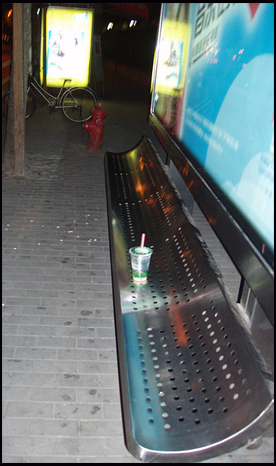
When I saw these bus stop benches in Shanghai I had to snap a picture. They are clearly designed to stop anyone from sleeping on them, but are also very uncomfortable to sit on at all. Another example of ‘Architecture of Control.’

So says Albert Sun, who took the photo on this page. (Follow the link to Flickr where, in the Comments, there’s an artistic yet very un-sleepable park bench spotted in Los Angeles.)

The following might apply to an individual or a society: The definition of insanity is doing the same thing over and over, and expecting different results. Every time legislation is made to increase the misery of the homeless, it’s based on a belief that a certain category of people should not exist, and that they can be made to go away by illegitimatizing everything about them. This belief is as quaintly erroneous as the belief that blowing out all the birthday cake candles will make your wish come true.

The park bench maneuvers are a perfect of example of a society’s tendency to “cut off its nose to spite its face.” Some cities solve the park-bench dilemma by simply removing them. Take that, homeless people! Try sitting on our park benches now!

The downside, and it’s a big one, is that nobody gets to sit on park benches. Not the young mother, who is taking her kids out for a walk because it’s free, and they need some exercise. Not the retired teacher, who is still recovering from knee replacement surgery, or the young sweethearts, who need a few minutes to talk, away from their parents.

How about this? How about putting more park benches around town, so there are plenty of places for anybody who wants to sit down, without having to spend a day’s pay for the right to sit inside the fenced patio of a sidewalk café?

Quotation of the Day:

It’s from a video by Patricia Espinosa and Christine Mai-Duc of Mission Local, regarding the sit/lie ordinance in San Francisco’s Mission District. One woman says, and this is really worth thinking about:

I do not typically sit or lie on sidewalks, but I think that if I needed to or if I wanted to, I’d like to have the right to.

Reactions?

Source: “Homeless Residents Forced Off Reno Sidewalks,” KOLOTV, 12/06/11
Source: “Santa Barbara seeks to turn the tables on the homeless,” LATimes.com, 01/21/22
Source: “Homeless React to Sit/Lie,” MissionLocal.org, 11/11/10
Image by Albert Sun, used under its Creative Commons license.

Putting Jesus in Jail

It was Brother Michael of the Morning Star Monastery who said it, in Austin, Texas, back in 1996. House the Homeless and many others were trying to repeal the then brand-new No Camping Homeless Ordinance. The City Council had passed this atrocity in the belief that it will make homelessness go away by outlawing it. Council members spoke openly of the “Homeless Ban,” and a city official was caught on tape stating that the goal was to “run these people out of town.” Being homeless in Austin was punishable by a fine of up to $500 or time in the Gray Bar Hotel. What Brother Michael said was,

This ordinance would have put Jesus in jail.

How many pastors have said those words, over how many years, in reaction to how many laws that were designed to further restrict the lives of people experiencing homelessness? Not to deny Austin its originality, but the script for the No Camping Homeless Ordinance drama has been passed around from city to city for decades. It’s all too sadly predictable. Here is another generic quotation, issued in this case from the mouth of the District Attorney:

The ordinance does not punish persons for being homeless.

How many law enforcement spokespeople and politicians, in how many cities, have had occasion to use that line? And, of course, it’s nonsense. By the time Austin’s ordinance had been in place for a year, more than 2,000 people had been charged with violating it, and by some strange coincidence, all of them were people experiencing homelessness.

In Looking Up at the Bottom Line, Richard R. Troxell says,

The ‘No Camping’ ordinance is punitive in nature and is being selectively enforced. Students are sleeping outside while waiting to get concert tickets without worry of being arrested. Visitors at Barton Springs and travelers in our airport and bus stations also sleep without fear of being arrested. This is obviously a crime of economic status.

As in so many other cities, the politicians talked about a “safer climate,” and none of them were talking about what was safe for the people experiencing homelessness. Does anybody ever stop to think that maybe homeless people like to be safe, too? Maybe they like to be around ordinary people, in places where there are plenty of witnesses if anything goes wrong, instead of out by the railroad tracks, vulnerable to any kind of predator. A few people, with more sensible heads and better intentions, noted that laws like this only drive people deeper into the woods. How many times has that been said, and hasn’t it been true every time?

Even a city council member who claimed to have once been homeless himself was in favor of the ordinance, and, in fact, cast the deciding vote. This is another cliché found all too often in human life: The person who claws his way up the success ladder and kicks anybody in the face who clings to a lower rung:

We already have laws against public harassment, trespassing and intoxication, the nuisances that the anti-camping measure is intended to counter.

That was another thing pointed out by Richard and other sensible people, and, alas, it too is a totally predictable bit of dialogue. The people who say it are absolutely correct, but no matter how often they repeat it, a lot of other people don’t listen. Every once in a while it occurs to somebody that there are situations in which more legislation might not be the solution. If societal problems could really be solved by passing laws, it seems like some of those problems would have been fixed by now, by the last four million laws that were passed. Along with the predictable sense, there was yet more predictable nonsense:

In the first year alone, close to $200,000 has been spent on processing ‘criminal sleepers.’ Additionally, the pressure and the costs to the court system have also been enormous as these victims continue to seek jury trials. Furthermore, the ban has now cost Austin well over 2000 misspent police hours.

You know what comes next. How many cities have put themselves through the same kind of financial wringer, using up limited resources that could much better be spent in some other way, and had gotten minimal results?

The Austin struggle attracted the attention of few celebrities, including Bruce Springsteen, who was in town to do a show and donated the proceeds from the concessions and t-shirt sales to the cause. Molly Ivins got mixed up in it too, and if you’re not familiar with her writing, you’re missing a lot.

The whole story is in Looking Up at the Bottom Line, which is one reason why professors in many disciplines ought to be assigning this book to their students as required reading. It’s an excruciatingly detailed account of the workings of city politics, and a harsh lesson in what aspiring social workers and activists will find themselves facing in the real world.

The homeless ban is still in force, and now it appears that Austin is trying to make mental illness illegal, or something. An effort to improve the No Camping Homeless Ordinance gave the city a chance to tamper with it in a way that guarantees even worse results. (Please see Richard’s description of the current situation and of the importance of the Universal Living Wage).

And then, to lighten the mood, check out Statesman reporter Andrea Ball’s story about Austin’s famous goose, Homer:

In the 1980s, the Austin fowl grabbed headlines when local homeless activists threatened to eat him unless city leaders agreed to a meeting about homelessness. He survived, met Willie Nelson, went to the 1988 Democratic National Convention and spent several months on a raft in Lady Bird Lake with two human companions protesting homelessness.

The conscientious journalist, not content to let Homer be forgotten, has tracked him down and followed him up, even learning the details of his current diet and his arthritis. Homer, now on his third wife, has been credited with being the catalyst that focused the attention of the Austin community on the problem of homelessness. We think House the Homeless had something to do with it, too.

Reactions?

Source: “Looking Up at the Bottom Line,” Amazon.com
Source: “Homer the Homeless Goose: Where is he now?,” Statesman, 12/30/10
Image by ItzaFineDay, used under its Creative Commons license.

I Am My Brothers’ Keeper… but for Everyone?

Again this year, 3.5 million people will experience homelessness in America. In the land of milk and honey, this is unconscionable.

Let’s examine the word homelessness for a moment. Who are the homeless? Well, clearly they come from all walks of life: homeless veterans, single women, women with children, people with mental health disorders, people with substance abuse problems, and the list goes on.

In January 2009, House the Homeless conducted a Health Survey of 501 people experiencing homelessness in Austin, Texas. Our survey showed that 48% of the people experiencing homelessness were so disabled that they could not work at a full-time job.

And in December 2007, another House the Homeless survey of 526 people experiencing homelessness showed that 37% of those surveyed were working at some point during the week, with 97% expressing a desire to work. In fact, we have come to understand that homelessness, for all its components, can be viewed in two major categories: those who can work and those who cannot work.

Reports from the last several U.S. Conferences of Mayors show that a person working full time, in a forty-hour-a-week, minimum-wage job, is unable to afford a basic, one-bedroom apartment, and remains homeless.

Who Are the Working Homeless?

They are the someone in our schools serving green beans and corn to our children in the cafeteria lines. They are the people in local dry cleaner operations pressing our suits and dresses. They are our janitorial staff cleaning our office buildings and urinals after we’ve gone to bed. They are the motel/hotel workers who change the sheets and clean up the trashed out rooms that we have left. They are the cashiers who cheerfully ask how they can help us.

They are our restaurant workers who work at below minimum wage ($2.13) and rely on us to (hopefully) boost their base pay with tips. They are poultry processors who work in our nation’s processing plants nationwide. They are farm workers who, even today, stoop behind the field machinery and continue to pick thorny cotton by hand.

They take our tickets in movie theaters, so we can see the next exciting 3-D movie. They are the healthcare aides in nursing homes who constantly turn over our loved ones to prevent bed sores. They do all the “dirty jobs” that you see on TV, and they flip our burgers at all the fast-food restaurants, and fold and refold the linen at every Wal-Mart.

And yet, the federal government continues to tell businesses nationwide that they only need to pay a minimum wage — not a living wage. A living wage would afford them basic food, clothing, and shelter. But as it is, nowhere in this country can receptionists, daycare aides, garage attendants, car washers, manicurists, grocery baggers, landscape workers, data entry workers, and elderly care aides afford the basics without a second job or relying on some outside support. That’s just wrong.

Who Should Pay?

Who should pay a wage sufficient to afford life’s most minimal necessities? Who profits from their labor if not business? Clearly it is businesses who benefit from their labor. So why are taxpayers footing the bill for food stamps when someone is working? Why do able-bodied individuals qualify for general assistance or the Earned Income Tax Credit, which is just another tax-sponsored program that would be unnecessary if businesses acted as responsible/ethical community partners?

If half these people who are homeless can work, why should you or I as taxpayers have to support them? I don’t want to. In fact, as a society, I’m not at all convinced that we could afford to support these millions of people indefinitely anyway. If a person is not disabled, then their homeless situation is really just an unmet economic need. This should be dealt with at the source: “A fair wage for a fair day’s work.”

When I was growing up, the saying was, “If you don’t work, you don’t eat.” I still believe in that postulate; however, that begs the question, if you work 40 hours in a week, shouldn’t you be able to afford the basics? If you work a full 40 hour week, shouldn’t you be able to afford a roof over your head (other than a bridge)?

I work in a homeless shelter. Every day I arrive to see hundreds and hundreds of people, half of whom are able-bodied. What they lack is opportunity.

There needs to be a spot on that shelter floor that I can point to and encourage people to get up off their chairs and go to that spot. It should be a spot that provides the big “O”: Opportunity. A spot where if they tuck their head down, lean into the wheel with their shoulder, apply themselves, they’ll know that, ultimately, they will be able to work themselves off the streets of America.

In other words, we simply need living-wage jobs. Then, as a compassionate taxpayer, I can get down to the work of helping people with disabilities. Perhaps in time, many of them will also be able to stand on that spot.

Take Action!

Tell President Obama that as he provides incentives for businesses to help in our economic recovery, he also needs to balance the equation by instituting the Universal Living Wage. Call the White House: 202-224-3121/1-800-459-1887, or email the President using the form at the White House website, http://www.whitehouse.gov/contact/.

Richard R. Troxell
House the Homeless, Inc.
National Chairman, Universal Living Wage Campaign

Source: “Mayors National Housing Forum Fact Sheet” (PDF), U.S. Conference of Mayors.
Image by schmuela (Karen Green), used under its Creative Commons license.

Some Heroes Who Help the Homeless

Bobby and Amanda Herring, along with a number of volunteers, used to feed some of the people experiencing homelessness in downtown Houston, Texas. For about a year, they dispensed between 60 and 120 meals a day, made from food donated by individuals and businesses. Then, reporter Bradley Olson tells us,

On Nov. 8, they were approached by Houston police officers and asked to provide food at another location under an overpass at Commerce and Travis streets adjacent to Buffalo Bayou, he recalled. They were happy to move to the new location and continued to provide food there until Dec. 30, when a park ranger and two police officers told them they would have to stop until they could obtain a permit.

Actually, they would need two permits, one from the parks department and one from the health department. The place they were moved to is on city park land, and it’s not clear why they can’t move back to the old location, except now this health permit thing has also come up.

Here’s a piece of official reasoning worthy of George Orwell. You know, the slogans from his dystopia of Nineteen Eighty-Four: “War is Peace, Freedom is Slavery, Ignorance is Strength.” Now, we got “Starvation is Health.” The following statement was made by Kathy Barton of the Health and Human Services Department. The regulations are all the more essential in the case of the homeless, Barton said, because “poor people are the most vulnerable to foodborne illness and also are the least likely to have access to health care.”

Connie Boyd of the Coalition for the Homeless offered hope that by connecting with another group, perhaps a local church that already has a certified kitchen and certified food manager, the Herrings could continue their mission.

Ryan S. Riddell is pastor of the Shelter Community Church of the Nazarene in Dayton, Ohio, where there are about 4,000 people experiencing homelessness that he wants to help. Riddell is also in the real estate business and the roofing business. He has been making a video diary of his 30 days of voluntary homelessness. Not wanting to take up a shelter bed that an actual homeless person could use, he sleeps in a van. Meredith Moss of the Dayton Daily News says,

The clergyman is hoping to bring awareness to the issue of homelessness this month by sleeping and living in his van on the streets of Dayton instead of in his comfortable Miamisburg home.

It’s not a total simulation of homelessness. Riddell has been visiting home twice a week to see his wife and kids, and he has a credit card ready for when someone needs help. His website offers video documentation of such events as a visit to a homeless man who lives in a hut in the woods, and reports such surreal experiences as running into a woman he had sold a house to, who didn’t recognize him.

The goal of Riddell’s month-long excursion into homelessness is to raise awareness, and it’s working. Along with the website, he has a Facebook page and a Twitter account, and the larger media have obliged by covering the story in newspapers and on television.

From Denver, Electa Draper describes the St. Francis Center, a co-ed daytime shelter open from 6:30 in the morning till 6 in the evening on weekdays and weekends. This mission of the Episcopal church has been in existence for nearly 30 years. On an average day, over 600 people experiencing homelessness will drop in to take a shower, pick up mail, make phone calls, or do laundry. No alchohol or other substances are allowed, nor is anyone admitted in an intoxicated condition. Best of all, a staff of 37 helps with job counseling and housing placement. The outreach program finds lost people on the street and brings them in. Draper says,

For the newly and first-time homeless — which the center is seeing more and more all the time — St. Francis is a great orientation in how to navigate a complex system of human services scattered throughout the Denver area.

Don’t forget to learn from Looking Up at the Bottom Line, how the Universal Living Wage could help millions of Americans be self-sufficient, taking a great many burdens from the shoulders of volunteers and taxpayers, and, of course, from the very overburdened shoulders of the working poor.

Reactions?

Source: “City puts a stop to homeless outreach,” Houston Chronicle, 01/13/11
Source: “Ohio pastor living in van aims to aid the homeless,” Dayton Daily News, 01/22/11
Source: “St. Francis Center works tirelessly to find homes, jobs for the homeless,” Denver Post, 01/12/11
Image by kelsey_lovefusionphoto, used under its Creative Commons license.

Economic Homelessness, Rent, and Deadened Memories

Economic homelessness is an important concept in the overall picture examined in Looking Up At the Bottom Line. The economic homeless are the working poor who have some kind of a job, but nothing close to a living wage that would provide, for instance, rent. They inhabit cars, shelters, squats, friends’ couches, and other temporary and very marginal quarters. Or no quarters at all.

An interesting thing happened when New York State was electing itself a new governor last fall. Jimmy McMillan, representing a political party called The Rent Is Too Damn High, participated in the televised debate, and his remarks are worth listening to. This video clip gives the gist, in under two minutes. The candidate did not succeed in the gubernatorial election, but that’s okay, because it frees him up to concentrate on his 2012 presidential campaign.

Suzanne Rozdeba conducted an interview with McMillan for the East Village local edition of The New York Times. At one point, the candidate underwent a spell of homelessness himself. The entire interview is highly recommended, and Rozdeba must be profusely thanked for capturing a number of excellent quotations from Jimmy McMillan. Here are just a few:

*Market value is a bunch of crap. It’s a plan to run out the poor.
*You’ve got to stop paying people in the government a football player salary.
*I would have no problem getting any bill passed before the House and the Senate.
*I guarantee you, if I’m sworn in in January, jobs will pop up in February.
*Whatever party I run under, I want them to know I’m not satisfied with anything coming from any elected official.
*We have bird-brained economic leaders. People need money to spend. And it boils down to one thing: the rent is too damn high.

Is McMillan just a freakshow? Maybe not. He was written up in the Wall Street Journal. For a very different establishment, the Center for a Stateless Society, Kevin Carson considered the ideas held by the very entertaining politician, and compared them with the ideas of Franz Oppenheimer. Here, roughly, is the argument, and it has a lot to do with homelessness. Economic exploitation, of course, goes way back. Carson says,

In sparsely populated areas of the New World, the state preempted ownership of vacant land, barred access to ordinary homesteaders, and then granted title to favored land barons and speculators. The result is that we see enormous tracts of vacant and unimproved land held out of use by state-privileged landlords, so that land is made artificially scarce and expensive for those who desire an opportunity to support themselves.

This artificial scarcity exists because the state wrongfully enforces artificial property rights. Of course, the first thing you want to ask is, what’s the difference between an artificial property right and a genuine property right? Capitalism creates artificial private property rights by coercion, backing up the right of a privileged few who control access to natural opportunities. Genuine, legitimate private property, by contrast, is about the right to possess the fruits of one’s own labor, for instance by growing a crop on land that nobody is using. Carson says,

[… T]he privileged classes of landlords, usurers and other extortionists seek to close off opportunities for self-employment because such opportunities make it too hard to get people to work for them on profitable terms. [… T]he artificial dearth of natural opportunities to produce creates a buyer’s market for labor in which workers compete for jobs instead of jobs competing for workers.

When everything is owned by the government plus a lucky few people at the top, the vast majority of the people can’t be self-sufficient, because they have no resources to work with. Which makes them sitting ducks, ripe for economic exploitation. For instance, they wind up paying a grotesque percentage of their income just on rent — or are totally unable to afford even the lowest available rent.

Which brings us back to Jimmy McMillan, a voice of sanity crying out in the wilderness. It puts him in the same realm as Richard R. Troxell of House the Homeless. We very much recommend the excellent radio interview (with host Wayne Hurlbert), during which Richard talks how the Universal Living Wage is good for business, and how it can get a million minimum-wage workers off the streets, while preventing economic homelessness for 10 million minimum-wage Americans.

In many cases, those with mental illness or substance abuse problems, or both, fall into the chronically homeless category. A lot of the “chronically homeless” are just plain unfit for the work force. But mental illness can be treated with conscientious medication, followup, and luck. Substance abuse can be treated with 12-step programs and other modalities. People experiencing either condition, or both, can find their way back to being productive members of the work force if there are jobs for them. They can escape the homeless condition, if there are places for them to live within the means provided by those jobs.

Those are two very big “ifs,” as Richard discovered in the late 1990s. He was working with people experiencing homelessness who had two major things going on — mental illness and substance abuse. With great struggle, he secured funding to put 20 people through a “continuum of care” program including detox, substance abuse counseling, housing, job training, and job placement. Despite the reported 100% trainee placement rate, they all ended up homeless within two years, unable to make rent with their minimum-wage paychecks.

“Substance abuse” is an interesting shorthand term. Richard expresses the same idea in different words, as “self-medicating with some memory deadening substance.” There is a valuable clue here, to the whole skid-row, lowest-common-denominator drug culture. There is a question that needs to be asked: What is it about life in contemporary America that makes so many people want to deaden their memories? When we confront that question, we will be ready to make some progress.

Reactions?

Source: “Looking Up at the Bottom Line,” Amazon.com
Source: “The Rent Is Too Damn High Party’s Jimmy McMillan at the NY Governor Debate,” YouTube.com
Source: “Interview | Jimmy McMillan,” The Local East Village NYT, 01/18/11
Source: “Yes — The Rent Really Is Too Damn High!,” c4ss.org,10/26/10
Screen capture of Jimmy McMillan is used under Fair Use: Reporting.

Harass the Homeless

Is there a website called Harass the Homeless? A complete instruction manual for creating extra misery in the lives of the least fortunate and least capable people in a society? There might as well be, because in many nations that consider themselves quite civilized, self-righteous housed people are brilliant at thinking up ways to screw around with people experiencing homelessness. If there were an actual “How to Harass the Homeless” guidebook, it would read something like this:

Stop volunteers from feeding them, as in Houston, Texas. A married couple who have been providing as many as 160 meals per day to people experiencing homelessness, have been forbidden to continue. The post, at From the Left, is attributed to Christopher di Spirito, who says,

Anyone serving food for public consumption, whether for the homeless or for sale, must have a permit, said Kathy Barton, a moron for the Health and Human Services Department. To get that permit, the food must be prepared in a certified kitchen with a certified food manager… The alternative for the Houston homeless — who Kathy Barton is allegedly so worried about protecting, is forcing them to eat garbage out of dumpsters.

Turn them away from an event held to benefit them, as in Coeur d’Alene, Idaho. A citizen activist (and a housed person) organized a peaceful demonstration, during which he and other citizen activists (and housed people) slept outside on the grounds of a college building. Throughout the night, they collected blankets, jackets and sleeping bags for distribution to the city’s needy. However, when dozens of actual people experiencing homelessness turned up, wishing to show solidarity by joining the caring citizens, they were directed by authorities to get back to their shelter.

Involve them in dubious political hanky-panky, as in Omaha, Nebraska. The blogger known as Street Sweeper covers the “homeless-pay-for-play scandal,” a complex yet mundane story that involves a mayor, a bus, a weather-dependent election strategy, and a number of people experiencing homelessness. Critics accuse Mayor Jim Suttle of “taking advantage of people down on their luck,” and of being a cheapskate besides.

The elected official apparently put the icing on the cake by telling the homeless people from the Siena-Francis house not to talk to any reporters about whatever it was he was doing with them. This was after being refused twice by another nonprofit agency, which plainly told the mayor’s minions that their request was out of line. A tale of such abysmal pettiness, it must be read to be believed.

Forbid them to hold signs, as in Salt Lake City, Utah. Actually, this just changed. The law itself didn’t change, but the municipality agreed to stop handing out citations to people experiencing homelessness who display hand-lettered requests for work, food, or whatever. This was accomplished by an attorney and some homeless plaintiffs, who made a federal case out of it. As Roxana Orellana tells us,

The lawsuit was filed in U.S. District Court last summer by one man and two women who were cited for panhandling by Salt Lake City police. The lawsuit challenged the constitutionality of the state law used to cite them.

For more than two years, SLC has debated the revision of its panhandling ordinance. A very tough group wants to outlaw any requests for handouts made within 10 feet of places like sidewalk cafés. No question about it, to be pestered by beggars is very disturbing for diners and espresso sippers. The article doesn’t mention whether beggars can be arrested for removing leftover food from the tables after the diners have finished.

Reactions?

Source: “Houston FAIL: Puts a Stop to Homeless Food Program,” From the Left, 01/16/11
Source: “Homeless turned away from event to benefit them,” Associated Press via KHQ, 11/29/10
Source: “Mayor Shuttle strategy,” LeavenworthStreet.com, 01/14/11
Source: “SLC agrees not to ticket homeless bearing signs,” The Salt Lake Tribune, 01/13/11
Image by The Accent (Hanlly Sam), used under its Creative Commons license.

Austin City Council Discriminates Against the Disabled

On Thursday, January 27, the Austin City Council is preparing to change the No Sit/No Lie Ordinance. This ordinance allows for fines up to $500 for people who (even momentarily) sit or lie down in public places.

On January 1, 2011, House the Homeless, Inc., a grassroots organization fighting for the civil rights of all persons, conducted a health survey. The survey showed that 48% of people experiencing homelessness in Austin suffer disabling conditions that are so severe they are unable to work. Nonetheless, the No Sit/No Lie ordinance makes no exceptions for this group of people and continues to fine and jail them for the act of momentarily sitting and resting.

The City of Austin, at the encouragement of House the Homeless, recognizing that it is presently in violation of the Americans with Disabilities Act (ADA), has set out to bring the ordinance in compliance with the federal law. To gain compliance, the City Council Health and Human Services Committee was preparing to present the full Council language that would exclude anyone with a disability from fines under the ordinance. Great! However, at the last minute, the committee has mistakenly inserted the work “physical” into the statement. Now, the language would basically read, “Anyone with a physical disability would be excluded from fines under the ordinance.” The effect of this one-word change is both dramatic and devastating.

It would mean that anyone with a mental health disability would be subject to fines and forced to enter the criminal justice system to defend themselves. Imagine the least capable among us, people with mental health disabilities, being steered into our court system and clogging it up just because they had a momentary respite. It is well documented in the journals of American Medical Association that people suffering with mental health disorders are routinely treated with very powerful drugs that often cause them to become woozy and dizzy. They often have sunlight and heat sensitivity that depletes them of their energy and causes them to need to temporarily sit and rest.

The promoters of this one-word change attempt to justify their targeting people with mental disabilities by saying that they would be protected under the language “physical disabilities” because they would be having a “physical” reaction to taking medication that causes them to need to temporarily sit down. Really? This sounds more like slippery lawyer talk and a thinly-disguised rationale created to persecute and prosecute people with mental health problems.

Hey — it’s not the Americans with “Physical” Disabilities Act. It’s the Americans with Disabilities Act, period. The basis of which is not physical problems or mental problems but rather medical problems.

In essence, the Austin City Council is also contending that it is absolutely, 100% impossible for a uniformed City of Austin police officer to identify someone who has a mental health concern. Really? Is it really so hard to read the label on a medication vial that says Haldol, Thorazine, Risperadol, or Zyprexa, and also see that someone needs to sit momentarily? Or to look at an individual presenting a letter from a local mental health facility and make a good judgment as to the legitimacy of the situation?

Furthermore, adding insult to injury, as proposed, the police officer will have no latitude whatsoever but to ticket this mentally ill person and send him or her on to the courts. What are the odds of that person showing up? And if that person stands before a judge (unrepresented or at taxpayer expense) showing that judge the same medical vial or document from MHMR, what then? The way the law will be written, the judge will also have no latitude and be forced to fine the individual hundreds of dollars that he or she will have no chance of paying.

What then? A warrant for their arrest for failure to pay the fine? Once arrested, will we then clog our jail system with people experiencing mental illness needing special medication treatment?

What then? Well, House the Homeless and others will have no choice but sue the city for repeated, flagrant violation of the Americans with Disabilities Act — all at taxpayer expense!

What’s the alternative? Well, we could simply use the original agreed-upon language that excludes all people with medical disabilities from fines and allow police officers to use their good sense and street smarts to determine who can sit and rest momentarily. And Austin can move to become the “world class” city that it purports to be simply by providing enough benches citywide so that anyone, such as moms toting kids and packages, can just sit for a moment and rest briefly before they move on.

Don’t give Austin a Black Eye. The whole world is watching… on FacebookTwitterYouTube, and the House the Homeless website with well over 1,000,000 followers.

Photo by Daniel Lobo (Daquella manera), used under its Creative Commons license.1