Our Mission

Founded in 1989, HtH is the oldest all volunteer, action, homeless organization in the state of Texas. The mission is Education and Advocacy around the issues of ending and preventing homelessness.

Urgent Issues

Re-Criminalizing Homelessness — Speak up now!

HtH supports the direction being taken by the City of Austin’s relatively new Homeless Strategy Office, led by a very committed and responsive David Gray, and with the commitment of Charles Loosen and other staff. We further strongly advocate ALL positions below that preceded The vote to basically criminalize homelessness — especially:

reinstating a camping ban must consider that those with disabilities, the aged, and in fact anyone with no place to go. The no sit/no lie ordinance is absolutely inhumane and unconscionable we must have at least 15 minute respites particularly for those with disabilities and make other provisions.

Mayor Kirk Watson, elected in 2023, is working to secure funding for homeless services from the State and within the City Budget.

2025 interests:

City Council approved a resolution making homelessness a top financial priority.

Increase the capacity of the Homeless Strategy Office to address and implement a comprehensive approach to strategic advancements in homelessness response. (Plan detailed in a 50-page memo from David Gray, June 2025).

Examples:

1. Expand HOST (Homeless Outreach Street Team) support including team members:

APD officers, EMS paramedics, behavioral health clinicians, social workers, peer support staff.

2. Support for Marshaling Yard operations.

3. Rapid Response housing and safe housing, especially for families.

4. Increase shelter beds with support; and more.


The Austin city council recently voted to put on its May 2021 ballot a vote to reinstate the no camping ban including the no sit/no lie ordinances. Now is the time to contact your mayor and council members particularly those who have supported decriminalizing homelessness, such as Mayor Adler, Kathy Tovo, Ann Kitchen, Greg Casar, Sabino Renteria, and others, we pray.

First call to action is cold weather shelter. Anyone that reads this, our urgent plea is to email our mayor and city council in this urgent time of cold weather. House the Homeless is encouraging to use the Convention Center or other alternatives sites that are already over burdened due to Covid-19 or at capacity.

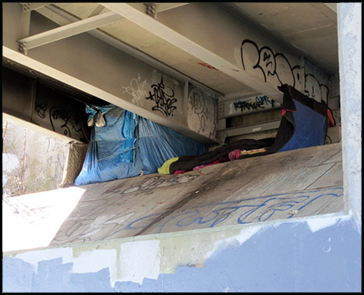
A second call to action is to not displace unsheltered neighbors from bridges and the four major camp areas without having an immediate plan for alternative shelter/housing.

Finally, advise your mayor and council members that the wording for the May ballot regarding reinstating a camping ban must consider that those with disabilities, the aged, and in fact anyone with no place to go. The no sit/no lie ordinance is absolutely inhumane and unconscionable we must have at least 15 minute respites particularly for those with disabilities and make other provisions.

Federal Minimum Wage Debate

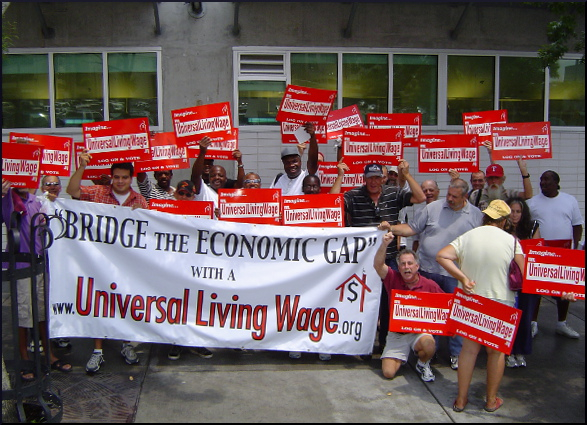
Federal resolve is insufficient; highly recommend Universal Living Wage formula indexed on the cost of housing wherever the person lives and works. 

Michael Moore, Filmmaker and Activist

The repercussions of the whole WikiLeaks affair will not end any time soon, and it seems like every day a new person or organization shows up in the headlines with some kind of WikiLeaks connection. One of these is filmmaker Michael Moore, who has put up a portion of Julian Assange’s bail and thereby has angered a lot of people. Moore recently appeared on Rachel Maddow’s political talk show, as we are reminded by Free Press staff writer B. J. Hammerstein.

Assange is charged with rape and molestation, two things of which Moore in no way approves. (The specific charges, even if true, would show Assange as more of a typical jerk than a savage beast.)

So, on the one hand, nobody approves of non-consensual sex. On the other hand, everybody is entitled to a defense, and on the third hand, there is a kind of selective-enforcement thing going on here that points to a political motivation. Ask yourself this: If Assange were not the founder of WikiLeaks, would these charges have ever been made?

Before that, Michael Moore was in the news for being on the hit list of the insurance industry’s public relations outfit, which strongly resents the things he said about it in another film. As he describes it,

When someone talks about pushing you off a cliff, it’s just human nature to be curious about them. Who are these people, you wonder, and why would they want to do such a thing? That’s what I was thinking when corporate whistleblower Wendell Potter revealed that, when ‘Sicko’ was being released in 2007, the health insurance industry’s PR firm, APCO Worldwide, discussed their Plan B: ‘Pushing Michael Moore off a cliff.’

Last year, many unemployed workers and people experiencing homelessness were invited to free screenings of Moore’s film, Capitalism, A Love Story. From the Venice Film Festival, Mike Collett-White of Reuters said,

The film follows… a group of citizens [who occupy] a home that has been repossessed and boarded up by the lending company, forcing the police who come to evict them to back down… And he interviews an employee of a firm which buys up re-possessed, or ‘distressed’ properties at a fraction of their original value and which is called Condo Vultures.

Then, I remembered, there is something about Moore in Looking Up at the Bottom Line. Richard is talking about the aftermath of the 1973 Energy Crisis in Flint, Michigan, when 28,000 people became homeless:

Michael Moore documented this time and events in the movie Roger and Me. The movie depicts the closing of entire auto factories… as businesses abandoned entire worker communities and closed their doors overnight.

In the book, the run-up to that is a great story about poverty-stricken Philadelphia, where Max Weiner decided to get consumer justice for one woman, and organized a demonstration to embarrass a retail store that was cheating people. Garland Dempsey showed up to address the crowd. A wide-ranging scam was uncovered, the victims got full refunds and, as Richard says, “It was victory of the poorest of the poor.” Plus, it led to the founding of the Consumers Education and Protective Association (CEPA) by Weiner and Dempsey. Richard says,

Max always spoke of ‘people power.’ He would always say that ‘we already had the power; we just needed to realize it and then learn how to use it.’

The CEPA strategy was one still followed today by activist groups: First, investigate. Then, negotiate and, if necessary, demonstrate. Within that simple framework, the organization used a lot of skills to get things done, which we learn about in detail. Renters, of course, are the ultimate consumers, in terms of needing a product they cannot do without. Learn how rent and the Universal Living Wage are related. Fixing the rent situation by, for instance, bringing it to the level where people can afford it, would go a long way toward alleviating the plague of homelessness.

Reactions?

Source: “Filmmaker Michael Moore defends WikiLeaks work,” Freep.com, 12/23/10
Source: “How Corporate America Is Pushing Us All Off a Cliff,” MichaelMoore.com, 11/19/10
Source: “Capitalism is evil,’ says new Michael Moore film,” Reuters.com, 09/06/09
Source: “Looking Up at the Bottom Line,” Amazon.com
Image by joguldi (Jo Guldi), used under its Creative Commons license.

Christmas, Homelessness, and Stuff

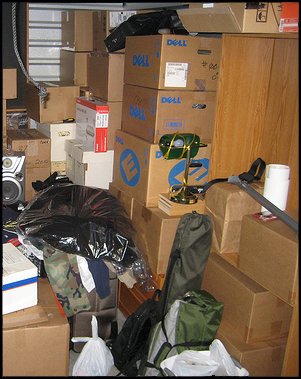
Sure, it’s a religious holiday and a secular celebration, and a time to remember Peace on Earth. However, mainly, Christmas is a time to get stuff. People become very preoccupied over what they’re going to give and what they’re going to get. Often, it’s stuff.

It’s a good time of the year to remember that some people experiencing homelessness have “too much” stuff — not in the sense of whether they need it, because they do need it just as much as housed people need their stuff. It’s too much stuff because there is nowhere to leave it, and it’s a real hassle to carry around with you everything you own. Too often, that is what homelessness is all about.

For USA Today, Marisa Kendall interviews Phillip Black, a person experiencing homelessness, whose belongings were thrown away by the police when he temporarily had to leave them unattended. A resident of Washington, D.C., Black currently keeps his stuff in two different shopping carts, one stowed behind a church and another in a parking lot. Kendall writes,

Finding a place to safely leave possessions is one of many challenges homeless people face each day, homeless advocates say. Some cities, including Portland, Ore., St. Petersburg, Fla., New York, San Francisco and Chicago are trying to help people in Black’s situation by offering free storage space to the homeless.

The District of Columbia, where Washington is located, once had a free storage program, back in the ’80s and ’90s. Kendall spoke with the deputy director of the Community Partnership for the Prevention of Homelessness, Cornell Chappelle, who said that one of the problems with free storage is that people would just leave their belongings there forever. It’s a major issue for the people who run such a facility. (It’s probably a major issue for the people whose belongings were abandoned, too, because they are likely to be in jail or dead.)

Kendall says that in New York City, a person experiencing homelessness can use any commercial storage facility, and the city will pay the bill. That sounds almost too good to be true, so there must be a mile of red tape connected with it. The program in Arlington, Virginia, sounds wonderful. In St. Petersburg, Florida, old reliable St. Vincent de Paul, which has been in the helping business for decades, operates a storage center with 260 large bins, and most of them are generally in use.

The Portland, Oregon, center, with 50 cubicles big enough to hold a shopping cart, opened very recently. The city paid $30,000, and the Portland Business Alliance kicked in another $8,000. It’s only temporary, however, because a Resource Access Center that is scheduled to open next summer will fill the storage need and provide many other services.

In Vancouver, British Columbia, a storage facility located in a church and financed for a limited time by the city, was used by over 200 people experiencing homelessness. When the startup grant expired, things looked grim. But the company won a $25,000 prize in a “great ideas” contest sponsored by Pepsi, and received funding from three local foundations and a lot of donations from the public, so it looks like it will be able to stay open for another year.

But somebody always has to make the hard decisions on when to get rid of stuff. It can’t just keep piling up forever. There must be many more dilemmas associated with operating a storage place like this, and the people who figure out how to make it work smoothly are to be congratulated and applauded.

Reactions?

Source: “More cities offer homeless free storage,” USA Today, 11/18/10
Source: “Vancouver homeless get aid from Pepsi,” Edmonton Journal, 11/13/10
Image by Phillip Stewart, used under its Creative Commons license.
A Homelessness Success Story for the Holidays

What better way to celebrate the holidays than to hear a success story? There is a good one in the San Francisco Chronicle and, no surprise, it’s about a person experiencing homelessness. The reporter is Tim Povtak, who writes for pro basketball annual magazines and has won many awards from the Associated Press Sports Editors. The story originates in Mt. Vernon, New York, a smallish city of 60,000 inhabitants, bordering on the Bronx.

Mt. Vernon is renowned for the number of excellent basketball players it has produced and supplied to college and professional teams. Their jerseys hang on the wall of the gym at the local high school. One of the athletes thus memorialized is Ray Williams, who was always remembered by his home town, even though no one had seen him for many years.

Once upon a time Williams, now 56, was a local hero and an inspiration to the young players coming up after him. From 1977 to 1987, he played for 10 seasons in the National Basketball Association (NBA). His professional career started with four seasons for the New York Knicks, including a year as team captain. Then he joined the New Jersey Nets, the Kansas City Kings, went back to the Knicks, and has also played for the Boston Celtics and the San Antonio Spurs.

Like many athletes, Williams didn’t manage money too well, either before or after retiring from the sport. He filed for bankruptcy in 1994, and consequently parted with his home and family. He received his NBA pension in a lump sum and then lost it speculating on real estate in Florida, where he than entered a span of 13 years as a member of the working poor, surviving on part-time, low-level jobs. As writer Povtak describes,

When his playing career ended, he started a gradual, downward slide, spiraling through a series of bad choices, bad investments, bad advice. Life after basketball was like quicksand. He kept sinking.

For many months, Williams lived a “dock of the bay” existence, fishing for his supper and sleeping in a found wreck of a vehicle. Then, in the summer of 2010, the Boston Globe published a story about him, written by Bob Hohler and titled “Desperate Times“.

Williams told the reporter that the NBA ought to make better arrangements for the players who apparently don’t understand that their careers won’t last forever. (I hate to be a negative voice here, but the NBA could protect retirees by refusing to hand out a pension as a lump sum. If it were paid out gradually, that would prevent the very situation that Williams found himself in. Of course, the players wouldn’t like it a bit, and neither would their lawyers.) Actually, two NBA-related groups had helped the retiree with “grants,” but he just couldn’t get a foothold on life. Hohler wrote,

Williams, 55 and diabetic, wants the titans of today’s NBA to help take care of him and other retirees who have plenty of time to watch games but no televisions to do so. He needs food, shelter, cash for car repairs, and a job, and he believes the multibillion-dollar league and its players should treat him as if he were a teammate in distress… One thing Williams especially wants them to know: Unlike many troubled ex-players, he has never fallen prey to drugs, alcohol, or gambling.

All of this came to the attention of His Honor Clinton Young, the mayor of Mt. Vernon, who set things in motion to get Ray Williams back home and living a productive life. Having returned to the land of ice and snow, Williams now holds the job title Recreation Specialist, but the expectation is that he will do so much more. Williams has already given a talk at the Boys & Girls Club, and addressed the Mt. Vernon High School boys’ basketball team. Ric Wright, the school’s football coach, calls him an icon.

Mayor Young envisions the revitalization of Mt. Vernon through its recreation and sports facilities. He is counting on the Williams’ charisma factor, presenting the former star as a kind of ambassador for the city who will relate to contractors and developers, and bring about a hoped-for alliance. Meanwhile, Williams has been reunited with his elderly mother, brother, and other family members who still live in Mt. Vernon for their first Christmas together in a long time.

Bonus Holiday Video!

Life Can Be Lonely This Holiday Season Lil Bob & the Lollipops.

Reactions?

Source: “Ray Williams Goes From Homeless to Home With a Job for Holidays,” San Francisco Chronicle, 12/17/10
Source: “Desperate Times,” Boston.com, 02/07/10
Image by LabyrinthX (Nicholas Bufford), used under its Creative Commons license.

Minimum Wage and the National Locality Wage (formerly Universal Living Wage)

Full Disclosure: Richard R. Troxell is President of House the Homeless, in whose online presence you are at this very moment. Richard is the guy in the picture, holding up Homey Too, the official thermal underwear model of the Thermal Underwear Drive in Austin, Texas, which is in progress even as we speak. In my capacity as newsblogger, I feel moved to read with interest, then capsulize and remark upon, his essay, “Reasons for raising the minimum wage,” the same as any other piece of journalism. So here goes.

The National Locality Wage (formerly Universal Living Wage) idea has three basic tenets. One of them is,

Spend no more than 30% of one’s income on housing.

See? I knew this would be interesting, and I’ll tell you why in a minute. Troxell explains that the 30% figure was established by the banks, as the cutoff beyond which a person presumably could not afford to make mortgage payments. The assumption is, a person needs 70% of his or her income for other things, such as food, transportation, medicine, etc. And if the mortgage bill is more than 30%, this person will continue to spend the 70% on those other things anyway, and the bank will get the short end of the stick.

Also, 30% is the standard guideline used by the Department of Housing and Urban Development, aka HUD. If a family is paying more than 30% of its income for housing, it needs help. So, the business community and the government agree that, theoretically, shelter should not eat up more than 30%, or approximately one-third of what a person or family has coming in.

This is the part that blows me away. When I was growing up and taking classes like Home Economics in school, we learned that the magic number was 25%. The received wisdom was that a person or family oughtn’t pay more than one-fourth of its income for housing. See, someone has sneakily raised the bar. In the old days, it was, “If you pay more than one dollar out of four, you are a bad household manager and a fiscal profligate.” Then, somehow, our expectations were re-engineered. Now, it’s, “If you pay more than one dollar out of three, you are a careless and irresponsible.”

We were once taught that one-fourth of what we had was the reasonable amount to spend for housing. We’ve been re-programmed to accept the idea that instead, now a larger proportion, one-third of what we have, is the reasonable amount to spend for housing.

And, of course, the whole thing is a crazy dream anyway. People are willing to pay half of their income just to get under a roof and avoid being homeless. They are willing to scrimp and do without other things to make their budget viable. But even if tenants are willing to get along without much else in order to be housed, landlords have their rules, too. They go by the same standards that the banks do. When you fill out a rental application, those numbers had better look good to them.

Another of the Universal Living Wage’s three prongs is the proposition that the minimum wage would vary by region, being indexed to the cost of housing locally. This would mean changing the way the federal government determines poverty guidelines. Rather than being based on food costs, it would be based on the cost of housing, which is less volatile. Troxell explains how the HUD voucher rental program currently works and how it determines Fair Market Rent.

The formula that would be used to determine the National Locality Wage (formerly Universal Living Wage) is explained in great detail on the National Locality Wage (formerly Universal Living Wage) website. (Choose “ULW formula” from the menu on the left.) Also available there is the opportunity to endorse the ULW:

In just the first three years of our five year campaign, we have the following international, national, business, celebrity, enlightened markets, regional, religious and union endorsements for the Universal Living Wage Campaign. Would your group like to stand up and be counted on the subject of a National Locality Wage (formerly Universal Living Wage)? Sign our Resolution and send it to us! We’ll add you to our roster.

We also recommend the “Facts and Myths” section of the site, which contains an exhaustive list of facts and information about why the myths are wrong. The ULW idea is based on the assumption that a person is putting in a 40-hour workweek, either at one job or perhaps a combination of two part-time jobs. The idea is simple: Anybody who works a 40-hour week ought to be able to afford basic rental housing. And if they can’t, something is wrong with the system.

Reactions?

Source: “Reasons for raising the minimum wage,” Helium.com
Source: “Endorsements,” UniversalLivingWage.org
Image by quapan, used under its Creative Commons license.

Animal Companions of People Experiencing Homelessness

How often do you see a great review of a great movie? Joanne Laurier has written extensively about film, bringing to the task more intelligence and wisdom than most of her fellow critics.

For the World Socialist Web Site, she wrote about “an honest picture of American life,” the indie film titled Wendy and Lucy. It’s about a young woman experiencing homelessness with only her dog for company, and it will break your heart.

Wendy and Lucy was directed by Kelly Reichardt, who wrote it with Jonathan Raymond. It reflects today’s reality even more than the situation in 2008, the year of its release. We don’t learn a whole lot of Wendy’s backstory. Apparently, she was staying with her sister and brother-in-law before she hit the road, heading for Alaska, to try for a fish-cannery job. But then her car dies in Oregon.

While shoplifting some food for Lucy — and you can tell it’s not something she enjoys at all — Wendy gets caught and is taken away to be fingerprinted, and so on. When she gets back, Lucy is gone.

It turns out that the car would just plain cost too much to fix. Now Wendy is no longer even a rubber tramp, just a close-to-the-bottom-rung homeless person, carrying all her stuff around. And guess what — no booze, no dope, no psychosis. This woman wants to be a productive citizen and make a living wage. She was willing to drive all the way to Alaska to do that. Wendy is just a regular person who can’t catch a break.

The film set out to portray the growing chasm between the upper and lower classes in America. Laurier repeats and discusses some of the things that were said by writer-director Kelly Reichardt in an interview with the Providence Phoenix:

Reichardt notes that the film was intended to test out the notion that all one needs to succeed in America is ‘gumption.’ She continues, ‘Is that all you need, if you don’t have the benefit of an education or a social net or a financial net or health insurance or anything? I think that that’s implied all the time, and I think that’s a farce.’

Wendy often hums, as if there is a soundtrack of celestial music always playing in her head, and sometimes it leaks out. She searches in vain for Lucy. Without shelter and terribly vulnerable, Wendy is victimized. But that’s not the worst thing. The worst thing is, her companion is still gone.

Finally, Wendy locates the dog fenced into a backyard, and recognizes that it’s a good home. Knowing she will be hopping freights or worse, Wendy does not bust Lucy out. Like so many fathers, mothers, and lovers confronting the brutal imperatives of economics have done, Wendy makes the hard decision. She leaves Lucy there, promising, “When I make some money, I’ll come back.”

Separating from a pet is a terrible decision to be faced with. A while back, we talked about Becky Blanton, who had experienced homelessness. When she inadvertently ended up living in her van, she couldn’t afford to rent an apartment that demanded security deposits for her cat and dog, and wouldn’t give them up, so she remained in the van.

The good folks who run Pets of the Homeless tell us that about 10% of the homeless have pets, which generally makes their situation more problematic:

Most people who experience homelessness are homeless for a short period of time, and need help finding housing or a rent subsidy. Unfortunately for those with pets it becomes more difficult.

The nonprofit organization, which extends across the U.S. and Canada, helps with food and vet bills. They would love to teach you how to start a pet food pantry in your town!

Reactions?

Source: “Wendy and Lucy: A picture of American life,” WSWS.org, 02/20/09
Source: “What We Do,” PetsoftheHomeless.org
Image by Beverly & Pack, used under its Creative Commons license.
Hate Crimes Against People Experiencing Homelessness

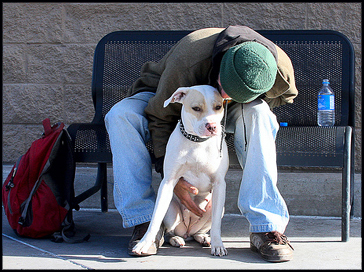
Here’s an interesting fact of modern life. If you set up a Google Alert for the words “assault + homeless,” you can amass quite a collection of incidents in a very short time. Let’s review the recent past :

November 7, 2010: In Youngstown, Ohio, John W. Goodwin interviewed a witness to the beating of a homeless man by a bunch of preteen and early teen boys, two days before. This young mother came outside to watch for her son to get off the school bus, and witnessed the apparently reasonless attack on a man who hung around the neighborhood and sometime slept in an empty house where his mother used to live.

November 24, 2010: In New Hampshire, Maddie Hanna reported on how a formerly homeless man was sentenced for his part (with two others) in assaulting a homeless teenager and throwing him in the river to die, last year. The other two attackers were also residents of an impromptu camp, and they say it was just revenge, because the teenager had stolen a pair of boots from yet another homeless man.

This is an example of the kind of news that causes some people to say, “Fine, as long as the bums stick to killing each other, the more, the merrier.” It is also an example of what society doesn’t need. Society needs people under roofs and within walls, and for them to be able to afford to stay there because they have a Universal Living Wage for being productive citizens.

December 1, 2010: From Eloy, Arizona, Lindsey Collom reported on how a 71-year-old man living in his car was attacked and severely beaten by as many as eight men.

December 7, 2010: Dana Treen and David Hunt reported on the stabbing of a 28-year-old homeless man, Jason Jerome, by a “dapper” 17-year-old boy acting out who knows what kind of sick fantasy. The kid was wearing a suit and tie, for heaven’s sake. We know this because he was videotaped by the security camera of a nearby business, which it appears the victim was savvy enough to lead his attacker within range of, before things got serious.

Jerome ended up with knife wounds in the neck, chest, stomach, hip, and hand, with a finger nearly severed. The sheriff wasn’t sure whether the stabbing was a hate crime, because it might have resulted from some kind of dispute. Treen and Hunt say,

At Shands Jacksonville where he was refusing surgery, Jerome told police he was asleep and woke to someone standing over him with a knife. He said he didn’t know the attacker who he described only as having long hair and glasses.

December 15, 2010: In Australia, like many other places, there is a public perception that people experiencing homelessness somehow “ask for” any violence that comes their way. They deserve to get beaten up or set on fire, and it’s their own fault for having such a risky lifestyle. Several institutions got together on a project to try and do something about the widespread misunderstanding of the voluntary nature of homelessness, among other things.

Dr. Catherine Robinson of Sydney’s University of Technology has completed a report titled “Rough Living: Surviving Violence and Homelessness.” The sections on “Violence during Homelessness” and “Violence in Institutional Care” have some harrowing stories. The dispatch says,

New research into trauma and homelessness uses ‘biographies of violence’ to understand how homeless people manage and survive repeated episodes of violence throughout their lives.

In-depth interviews with a dozen people experiencing homelessness revealed histories of physical and sexual abuse in childhood, parents with multiple problems including housing instability, and parents practicing domestic violence on each other. The study included six men and six women. A PDF file of the entire 70-page report is available online.

There are plenty more examples to choose from, and violence against people experiencing homelessness is no new phenomenon. In Looking Up at the Bottom Line, Richard R. Troxell talks about a man who was shot for asking for a cigarette, and a man set on fire, and taser attacks, and all kinds of senseless savagery against people who don’t have a place to live. Here is one of Richard’s narratives:

I remember clearly how I felt that morning when I heard that two of our guys had been beaten with two-by-four boards… In the middle of the night, two college-age boys driving an old Chevy raced to a stop, jumped from the car, clutching two-by-fours. They then proceeded to whale on the guys. They broke one arm of each of two men who lay sleeping. One man suffered a fractured hand and a skull fracture. The other had three broken fingers. The assailants then jumped back into the car and were gone. The event really had no beginning, only an end. It was a senseless beating. No one knew why it had occurred. We only knew that if our guys had not been sleeping on the street it probably would not have happened.

Reactions?

Source: “Witness: Kids who assaulted homeless man are ‘menace,’” Vindy.com, 11/07/10
Source: “Man pleads to homeless beating,” ConcordMonitor.com, 11/24/10
Source: “Up to 8 sought in attack on homeless man, 71, in Eloy,” AZCentral.com, 12/01/10
Source: “Stabbing of homeless man in Jacksonville could be a hate crime,” Jacksonville.com, 12/07/10
Source: “Violence Faced by Australia’s Homeless,” ProBonoAustralia.com
Source: “Looking Up at the Bottom Line,” Amazon.com
Image by Vincent Bernier, used under its Creative Commons license.
First-Person Homeless

People often ask Lars Eighner whether he became homeless in order to have something to write about. After all, he wouldn’t be the first aspiring wordsmith to have launched himself into the world in search of material. But no. The author of Travels with Lizbeth says,

I cannot imagine deliberately exchanging a gentleman’s attire for rags, sleeping on a bench when I had a good bed of my own, or doing any of the other things the other authors are said to have done merely to get a book. Whenever I had the opportunity of improving my situation, I took it, and if I had found the chance to get off the streets, my book would not now exist.

The thing about writers is, they are unable to not write, and they will continue to write any time, anywhere. So, naturally, Eighner wrote letters to a friend, knowing he would hold onto them. This stratagem is commonly employed by impoverished artists in shaky circumstances. The friend, historical novelist Steven Saylor, thought there was a book in it.

Eighner recounts the long, excruciatingly difficult process of squeezing out a publishable manuscript on a $10 manual typewriter, in a building without heat, water, or electricity. He sometimes had trouble endorsing the project himself, because being homeless was simply his everyday life. If he could have done so, he would have swapped it for a different one, preferably with a better class of accommodations.

Picaresque memoirs inhabit a long and honorable tradition. Sometimes, a wanderer sets out to roam the world and endure hardships for a greater purpose. Sometimes, a person who was perfectly all right where he or she was is plucked up by the hand of fate and set down on a road. Either way, might as well get some good copy out of it.

We live in a time when the minimum wage won’t house an individual, let alone a family. No longer can a living wage be lived on. An awful lot of people are in dire straits, and the more their individual voices can be heard the better it is for everybody.

The book we often mention, Richard R. Troxell’s Looking Up at the Bottom Line, is not just a history of his own activities in the cause of social justice, and it’s not merely a history of social phenomena in Austin, Texas. (Where, incidentally, Eighner also lives.) Nor is it only an activist how-to manual. It is also the repository of the individual stories of many, many of the people experiencing homelessness.

We have mentioned the Ace Backwords’ classic Surviving on the Streets in relation to the Thermal Underwear Drive that is currently underway in Austin. (Yes, there is a connection.) Backwords has played the role of a recording angel on behalf of many stories other than his own. His profiles of the street people of Berkeley, California, are valuable documents in the story of our millennia-straddling era.

The very vocal, eloquent and noticeable personality of Eric Sheptock is penetrating the nation’s consciousness as he keeps his promise to “enlighten, empower, engage, enrage, entertain, and explain.” Here’s a man who is unlikely to shop online, is probably not many women’s idea of a dream date, and can’t help anybody find job. Yet, nearly 5,000 people have signed up to be his Facebook friends. Why do you suppose that is? Could it be because he has something to say? The “homeless homeless advocate” in our nation’s capital could become a man to reckon with. In fact, he is already, as Nathan Rott demonstrates in his Washington Post profile of Sheptock.

Alexandra Jarrin is making news at this very moment by encouraging people across the country to write letters about what it’s like to run out of unemployment benefits and stare the specter of homelessness in the face, if they’re not already experiencing homelessness. She prints out their individual stories and delivers them to the office of Senator Bernie Sanders of Vermont, who is one of the good guys.

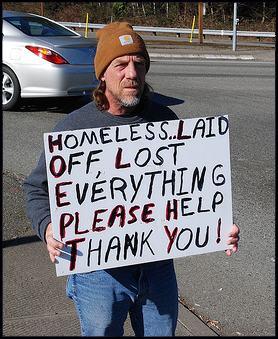
Photo Note: Photographer Aaron M says,

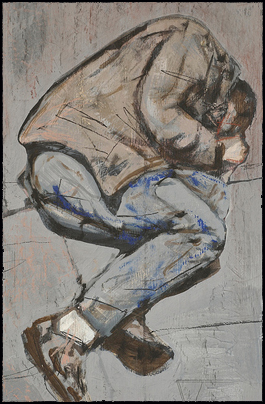
This guy used to be an industrial painter (bridges, that sort of thing). He lost his job 18 months ago, and hasn’t found anything since. Once he went through his unemployment benefits and then his savings, his home was foreclosed and his vehicle repossessed. So now he panhandles in suburban Seattle.

Reactions?

Source: “About Travels with Lizbeth,” LarsEighner.com
Source: “DC’s ‘homeless homeless’ advocate,” The Washington Post, 12/13/10
Source: “Alexandra Jarrin, Homeless Unemployed Woman, Writes To Bernie Sanders for Help,” The Huffington Post, 12/12/10
Image by Seven_Null7 (Aaron M), used under its Creative Commons license.
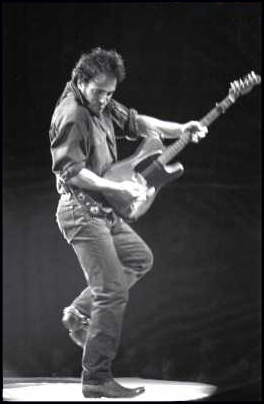
Outsider Hero Bruce Springsteen Champions the Homeless

The names of certain celebrities are inevitably linked with the causes they embrace, and one of the most prominent examples of that is Bruce Springsteen. He has always been a compassionate friend of the underdog, the disenfranchised, the dispossessed, and anyone who sees the possibility of making a living wage as a mirage in the desert. He has especially supported people experiencing homelessness.

There was his work in Philadelphia, back in 1985, with the Committee for Fairness and Dignity for the Homeless; the 1987 All-Star Benefit for Homeless Children at Madison Square Garden in New York; the 2005 concert in Los Angeles to benefit PATH (People Assisting The Homeless) — well, you get the picture. He has made generous donations to food banks, and helped homeless groups not only in the United States but other countries as well.

There are the songs, like “Brothers Under the Bridge” and “The Ghost of Tom Joad,” and many others with similar themes. Springsteen’s 2007 album Give US Your Poor carried on with the tradition of raising awareness about homelessness, and included the work of homeless musicians.

Biographer Dave Marsh, speaking of one particular period of intense work on homeless issues, wrote,

Springsteen processed the information he received as an artist, not a politician. In all his meetings, he felt that he received at least as much from the community group as he gave to them.

Many people share the feeling expressed by Richard R. Troxell, who says,

The travails of homelessness are easier experienced through the songs of Bruce Springsteen… To so many working stiffs, and especially to those of us who have hit rock bottom, he is simply, ‘The Boss.’ His words always seem to hurt us and at the same time free us.

We all have at least one “I almost met” story, and Richard has one about almost meeting Springsteen. It was a wild time in Austin, early 1996, when the city’s ordinance against “camping” went into effect, and there was citizen unrest. Richard and other advocates for the homeless and the working poor were making speeches and organizing the Coalition to Repeal the Ban. At a homeless campsite, writer Molly Ivins and musician Steve Fromholz caroused all night in defiance of the ban. From a local monastery, Brother Michael hit the street to declare,

This ordinance would have put Jesus in jail.

Here is Richard’s account, from Looking Up at the Bottom Line:

Bruce Springsteen was in town that night. He was performing at the Austin Music Hall… He had sent word that he wanted to meet me. When I heard this, I felt a validation for our efforts even beyond our own belief of our right actions. But all night I struggled with small rolling skirmishes between the guys and the police. Heckling words of antagonism were used like swords all night, and they needed to be calmed. I spent the night stamping out flaming ducks. I never made it to meet The Boss, but the fact that he had dedicated the T-shirt and concession sales to House the Homeless satisfied me that night.

More than once I have thought of that as a missed opportunity, and more than once I’ve wished that I had a chance to meet him and share with him our plans, even today, to turn this thing around.

A person who doesn’t live inside must live outside. If living outdoors is defined as “camping,” and camping is against the law, then living itself is illegal for these people. Imagine being officially declared as having no right to live. It’s no wonder that the ignorant yahoos feel entitled to assault and kill people experiencing homelessness. It’s like the authorities have declared open season on them.

And now Austin is gearing up for another confrontation between the homeless and the housed. Its Sit/Lie ordinance is seriously flawed, and, in fairness to human dignity, probably should not exist at all. Many medical conditions that people might be suffering from are not taken into account. House the Homeless did a survey to illustrate the problem. A staggering 94 % of the respondents said that when they needed to sit down, they were unable to find a bench, and some of these folks have long-standing, debilitating physical illnesses or disabilities.

The law is so loosely written that people waiting for buses could technically be ticketed for violations. By strange coincidence, the ordinance particularly applies in the part of town where a number of agencies and services that help the people experiencing homelessness are located, and the whole thing is a big mess. So, watch for further developments on that front.

Reactions?

Source: “Bruce Springsteen: two hearts : the definitive biography, 1972-2003,” Google Books
Source: “Looking Up at the Bottom Line,” Amazon.com
Image by Tim Van Schmidt, used with permission.

People Experiencing Homelessness Go Underground

We just have to share this amazing photoessay, the pictures taken by Getty Images staff photographer Paula Bronstein (and erroneously credited here to Paul Bronstein.) In Ulan Bator, the capital of Mongolia, the winters are long and very, very cold, and many homeless people survive by living underground in tunnels that are not actually sewers, as the headline states, but channels for heating pipes.

Really, this is fascinating. Someone has taken the trouble to translate (from another website) nearly 100 comments from “Chinese netizens” as well as, apparently, European expats in China, and people from other countries too. Some cruelly anti-Mongolian sentiments are expressed. The country used to belong to China, then became a satellite of the USSR, but now Russia is kaput, so things don’t go well in Mongolia. But many points of view are represented. One person says,

Beijing isn’t lacking either — If you have the chance, go to the Beijing Film Academy campus gates and look under the manhole covers…

Another says,

There is in fact a tradition of cave dwellings in northern provinces such as Henan and Shaanxi. The soft loessial soils allow cave dwellings to be excavated, providing homes that are spared the worst of baking summers and freezing winters. Getting enough natural light into the cave dwellings however is one problem that is shared with living in a sewer. There is simply never enough sunlight or daylight.

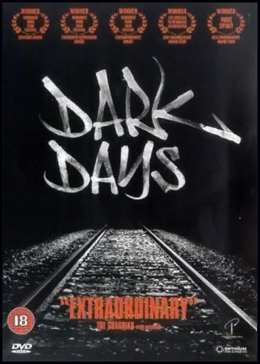
In case you’re thinking, “This could only happen in Mongolia,” think again. Or rent Dark Days, a documentary directed, produced, and filmed by Marc Singer, and released in 2000. It’s all about homeless people living in an Amtrak tunnel under New York City, amid construction debris and terrible noise from the trains, with plenty of rats for company. They build shelters from scrap wood, cardboard, tarpaulins, and whatever else they can get hold of.

Many of the residents have managed to pull electricity into their subterranean shacks. Sometimes they go “up top” to find food and things to sell. Many have pets, for protection or companionship. The sanitary arrangements vary. One resident says that if you’re homeless, this is the best place in the city to be.

But it’s not safe down there. One guy demonstrates for the camera how he sets up a noise trap, so if anybody approaches his place while he’s sleeping, a bunch of frying pans will fall down and wake him. Another claims that 80% of the tunnel dwellers are crackheads. A woman named Dee tells how someone tried to burn her hut with her in it. Still, most of the tunnel dwellers look out for each other and engage in cooperative efforts, and some of them have been down there for 20 years. It is a weird but not totally dysfunctional family.

Then, along come the armed Amtrak police, telling everybody they have 30 days to get out. Not one person wants to go to a shelter, where everything you have including your clothes will be stolen. With the aid of the Coalition for the Homeless, they negotiate the Section 8 bureaucracy. With the promise of housing, they demolish the cozy shelters that were built with so much care. The film ends by showing the various formerly underground people in their new apartments, with real beds, and windows with trees outside.

Now, check out “Lost Vegas” by Pete Samson, who explored the unknown world underneath America’s capital of gambling and glitz. He says hundreds of homeless people live in parts of the 350-mile flood tunnels beneath Las Vegas:

Rather than working in the bars or kitchens they ‘credit hustle’, prowling the casinos searching the fruit machines for money or credits left by drunken gamblers.

But the competition is stiff. Sometimes there is day labor, and there are always dumpsters to recover food and useful items from. Sampson interviews several residents, including a woman named Amy, who says,

The main dangers are the floods and the Black Widow spiders. But it’s not a terrible place to be if you’re homeless… It’s much cooler than on the streets, we get a breeze coming through and the cops don’t really bother you. It’s quiet and everyone helps each other out down here.

Clearly, something is amiss, not only in the United States but throughout the world. Despite all the promises humankind has made to itself about a brighter future, conditions are getting worse and worse for more and more people. What can alleviate the situation? The Universal Living Wage might be a good place to start.

Reactions?

Source: “Mongolia’s Homeless Living Underground In Sewers,” ChinaSmack.com, 11/06/10
Source: “Dark Days (2000),” IMDb.com
Source: “Lost Vegas,” TheSun.co.uk, 09/24/09
Image of Dark Days, used under Fair Use: Reporting.
0