Our Mission

Founded in 1989, HtH is the oldest all volunteer, action, homeless organization in the state of Texas. The mission is Education and Advocacy around the issues of ending and preventing homelessness.

Urgent Issues

Re-Criminalizing Homelessness — Speak up now!

HtH supports the direction being taken by the City of Austin’s relatively new Homeless Strategy Office, led by a very committed and responsive David Gray, and with the commitment of Charles Loosen and other staff. We further strongly advocate ALL positions below that preceded The vote to basically criminalize homelessness — especially:

reinstating a camping ban must consider that those with disabilities, the aged, and in fact anyone with no place to go. The no sit/no lie ordinance is absolutely inhumane and unconscionable we must have at least 15 minute respites particularly for those with disabilities and make other provisions.

Mayor Kirk Watson, elected in 2023, is working to secure funding for homeless services from the State and within the City Budget.

2025 interests:

City Council approved a resolution making homelessness a top financial priority.

Increase the capacity of the Homeless Strategy Office to address and implement a comprehensive approach to strategic advancements in homelessness response. (Plan detailed in a 50-page memo from David Gray, June 2025).

Examples:

1. Expand HOST (Homeless Outreach Street Team) support including team members:

APD officers, EMS paramedics, behavioral health clinicians, social workers, peer support staff.

2. Support for Marshaling Yard operations.

3. Rapid Response housing and safe housing, especially for families.

4. Increase shelter beds with support; and more.


The Austin city council recently voted to put on its May 2021 ballot a vote to reinstate the no camping ban including the no sit/no lie ordinances. Now is the time to contact your mayor and council members particularly those who have supported decriminalizing homelessness, such as Mayor Adler, Kathy Tovo, Ann Kitchen, Greg Casar, Sabino Renteria, and others, we pray.

First call to action is cold weather shelter. Anyone that reads this, our urgent plea is to email our mayor and city council in this urgent time of cold weather. House the Homeless is encouraging to use the Convention Center or other alternatives sites that are already over burdened due to Covid-19 or at capacity.

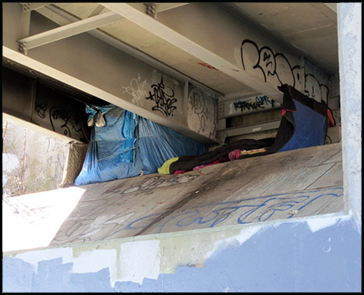
A second call to action is to not displace unsheltered neighbors from bridges and the four major camp areas without having an immediate plan for alternative shelter/housing.

Finally, advise your mayor and council members that the wording for the May ballot regarding reinstating a camping ban must consider that those with disabilities, the aged, and in fact anyone with no place to go. The no sit/no lie ordinance is absolutely inhumane and unconscionable we must have at least 15 minute respites particularly for those with disabilities and make other provisions.

Federal Minimum Wage Debate

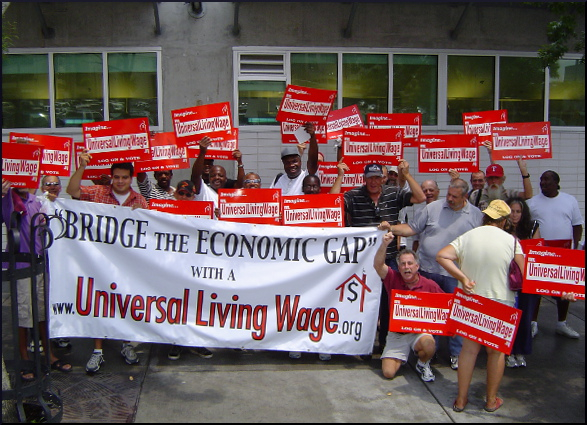
Federal resolve is insufficient; highly recommend Universal Living Wage formula indexed on the cost of housing wherever the person lives and works. 

Myths of Homelessness

German Lopez of Vox.com has published a very enlightening essay called “11 myths about homelessness in America.”

Perhaps the saddest is Myth #2 — “Getting a job will keep someone out of homelessness.” If only! Instead, as House the Homeless has emphasized many times, even full-time work is no guarantee of living inside walls. That condition of being employed, yet unable to afford housing, is called “economic homelessness,” and it is ugly. Not only ugly, but absurd. In what universe would these words make any sense?

The National Low Income Housing Coalition found a full-time minimum wage worker would have to work between 69 and 174 hours a week, depending on the state, to pay for an “affordable” two-bedroom rental unit … A full-time minimum wage worker couldn’t afford a one- or two-bedroom apartment at Fair Market Rent, a standard set by the federal government, in any state.


Source: “11 myths about homelessness in America,” Vox.com. 01/15/15
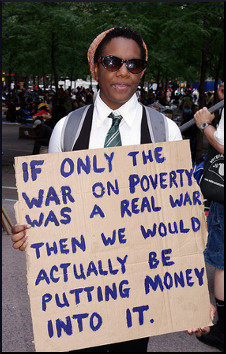
Image by David Shankbone
Day 9 Occupy Wall Street September 25 2011

The Return of First Person Homeless

In English class we learned such grammatical expressions as “first person singular” (I) and “first person plural” (we). This is the latest in a collection of posts called “First Person Homeless,” which covers autobiographical accounts by people who have experienced homelessness.

When veteran Glenn Higham of Longmont, Colorado, wrote a letter to the editor, he took the opportunity to thank convenience store workers for giving him hot water in the mornings, and employees of the public library for allowing him to use the computers to find job information and send and receive email. He reminded readers how difficult it is to carry everything you own along with you at all times, and admonished an anonymous housed person for making assumptions about how he lost his two front teeth. He also wrote:

I am a man trying to survive and find a job. I’ve been told many reasons why I do not qualify for housing and financial assistance: too young or old, not physical/mentally disabled, single, no kids, not an immigrant, and wasn’t in a wartime period.

Unfortunately, this situation is shared by many military veterans, even when the systems put in place to help them are in top-notch working order and not corrupted by uncaring and neglect.

Charley James wrote for the Daily Kos that in a year’s time, he had replied to over 300 employment ads and had sent out 200 resumes. The result? Five responses – a total of five phone calls – none of them leading to a job interview. He described the inability to afford prescription medication, the shame of dumpster-diving,  and the disgrace of cheating the transit system of bus fare. He wrote,

During the eight months I have been homeless, I lined up for food only to learn that the charity had run out by the time I got inside. I stood patiently for hours when winter jackets and boots were being distributed to be told nothing in my size remained. I had my underwear stolen, my dignity assailed, my spirit beaten down. I experienced the agony of learning that people I thought were friends would turn their backs on me when I wasn’t any use to them anymore.

Less than two months ago, after the city of Chicago had spent nearly $50,000 building concrete barriers  beneath a highway underpass to expunge people who had been sleeping there, local journalists discovered that the construction had created a truly dangerous situation and would need to be redone at additional cost. A woman who had called this place home published a letter to the neighborhood residents, reminding them of the difficulty of finding work when you have no way to keep your clothes or yourself clean, can’t afford transportation, and never get a proper night’s sleep. Teri Sanchez wrote:

Notice that when you do pass through that we try very hard to keep it as clean as we can; we usually don’t speak unless spoken to, and we never ask for anything… If anyone would just reach out and ask they would know that we are harmless and we are just as afraid as you are – remember we are there all night. We are alone, we are treated as if we are not human… I would like to tell anyone who is interested that we do not want to be there any more than you want us there.

For the Huffington Post, a woman named Vennie Hill reflected on the actions that seemingly led to her being homeless. The interesting part is, an awful lot of housed people have quit school too early, taken a drink, tried a drug they should have stayed away from, lost their virginity too young. Yet somehow, life and the Universe forgave them, and they were not cast out into the streets to struggle for survival, year after year.

Hill had too much humility to say this, but none of the things she mentioned were any worse than the things done by millions of people who, nevertheless, are lucky enough to live beneath roofs. She wrote:

I’ve made a lot of wrong choices in my life, but realizing that has helped me make better ones. So, if you happen to see me walking and talking to myself, remember that I’m not crazy; I’m just talking to God.

Reactions?

Source: “The homeless are many, diverse,” TimesCall.com, 02/08/12
Source: “Suddenly Homeless 37: Daring To Hope,” DailyKos.com, 11/15/12
Source: “Kedzie Underpass Homeless Woman Pens Online Letter to Avondale,” DNAinfo.com, 12/01/14
Source: “Why Am I Homeless?,” HuffingtonPost.com, 11/23/11
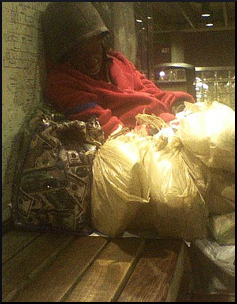
Image by gaspart64 (Gaspar Torres)

Ending and Preventing Economic Homelessness

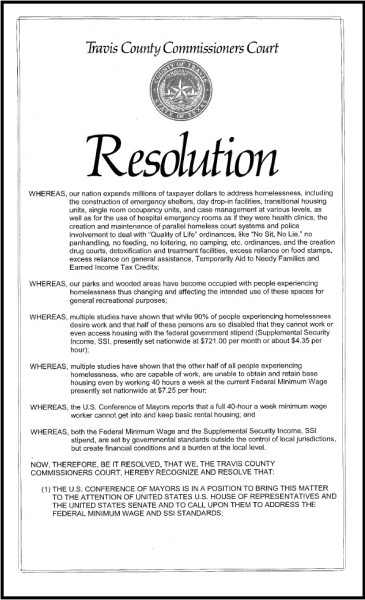
In December 2014, the Travis County Commissioners Court in Texas joined a growing number of Mayors who have endorsed similar Resolutions calling for the U.S. Congress to adopt the House the Homeless, Inc., three-pronged SOLUTION that will End and Prevent Economic Homelessness.

There are two Federal Standards causing Homelessness in the nation. According to the last several reports from the U.S. Conferences of Mayors, a full-time, minimum wage worker cannot get into and keep a one-bedroom apartment. This makes up fully 1/2 of the 3.5 million people who will again experience homelessness in the nation this year. The other half, who are so disabled that they cannot work, are eligible to receive federal disability benefits called Supplemental Security Income, or SSI. While the Federal Minimum is currently set at $7.25 per hour, and shown to leave full-time workers on our streets, the SSI stipend for those who cannot work equates to about $4.22 per hour, or a little more than half that failed amount.

The Resolution calls upon the U.S. Congress to:

1) Fix the Federal Minimum Wage so that a person working a 40 hour week will be able to afford basic food, clothing, and shelter (including utilities and transportation) wherever that work is done throughout the U.S.

2) Index the SSI stipend to the local cost of housing so that a person deemed disabled by the federal government can afford a roof over their head other than a bridge.

3) Embrace the Ethical Tenet: “Discharge No One Into Homelessness.” Our nation’s Institutions: hospitals, prisons, mental health facilities, jails, foster care facilities, U.S. military, etc., must devise plans to ensure that when people are discharged from their facilities (on time), they attain stable housing situations and are not discharged to our streets. (Sign the petition here.)

Note that there are already existing structures available to enact this proposal, as each institution is already equipped with a team of social workers.

This three-pronged Blue Print will end economic homelessness for over 1 million minimum wage workers and prevent it for all 20 million other minimum wage workers. Finally, the plan will prevent homelessness for anyone leaving one of our Institutions.

Presently, the financial cost of dealing with homelessness falls 100% to the shoulders of tax payers. This plan will reduce that burden on our Municipalities that currently sustain and deal with homelessness through the creation and maintenance of shelters, transitional housing units, the use and cost of our hospital emergency rooms as if they were health clinics, parallel court systems, and police diversion for the enforcement of “Quality of Life” ordinances. Other tax savings can come from the reduction of excessive reliance on food stamp supports and excess reliance on General Assistance, TANF and EITC as all will be reduced by 50% or, in the case of The Earned Income Tax Credit, done away with entirely. This could all be done if employers (who benefit from the labor of workers) were to pay a wage that at least pays these workers enough so they can afford a simple efficiency apartment (which is even less than even a one-bedroom apartment).

Additionally, it has been clearly shown (www.UniversalLivingWage.org) that by paying living wages business will benefit by stabilizing the workforce and by simultaneously stimulating both local and national economies through increased consumer activity.

Finally, by paying fair, living wages, we will spur on the housing construction industry both locally and nationally as we respond to the housing needs of people who will finally have enough income to rent efficiency apartments just as Henry Ford’s workers became able to afford to buy the cars they were making.

Let’s take Action to make America the strong, industrious country that we know it can be. Let’s put the “O” back into Opportunity.

Richard R. Troxell

President/CEO/Founder House the Homeless and the Universal Living Wage Campaign

When Vets Hunt for Vets

Many Veterans, Especially the Homeless, Simply Avoid VA System” is the title of a story from KFBK NewsRadio in Northern California’s Placer County. The system is overloaded, says radiation oncologist Dr. Darryl Hunter, a member of the U.S. Air Force Reserve. He founded and runs a nonprofit organization, the Sacramento Community Veterans Alliance, whose mission is to connect homeless vets with health care services, a process that starts with free checkups.

Dr. Hunter has said in the past that some Vietnam veterans were made to feel ashamed of the war in which they participated. Also, a large number of vets from all eras are simply unaware of the services available to them. Whatever the reasons, former military personnel are “disappearing in the shadows.”

Throughout the country, veterans seeking help for medical and/or psychological damage have faced so much obstruction and indifference that they have simply stopped trying. Many now prefer to steer clear of bureaucracies, and some purposely hide. Remember, these people were trained to endure hardship, to improvise, to live off the land, to conceal themselves. A lone veteran who does not want to be bothered can vanish much more successfully than, for instance, a civilian single parent with 3 or 4 kids.

Missing, Not in Action

Two years ago, Joe Leal told NBC News that in Southern California he has personally encountered thousands of homeless veterans – not just hard-core old-timers left over from the Vietnam era, but military personnel who served and were discharged post-9/11. His team of vets and active duty soldiers searches the canyons and underpasses, finding burn-out cases, both male and female, who are shockingly young.

Leal, an Iraq veteran, founded the privately-funded Vet Hunters Project, which since 2010 has placed more than 2,500 veterans in either temporary accommodations or permanent homes. The preparation offered by the government for transition from military life back to civilian is totally inadequate. There are even reservists, technically still on active duty, who are homeless. Leal is quoted:

A lot of the active-duty people are getting out even though they don’t have a plan. They’re so fed up after five to six deployments. They say, ‘I don’t care what I do when I get out, I’ll just figure it out when I get out, but I know I don’t want to do this any more.’ That’s what I’m running into.

House the Homeless previously called attention to the efforts of George Taylor, who searches the byways of Florida with the object of rescuing veterans.

Shad Meshad founded the National Veterans Foundation and is himself a retired medical officer. Under his guidance, teams comb the Los Angeles area twice a week, looking for the lost. Journalist Siri Srinivas writes:

Meshad says that the VA’s estimate of homeless veterans may be a mere fraction of the actual numbers – he speculates that veteran homelessness may be five times the problem that the VA acknowledges.

Housed people who do volunteer work or interact informally with the chronically homeless may form a vague suspicion that all the vets on the streets are not officially accounted for. But when professional experts believe that the veterans experiencing homelessness are chronically undercounted, the whole situation begins to look even more serious. Currently, the number in just one city, Los Angeles, is estimated to be around 6,000. How many is that? If you lived in L.A. and had time each day to meet with one homeless vet, and listen to his or her story, that number would supply you with 16+ years of daily coffee dates.

Reactions?

Source: “Many Veterans, Especially the Homeless, Simply Avoid VA System, KFBK.com, undated
Source: “Fewer homeless vets this year, but advocacy group sees ‘alarming’ rise in younger ex-service members.” NBCNews.com, 12/10/12
Source: “’They don’t care’: how a homeless army veteran was forgotten by the VA,” TheGuardian.com, 11/11/14
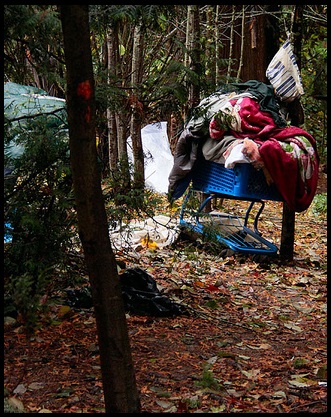
Image by waferboard

2015 Homeless/Police Survey Results Are In! Results and Cover Letter:

February 4, 2015

City Manager

Marc Ott

PO Box 1088

Austin, TX 78768


Police Chief

Art Acevedo

715 East 8th Street

Austin, TX 78701


Public Safety Commissioner

Kim Rossmo -Chair

C/O Jennifer Heatly, Administrative Assistant

Office of the Fire Chief

Austin Fire Department

4201 Ed Bluestein

Austin, TX 78721


Human Rights Commissioner

Sara Clark-Chair

bc-Sara.Clark@austintexas.gov

C/O Jonathan.Babiak@austintexas.gov


Dear City Manager Ott, Chief Acevedo, Commissioner Rossmo and Commissioner Clark:


House the Homeless Inc. is the oldest, all volunteer, action, homeless advocacy organization in the state of Texas.  It was founded in Austin in 1989 with a board of directors that is comprised of no less than 60% of homeless and formerly people.


Since our inception, House the Homeless, Inc. has conducted surveys that shed light on issues that affect the lives of people experiencing homelessness.  These have included work, employment, wages, disability, health, etc.  This survey is focused on daily interactions with Austin police officers.


The questions arose from my daily interactions with people experiencing homelessness through my role as Director of Legal Aid for the Homeless and President/Founder of House the Homeless since 1989.


I am a US Marine, Viet Nam Veteran. I am a former volunteer fire fighter. I am a graduate of the Austin Citizen’s Police Academy. I am author of the police program; Blue Grey Task Force and creator of our nation’s Mobile Mini Police Stations. Please see my enclosed autobiography for greater detail.  I mention these things to give clarity and inform the readers that I and the members of House the Homeless, Inc. have the utmost respect for the Austin Police Department and its men and women who protect our citizens.


While an undergraduate of Saint Edward’s University, I studied Statistical Survey Taking under Dr. Robert Ambrosino at the University of Texas. Our surveys are not intended to disparage anyone.  The goal is to shed light on the social conditions that affect the lives of people experiencing homelessness.


Respectfully submitted,


Richard R. Troxell

President


CC: Mayor Bill Adler

Mayor Pro Tem Kathie Tovo

All City of Austin Council Members

All Public Safety Commissioners

All Human Rights Commissioners

National Coalition for the Homeless

Protect and Serve (Survey Results)

On January 1st 2015 conducted  at the 14th Annual House the Homeless Thermal Underwear Distribution Party.  This survey was offered to all people experiencing homelessness in attendance.

Total 277 people responded to the Survey.

1) Male:   228     Female: 46   Transgender: 3  

 2)  Age:  45.6

3)  How long have you been homeless all together?   9.49 years  

3b) How long have you been homeless in Austin, Texas?  6.24  years

4)  Have you ever been told to move along by police without giving you an opportunity to comment?          

 Yes: 170    No:  88

People were denied an opportunity to comment before being moved along at a rate of about 2:1.

5)  Has a Police Officer ever given you a ticket for sitting or lying down even though you told them you were disabled or too sick to move?  

Yes:120   No 140 Note.  This in violation of the City of Austin, TX, law for which Police Procedures have been written.  Every police officer in the downtown area has been trained in the enforcement of the No Sit/No Lie ordinance and it’s language that brings Austin’s ordinance in compliance with the American’s With Disabilities Act, law.

6)  As a Disabled person, did you always get a 30 minute warning period, before being ticketed for sitting or lying down? 

Yes: 29  No: 156  N/A:  97.

This is in violation of the City of Austin, No Sit/No Lie ordinance and the Americans with Disabilities Act, Law. See #5 above.

7)  Have you ever had your ID taken by police and not returned? 

 Yes: 92   No: 183     Approximately 1/3rd of all people surveyed had their identification permanently taken from them by the police.  Note. Replacing photo ID costs time and money. These people are homeless and without money.

8) Have you ever had your things taken by police without giving you a receipt and the name of a contact person to get your things back? 

Yes: 125  No: 152  A little less than half the folks answering the question reported improper impounding practices conducted by  officers of the Austin Police department.

9)  Did you ever get a ticket, go to court, then be told your ticket is not in the system yet and you would have to return?

 Yes: 123  No: 118  N/A: 36  Half the people receiving tickets found the Community Court system which is supposedly designed to “aid” people; actually hinders their ability to change their condition of being homeless.

10)   Do you feel that the police are there to help you or control  you?  

Help: 47    Control: 190   Both: 38  (write in)   By 4 to 1, people felt that the police were not helping them, but rather controlling them.  At the same time, 38 people voluntarily wrote in that the police were both helping and controlling.

Unsolicited Comments:

General Comment: “Ticketing the homeless for sitting @ the homeless drop in center should be a crime.”

General comment:  “Dear Police: Keep clearing the streets of drug users and drug dealers.”

7) Have you ever had your ID taken by police and not returned?  Comment: “ 3 Times!”

8) Have you ever had your things taken by police without giving you a receipt and the name of a contact person to get your things back?  Comment: “ 5 times.”

Additional person’s Comment: “ $12,000.00 tools and truck.”

Additional person’s Comment: “Lots of times.”

10) Do you feel that the police are there to help  or control you?   Comment:   “They abuse power.”

Additional person’s Comment: “They are on a power trip!”

Additional person’s Comment: “They are looking for any excuse to shake people down for drugs or whatever and in the process are violating people’s rights.”

10) Do you feel that the police are there to help you or control you?

Comment:  “Control…if you are black.”

Additional person’s Comment:  “Black people.”

An Open Letter to President Obama and the U.S. Congress

Not since 1938 following the Great Depression and the creation of the Federal Minimum Wage, FMW, has our nation had as great an opportunity to create income equality and simultaneously stabilize our small businesses.

What people do not understand is that as opposed to when I was a young lad, we now have people who work a full 40 hour a week job but, in spite of that, are becoming homeless.  Incredible!  The basic opportunity to chase the American Dream has vaporized.  Because the FMW was never linked to any economic standard, the cost of the most expensive item in the budget of every single American, housing, has now moved beyond the reach of every hard working minimum wage worker.  A full time minimum wage worker simply cannot afford a one room, efficiency/studio, apartment.

We are a nation of a thousand plus economies.  Everyone knows that the cost to live in Biloxi, MS, is not the same as it is to live in Santa Cruz, CA, or Washington, D.C., or New York City.  One size does not fit all whether it is $7.25 per hour or $9.00 per hour.  The federal minimum wage must relate to the minimum cost of housing where a person lives!  In this fashion, if a person works 40 hours of work, then that full-time, minimum wage worker will not become homeless due to economics.  This will end homelessness for over 1,000,000 minimum wage workers.  Think of the tax savings. Small businesses that rely on these workers may finally be able to address their start up failure rate of 64% after 4 years and 90% after 5 years by no longer having to rely on destabilized workers. Carpe Diem!

More Heroes

Last time, House the Homeless paid respect to several people who made life better for people experiencing homelessness, and who passed away recently. Fortunately, many such heroes are still alive and at work among us.

In mid-2012, Ray Castellani served his one millionth sandwich to residents of Skid Row in Los Angeles, under the auspices of the nonprofit group he founded in 1987. For many years, Castellani was tethered to this life mission by empathy cultivated by three aspects of his own earlier years: as a military veteran, a recovering alcoholic and an occasional Skid Row homeless person himself. When the former Marine started to make a good living from painting houses and from the occasional acting job, he was prompted by spiritual convictions to give back.

During the years when the Frontline Foundation operated at its peak, it made and served more than 6,000 meals every month. In 1990, when the group’s truck was stolen, that well-publicized crime brought an outpouring of generosity from the community. In 1995, Castellani was summoned to Washington to receive the President’s Service Award, which is the most significant prize a volunteer can get.

Ups and downs

With the economic recession, donors cut down their giving significantly, and the foundation had to close its Van Nuys facility. But the day was saved by a generous donation from a storage company, so despite financial setbacks (and two heart attacks), Castellani continued to deliver as much food as he could, as often as he could, to the inhabitants of L.A.’s scruffiest district.

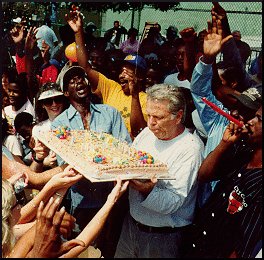
As recently as March of 2013, he was still active at age 80, and friends organized a celebrity golf tournament to raise money for Frontline Foundation. The photo depicts one of the birthdays he celebrated, with a little help from his friends, on Skid Row. Daily News writer Susan Abram describes another occasion when the longtime activist was interviewed:

On a recent day at his home, Castellani said he was awaiting a volunteer to bring him some ingredients for the sandwiches, likely hundreds of them, he’ll serve on Skid Row today. He’ll have tuna fish, peanut butter, and egg salad sandwiches, along with some chips and candies. He likes to give the homeless a choice, he said, because they have so few.

In Dallas, David “the SoupMan” Timothy has been serving the homeless for ten years. An interview with KERA News reporters Courtney Collins and Rick Holter revealed that Timothy’s own childhood was blighted by food insecurity. He pointed out that hunger is hard enough to deal with, but the really painful part is when a person doesn’t know when or if there will ever be anything to eat again.

Normally the SoupMobile sets up near a city park, but on Christmas Eve, Timothy hosts a gala at a downtown hotel. For this special occasion, as many as 2,500 volunteers help out with an event that creates a special holiday for 500 people experiencing homelessness. There is a huge banquet, with gifts of new clothes and other necessities, and the guests stay overnight so that “when they wake up on Christmas morning, it’s in a warm, safe bed.” Of course this haven is only temporary, but the following week Timothy and the SoupMobile are back on the streets again along with the disenfranchised poor. He told the news team:

Every day when we feed the homeless, not just feeding their stomachs, but we feel like in a very powerful way that we’re feeding their souls with some hope and some caring and some love and compassion. And we just think that makes a real long-lasting difference.

Tomy Bewick, a man with a reputation as one of Toronto’s best slam poets, demonstrates that Canadians also have compassion. Several years ago he established an annual grassroots initiative called Straight to the Streets, which collects winter clothing for distribution to people experiencing homelessness. Workers also buy or put together “survival kits” containing socks, gloves, scarves, hygiene products, water bottles and other useful items. Writer KJ Mullins makes an interesting point about the event:

Giving to others may seem like the main focus of Straight to the Streets but it’s not. It’s taking the time to interact with another person. For many of the volunteers it was the first time that they had a true respectful conversation with someone living on the streets. Those conversations help to change lives. The lives changed are those of the volunteers who finish the day wanting to do more.

Straight to the Streets shows that one man’s decision to make a difference does just that… Once a person can see that they, a single person, can make a difference in the world they want to continue helping others. It’s a never ending circle of good.

Reactions?

Source: “Ray Castellani serves up his one millionth sandwich to homeless,” DailyNews.com, 05/12/12
Source: “The SoupMan On Making Christmas Bright For 500 Homeless Men, Women and Children,” KERANews.org, 12/24/13
Source: “Op-Ed: One man’s vision — Straight to the homeless of Toronto,” DigitalJournal.com, 12/16/12
Image by Frontline Foundation

The Homeless Veterans Hotline

Last week, House the Homeless deplored the mismanagement of a certain project, and it turns out there is more to say. Here are some excerpts from the official government webpage:

The Department of Veterans Affairs’ (VA) has founded a National Call Center for Homeless Veterans hotline…
Available 24 hours a day, 7 days a week
You will be connected to a trained VA staff member.
Homeless Veterans will be connected with the Homeless Point of Contact at the nearest VA facility.
Contact information will be requested so staff may follow-up.

Thanks to Office of the Inspector General, and the investigative journalism practiced by WNDU-TV, several things became evident regarding the project’s first year of operation. As we mentioned, the “trained counselors” were missing in action during many of their scheduled work hours, and didn’t do a heck of a lot even when they showed up.

The most outrageous discovery was that over 20,000 calls were relegated to a bank of answering machines, and 13,000 veterans were never called back because (supposedly) their messages could not be understood or because they did not leave contact information.

Verbal Deconstruction

Let’s parse this sentence: “The Department of Veterans Affairs’ (VA) has founded a National Call Center for Homeless Veterans hotline.” Consulting several dictionaries, we find that a “hotline” is universally agreed to have certain characteristics. As a means of communication, a hotline is direct, immediate, and in constant operational readiness. Also, the caller is likely to be in crisis. Nowhere in any definition of “hotline” do the words “answering machine” appear.

Now, for the most diabolical aspect of the whole sorry tale. Who are the clients? Veterans with serious and even life-threatening problems. What is their situation? They live on the streets or in shelters or transitional housing. It’s all there in the project title: “National Call Center for Homeless Veterans.”

Another Definition

Homeless means without a residence or permanent abode – in short, without a home. And for many of these homeless veterans, the only way they can access the help line is by leaving a message on an answering machine and waiting to be called back. Called back where, and at what number, and when? Most shelters kick everybody out at the crack of dawn. Sure, in a large urban area a day center with a phone may be open, where there is a slight possibility of receiving a return call – if it isn’t mealtime, or if someone else isn’t tying up the line with their own crisis.

At least in the old days, there would be a phone booth, or a pay phone attached to the wall of a laundromat or pool hall, where a person could stay, hoping for the phone to ring. Eventually, the message-leaver would have to go find a place to pee or would be chased away for looking suspicious. Try to find a phone booth now, or any spot where a person experiencing homelessness can hang around all day, every day, waiting for some VA “counselor” to call back.

But Don’t They All Have Cell Phones Now?

Contrary to popular belief, all street people do not have cell phones. Some do, and manage to figure out how to renew the service without a bank account, and cleverly find ways to recharge their devices. Some did have cell phones, but they were stolen by other street people or by thugs from the allegedly more decent housed population, or ruined by water damage, or just plain lost. Or thrown away by police officers, with the rest of their belongings, in what the housed people call a “sweep.”

Speaking of which, check out the news from Tucson, Arizona, which generously allows people experiencing homelessness to sleep on the sidewalks that border a certain park – as long as they don’t step inside the park, which can get them arrested. So can owning more than three items. That’s right, a homeless person is legally allowed to possess a blanket, a bedroll, and a beverage. Period. It’s an ordinance that leaves no room for a phone.

Reactions?

Source: “Homeless Veterans,” VA.gov, undated
Source: “Court: Confiscation rules at Tucson park unfair,” Tuscon.com, 12/26/14
Image by DaveBleasdale