
Our Mission

Founded in 1989, HtH is the oldest all volunteer, action, homeless organization in the state of Texas. The mission is Education and Advocacy around the issues of ending and preventing homelessness.

Urgent Issues

Re-Criminalizing Homelessness — Speak up now!

HtH supports the direction being taken by the City of Austin’s relatively new Homeless Strategy Office, led by a very committed and responsive David Gray, and with the commitment of Charles Loosen and other staff. We further strongly advocate ALL positions below that preceded The vote to basically criminalize homelessness — especially:

reinstating a camping ban must consider that those with disabilities, the aged, and in fact anyone with no place to go. The no sit/no lie ordinance is absolutely inhumane and unconscionable we must have at least 15 minute respites particularly for those with disabilities and make other provisions.

Mayor Kirk Watson, elected in 2023, is working to secure funding for homeless services from the State and within the City Budget.

2025 interests:

City Council approved a resolution making homelessness a top financial priority.

Increase the capacity of the Homeless Strategy Office to address and implement a comprehensive approach to strategic advancements in homelessness response. (Plan detailed in a 50-page memo from David Gray, June 2025).

Examples:

1. Expand HOST (Homeless Outreach Street Team) support including team members:

APD officers, EMS paramedics, behavioral health clinicians, social workers, peer support staff.

2. Support for Marshaling Yard operations.

3. Rapid Response housing and safe housing, especially for families.

4. Increase shelter beds with support; and more.


The Austin city council recently voted to put on its May 2021 ballot a vote to reinstate the no camping ban including the no sit/no lie ordinances. Now is the time to contact your mayor and council members particularly those who have supported decriminalizing homelessness, such as Mayor Adler, Kathy Tovo, Ann Kitchen, Greg Casar, Sabino Renteria, and others, we pray.

First call to action is cold weather shelter. Anyone that reads this, our urgent plea is to email our mayor and city council in this urgent time of cold weather. House the Homeless is encouraging to use the Convention Center or other alternatives sites that are already over burdened due to Covid-19 or at capacity.

A second call to action is to not displace unsheltered neighbors from bridges and the four major camp areas without having an immediate plan for alternative shelter/housing.

Finally, advise your mayor and council members that the wording for the May ballot regarding reinstating a camping ban must consider that those with disabilities, the aged, and in fact anyone with no place to go. The no sit/no lie ordinance is absolutely inhumane and unconscionable we must have at least 15 minute respites particularly for those with disabilities and make other provisions.

Federal Minimum Wage Debate

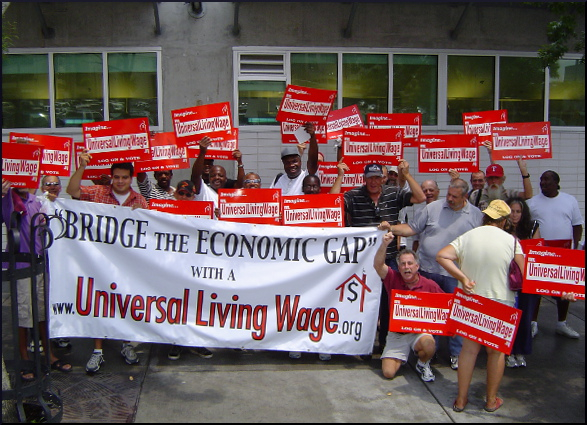
Federal resolve is insufficient; highly recommend Universal Living Wage formula indexed on the cost of housing wherever the person lives and works. 

London Tries a Different Way of Giving

In Britain, the homeless are known as “rough sleepers,” and like any metropolis, London has its share of rough sleepers who are, for whatever reason, uncooperative with efforts to get them indoors. It happens for a variety of reasons. A married couple might flat-out refuse to go to a shelter where they will be separated into male and female dormitories. A veteran with PTSD might be phobic about any enclosed space and only comfortable outside.

A very small minority of rough sleepers live in the midst of society but are so disconnected from it, they seem to have reached a point of no return. Their presence on city streets creates problems for law enforcement personnel, frustration for agencies that want to help, and a big public relations problem for the much larger majority of people experiencing homelessness. It only takes a few individuals perceived as “bums” to make a whole lot of people look bad.

Most of the people experiencing homelessness want help, and even more than help, they want jobs so they don’t need help. But this isn’t about them. This is about one organization’s decision to work with a handful of seemingly intractable hard-core, long-term holdouts.

Juliette Hough and Becky Rice write on the Joseph Rowntree Foundation website,

This group often perceived themselves as different from people who went into hostel accommodation. There was strong resistance and even antagonism towards outreach workers, who were viewed as part of the establishment, aiming to force rough sleepers into accommodation they did not want to go into.

A charity organization called Broadway recently tried out a pilot project directed at helping this particularly problematic sub-group whose reclamation would not have been expected by anyone, least of all themselves. It started with a radical notion that departs from the traditional wisdom regarding rough sleepers: give them money and let them exercise control, rather than telling them what to do.

The “personalized budget” is only one part of a coordinated plan, according to Hough and Rice. The authors write,

Fifteen long-term rough sleepers were offered a personalised budget plus flexible, personal support from the project co-ordinator; 13 accepted. These 15 were targeted because they were the hardest to reach using standard methods. They had been sleeping rough for between four and 45 years.

Eleven individuals eventually moved into accommodations; four went back to the streets or to prison. Of the seven successfully transplanted people, at the time of the report, they had been housed for periods ranging from four months to nearly a year. Of that number, six adjusted to such an extent that they were making plans for long-term future accommodation. Given that these people had previously been pretty much written off as hopeless cases, even this success rate far exceeded the expectations of some supporters.

The basic elements of the pilot project were coordinator and a budget allotment of £3,000 per person (currency rates change, but call it around $5,000). Each participant was asked what it would take to encourage them to get off the streets, and told that funds were available to help accomplish this. The difference here was that the assessment of needs was made by the person concerned, rather than by a social worker. With the help of the coordinator, each participant made a plan of action, subject to approval by the local authority.

Handing over control of the process was accomplished in a number of different ways, such as letting the rough sleeper choose where to meet with the coordinator. Apparently, social workers usually work in pairs, which is off-putting to the individuals they are trying to help. Under the Broadway project’s plan, the coordinator usually worked one-on-one with the rough sleeper, and devoted a lot more time than state-sponsored outreach workers were able to. And rather than being hurried or pushed, each participant was brought along at his or her own pace.

In one case, all the person needed in order to stay off the streets was a place with a working television. Some of the participants went so far as to sign up for courses, and some used the opportunity to learn skills that had always eluded them, such as how to pay bills or cook simple meals. Some took steps to address their mental health or substance abuse problems. Four people signed up for welfare, which British society would much rather pay than see people living like feral creatures. Some got back in touch with the long-forgotten family members.

Broadway found that for such a program to succeed, continuity of personal contact is essential. Because of deep-seated trust issues, the rough sleeper coming in from the cold really needs to bond with one particular coordinator, and the contact needs to be intense and continuing. Still, it was clear to both the participants and the professionals that such an approach has a chance of working when other avenues have failed.

The report says,

This suggests that even long-term rough sleepers who say that they do not want to go into accommodation can choose to do so when they are in control of the conditions for making such a move. Throughout the interviews, many people used the phrases ‘I chose’ or ‘I made the decision’ when discussing their accommodation and the use of their personalised budget, emphasising their sense of choice and control.

Interestingly, the participants were not told how much their personalized budget amounted to. The report says,

Instead, they were asked what they wanted in order to help them. Total spending in the first year averaged £794 per person, compared with the £3,000 allowed.

Speaking of Giving…

Here is a way to donate to your favorite cause, such as House the Homeless, just by shopping online. iGive’s literature says that since 1997, its members have donated $5,600,000 to more than 28,000 causes in this painless way. They promise “No pop ups, ads, toolbars, special search engine, or unwanted emails.” Check out iGive’s FAQ page (PDF) and Facebook page, or just hop to the sign-up page and get started.

Reactions?

Source: “Providing personalised support to rough sleepers,” JRF.org, 10/28/10
Image by garryknight (Garry Knight), used under its Creative Commons license.
What Kind of Help Really Helps?

People experiencing homelessness do not always remain adrift. Sometimes they land on a friendly shore. Is it all a matter of luck? Or do their stories contain factors that could be applied more generally? What kind of help was extended to them by nonprofit groups, local businesses, individual benefactors, faith-based organizations, the media, or the government? What kind of help really helps?

Last time, we found that, for veteran Bill Jenkins, the things that made a difference were Alcoholics Anonymous and the nonprofit Veterans First. What helps even more, he told the reporter, is the respect given him by fellow citizens who recognize the contributions he has made to the community.

In the realm of show business, a person’s housing status is less important than whether they make it to the recording studio on time. Of course, it always helps to have a stable residence as a center of operations.

In January, Eminem signed a rapper called Yelawolf, who had been on the streets for about a year, to his record label. Since then, the young musician has been homeless in a whole different way, touring the U.S. and Europe.

Everybody heard about Ted Williams, the widely publicized “Homeless Man with a Golden Voice.” After being “discovered” by a journalist, he was introduced to many opportunities, but was psychologically unable to cope with the sudden changes in his life. This seems to be the theory held by Cord Jefferson, who describes the arc of Williams’s career and reflects,

In the future, it would probably be wise for Americans and the media to remember that people emerging from the depths to which Williams sank need time to recover before they’re thrown in front of cameras and lights and millions of people. Nobody’s saying that it can’t be done, of course, but it shouldn’t be done over night. And when people crash and burn because they weren’t ready for the spotlight, it seems wholly wrong to immediately forget about them.

Vicki Lawrence followed up with a video piece in which she plays a character called “Homeless Mama,” which is seen as either a humorous parody or a mean-spirited attack on the homeless, depending on who you ask.

Country singer Miranda Lambert’s parents were private investigators, a profession which apparently doesn’t pay very well or support a stable domesticity. Journalist Carina Adly MacKenzie titles her article, “Miranda Lambert spent part of childhood homeless bankrupt,” and says,

In fact, her family occasionally sheltered abused women and children at their home. These women inspired one of Lambert’s biggest hits, ‘Gunpowder & Lead.’

In The New Yorker, Dana Goodyear recounted the story of Nathaniel Ayers. This amazingly talented musician suffered from paranoid schizophrenia, and went from the Skid Row streets of Los Angeles to being the subject of a book titled The Soloist: A Lost Dream, an Unlikely Friendship, and the Redemptive Power of Music. And then his story was made into a movie that starred Jamie Foxx and Robert Downey, Jr.

In fact, it appears that what turned things around for Ayers was the interest taken in him by Steve Lopez, who first publicized the story of the homeless musical genius in a series of columns, then published the book. Like the golden-voiced homeless man Ted Williams, Ayers and his story captured the imagination of someone with the skill and the platform to make it public.

The other deciding factor was his membership in the Lamp Community, the Los Angeles nonprofit organization that follows the “housing first” principle. For helping people one at a time, there are not enough reporters to go around. Or enough facilities like Lamp.

The good news is that we don’t need to be newspaper journalists or shelter administrators in order to help this situation. There are plenty of different ways to help, and one of them is to learn about, and spread the word about, the Universal Living Wage.

Reactions?

Source: “Eminem signs homeless rapper,” Musicrooms.net, 01/18/11
Source: “A Month Later, ‘Homeless Man with a Golden Voice’ Is Abandoned by His Corporate Friends,” Good, 02/25/11
Source: “Vicki Lawrence as Homeless Mama,” Youtube.com
Source: “Miranda Lambert spent part of childhood homeless, bankrupt,” Zap2it, 11/04/10
Source: “Dana Goodyear, Letter from Los Angeles,” The New Yorker, 05/05/08
Image by Vincent van der Pas, used under its Creative Commons license.
A Veteran’s Success Story

Yvette Cabrera, a columnist for the Orange County Register, recently profiled Bill Jenkins, a disabled Army veteran who, after experiencing homelessness for a spell, has now found a place. The publication of the article, “Homeless to respected: Vet earns it” coincided with Jenkins’ graduation to the independent-living phase of his program.

The program is sponsored by Veterans First, described as “the only nonprofit in Orange County, CA offering veterans a wide range of services: case management, counseling, substance abuse programs, job training and placement and homeless shelter.” In the usual way of things, a participant has as long as two years to reach the independent-living stage. Jenkins has fulfilled the requirements in a mere eight months.

Now in Alcoholics Anonymous and sober for nine months, Jenkins lives on his military pension. The apartment he moves into will be partly paid for with federal funds, and he will be subject to case management for a period of time. Someone keeps an eye on the graduates so, if there is any backsliding, they can help before it’s too late.

Cabrera says,

Jenkins is proud of the work he’s done to turn his life around. But he gets even more satisfaction from his work helping other veterans who are still homeless. Others might ignore or look down on these men and women, but Jenkins considers many to be friends and all well worth helping.

At the group home, he was the “Information Liaison” person, responsible for keeping up with and spreading the latest news on available resources and how to tap into them. He speaks to groups, and he helped as a street guide for the Orange County homeless census. Jenkins is working to organize the county’s first Veterans’ Stand Down.

For his service at the cold-weather shelter, the President’s Council on Service and Civic Participation gave Jenkins an award. The journalist says,

Jenkins acknowledges that much of his progress is due to sobriety and to having a home base, a place where he can stabilize himself. But there’s more to the equation. Jenkins has carved out a place for himself in society, a role; a reason to stay sober and in a home… ‘It’s neat for me to have people who call me by my first name and know that I’ve made a difference somewhere along the way; where they actually remember me,’ says Jenkins. ‘This isn’t something I want to walk away from.’

In general, there are at least three things to consider about volunteer work. The obvious and empirically proven aspect is that helping others is one of the essential elements in any recovery program. That’s just how people are built, and if it works, don’t fix it.

Sometimes a volunteer situation turns into or leads to paid work, which is even better. A space is left for someone else whose recovery program includes helping others, while the person who now has a paying job can move on, to volunteer in some other area of need.

On the other hand, things could still be better. To make an approximate analogy, large numbers of recovering addicts have become drug counselors. Sometimes, that’s the best they can hope for as employment. Which shows that society still needs a whole lot of fixing. If a formerly homeless person becomes a homeless advocate, it should be a choice made because they have a passion for the work, not a position accepted because there are no better options.

Let’s dare to imagine a world where there is no need for drug counselors or rape counselors, or any other kind of trauma counselors, or even a need for homeless advocates. Let’s go all the way and just end homelessness. Richard R. Troxell is convinced this can be done. House the Homeless supports the Universal Living Wage, the benefit of which is that it will end homelessness for over 1,000,000 minimum-wage workers, and prevent economic homelessness for all of 10.1 million minimum-wage workers.

Reactions?

Source: “Homeless to respected: Vet earns it,” OCRegister.com, 08/03/11
Image by jdn (Jack Newton), used under its Creative Commons license.
Shifting Gears: A Statement by Richard R. Troxell

As you may know, it was never about the book. That’s right, I have written a book, Looking Up at the Bottom Line. It is about homelessness and the Universal Living Wage, which will end economic homelessness for millions of people. I view the stories and the struggles in the book as the icing on the cake. It is a way to get people to eat the cake — the concept/formula of the Universal Living Wage. The goal remains the same: a pragmatic solution that will end homelessness in our lifetime.

Rather than looking at folks on the street as “The Homeless,” I prefer to think of them as human beings. They are people who can either work or not work. To those who cannot work, I offer my sympathy, my help, and my tax dollars. To those who can work, we can offer opportunity: a Universal Living Wage that will ensure that anyone working 40 hours in a week can afford the basics in life, such as food, clothing, and shelter (utilities included). But they are not in need of my tax dollars.

Did you hear that?

The Universal Living Wage offers tax-dollar savingsstable jobs, stable work force, a way to stimulate the economy (97% of minimum-wage hikes get re-spent right back into the economy), and a way to stimulate the housing construction industry. Wow! This is an idea whose time has come. But first, we must reshape our thinking.

Business is a FULL, equal partner in this concern. Those who operate businesses and profit from our labor must be convinced to act as full community partners. Our cry is, “A Fair Wage for a Fair Days Work.” Anyone working 40 hours in a week should be able to afford a roof over their head — other than a bridge. Who benefits from the work of the laborer, if not business? It is up to us to begin to stress all these benefits to business.

We must show them that using people like tissue paper and replacing them on a whim only results in exorbitant retraining costs. We must show them that, according to the Small Business Administration website, with 64% of all new small businesses failing by the fourth year, they must stabilize all parts of their business, including the wage of the worker.

Thus far, our campaign has focused on the “fallout” of this phenomenon that we call homelessness. Our efforts have been to assist those who fall into this condition. I believe we must continue to reach out and take care of folks, but now we must also emphasize the concept of ENDING HOMELESSNESS! It’s good for business, it’s good for the worker and, with 3.5 million people experiencing homelessness, it’s critical for our society.

The alternative is a nation of cast-off, disenfranchised workers who are growing angrier by the day. No doubt we’ll face more draconian laws that arrest people for things such as feeding the homeless people in our parks. Cruel laws like that have given life to vigilantes, such as “Anonymous,” who vow to crash official websites and disrupt communication systems in response to perceived injustices.

The cry in Congress is for jobs, tax savings, and social/economic responsibility. The Universal Living Wage offers all these things. To this end, I am taking our campaign to the next level.

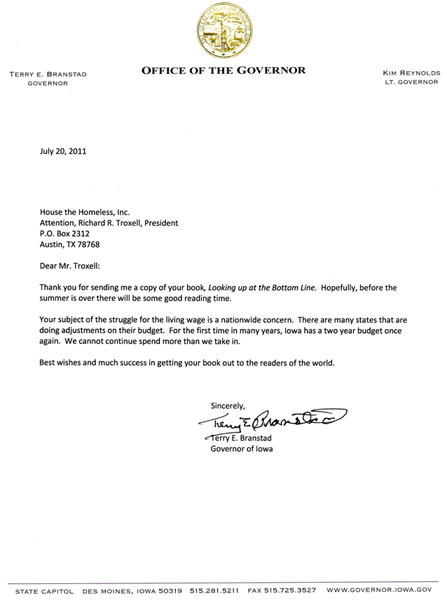
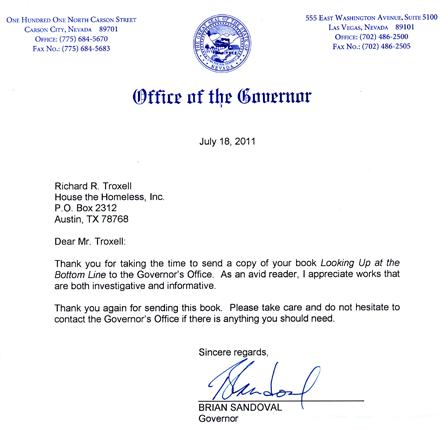
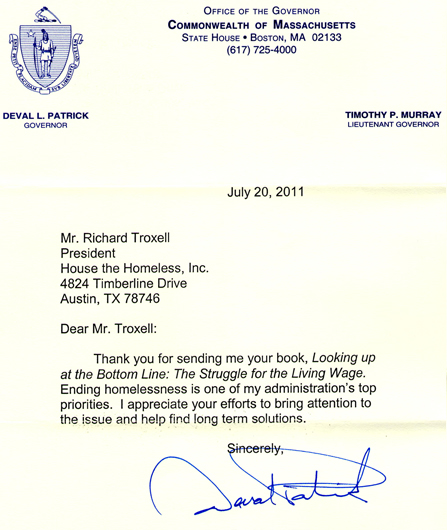
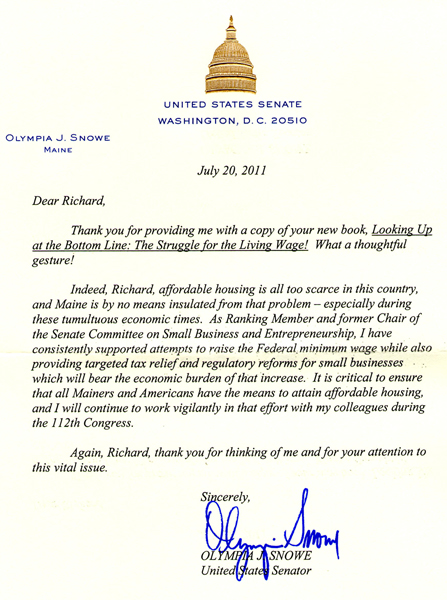
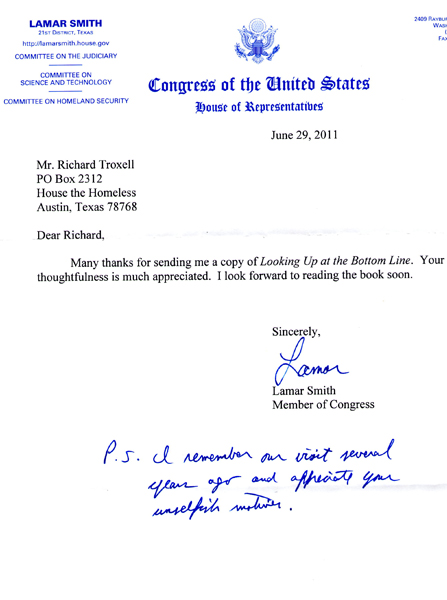
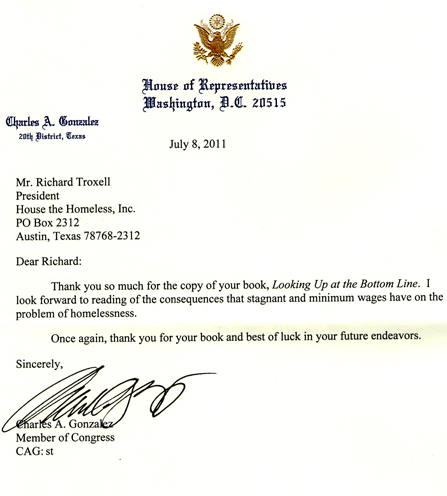
Just last week, we completed our mailing of the book, Looking Up at the Bottom Line, to each member of the House of Representatives (435). We sent a copy of the book to each United States Senator (100). We sent a copy of the book to all 50 Governors and, of course, we finished with a book going to the President of the United States.

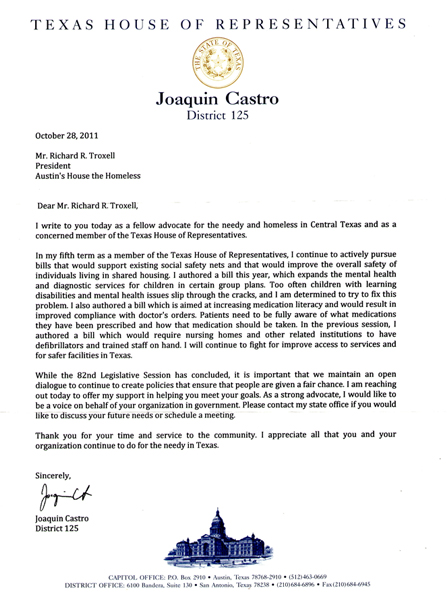
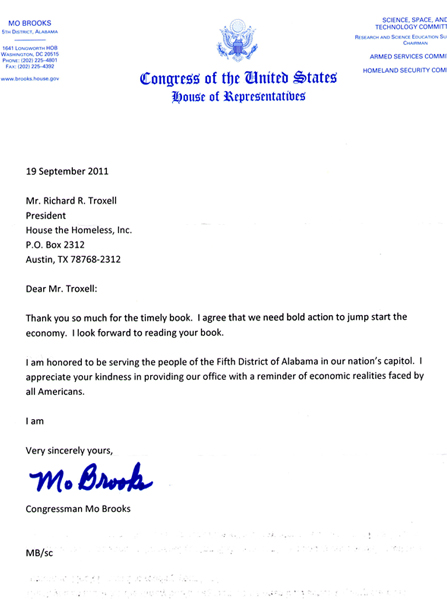
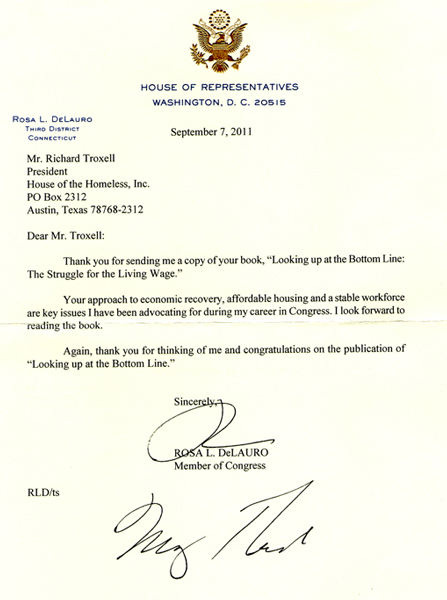
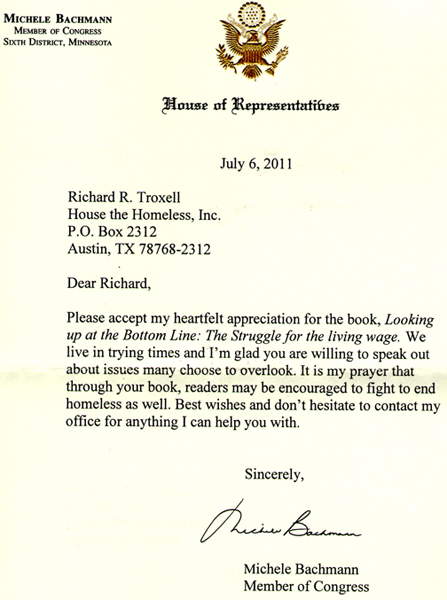
We were able to send an advance email to each official. This turned out to be prudent. We have now begun to receive official letters of appreciation for the book from members of the House, Senate, and from state governors. I have chosen a select few of these for posting on our website, HouseTheHomeless.org.

One of the first letters we’ve received came from Minnesota Republican Congressperson and presidential candidate, Michele Bachmann. She says she wants to end homelessness and that we should contact her for anything that we need. I’ve been ridiculed for posting her letter. I’ve been told that “she doesn’t care about the homeless.” But I say that she does care. She has provided foster care for at least 23 children. They were all girls, many with eating disorders, and she cared for them until they could care for themselves.

Everybody cares about what we’re offering. They just may not realize it. It’s like when I approached people in the Green movement, only to find out they were all unassociated groups and couldn’t see how homelessness was their issue. I found perhaps their strongest leader, Nathalie Paravicini in Houston, and I showed her a picture of Austin’s Waller Creek. I made her guess what what was in the picture: a creek, an abutment, a sleeping bag, a blanket, a thousand Styrofoam cups. I explained that lots of my fellow veterans were now living in the woods along America’s creeks and estuaries without trash pick-up or toilets.

I believe I actually referenced the word “feces.” I asked how that could possibly be good for the environment? I suggested that they contact all the other “Greens” around America and form themselves into a single group, then endorse the Universal Living Wage. They discussed, both over the Internet and in person, for about two weeks. Today, they are called the Green Party. We have their endorsement.

We are poised to get our issue on the dinner-table agenda of America. Let’s go forward together. Use your voice.

Together, we are a great team.
Richard

Image by BinaryApe (Pete Birkinshaw), used under its Creative Commons license.
Homelessness, Foster Kids, and Michele Bachmann

According to the Child Welfare Information Gateway, in September of 2009 (the last date for which statistics have been compiled), 423,773 American children were in foster care. That’s nearly half a million: Not such a large number these days when applied to dollars, but a very large number indeed when it’s children we’re talking about.

Kids in foster care are in an ambiguous situation, not actually homeless (PDF), but not in their own permanent homes, either. For about half of all the foster kids, the stated “case goal” is reunification with their families, a goal much more easily met if their families are lucky enough to have homes.

Although some are placed with relatives, about half of the children in foster care at any given time are with non-relatives. It seems that about half the total number of children remain in foster care for less than a year. Presumably, the family situation improves, and they are able to return.

Of course, a small percentage of kids “age out” of foster care each year, and their circumstances are often dire. Of the system’s graduates, only about half also graduate from high school. Only one in 50 goes on to earn a college degree.

It is estimated that a quarter of the teenagers too old for foster care are now homeless, and a third receive public assistance. Half are unemployed, and more than 4/5ths become parents at an age when they are not equipped for it, and without the means to prevent their children from joining a cycle of poverty, neglect, and even abuse.

Recently, all the members of the U.S. House of Representatives and the U.S. Senate, all the state governors, and the president received copies of Looking Up at the Bottom Line. An enthusiastic reply came from Michele Bachmann, who represents the 6th congressional district of Minnesota, and hopes to be the next Republican president.

Bachmann’s political activism is said to have originated with her experience as a 23-time foster parent. Sheryl Gay Stolberg explained in The New York Times, saying,

… [I]t was her role as a mother, both to her biological children and to her adolescent foster daughters, that spurred her to seek public office.

The state allowed a family to take care of up to three foster children at a time, and the Bachmanns specialized in teenage girls with eating disorders. The Bachmann biological children were home-schooled or went to private Christian schools, but foster children must attend public schools, and Michele Bachmann became politically active through wanting to influence how the schools are run.

Stolberg says,

By the late 1990s… Mrs. Bachmann was upset by the education her foster children were getting in public school. Teachers gave them ‘little special attention,’ and many were ‘placed in lower-level classes, as if they were not expected to succeed,’ she told a House subcommittee in 2007.

Benjy Sarlin takes the story a bit further, noting that Bachmann, at the same time,

… [P]itched her own legislation that would allow states to use vouchers to move foster children into private or home schools, injecting a hot-button partisan issue into the mix of what had been a mostly apolitical process.

Kathleen Strottman, executive director of the bi-partisan, nonprofit Congressional Coalition on Adoption Institute, is extremely appreciative of Bachmann’s advocacy for the organization, saying,

She’s been very helpful in speaking about what drew her to become a foster parent and using that for state and local recruiting efforts.

Although many of Bachmann’s ideas are frightening to those who fear the total disintegration of the social safety net, her sincerity and charisma cannot be doubted.

Reactions?

Source: “Foster Care Statistics 2009” (PDF), ChildWelfare.gov, 05/11
Source: “Roots of Bachmann’s Ambition Began at Home,” The New York Times, 06/21/11
Source: “Michele Bachmann’s Foster Care Contradiction,” TPMDC, 07/06/11
Image by Gage Skidmore, used under its Creative Commons license.
To Avoid Homelessness, Workers Need Better Pay

Corporate America’s chokehold on wages” is a piece by Harold Meyerson that appeared in The Washington Post, Austin’s The Statesman, and many other newspapers. The author begins by engaging our interest in the question of why we, as American consumers, are still in a dismal economic situation. The answer is twofold: a lot of people are unemployed, and a lot of people with jobs are underpaid.

Writing in a conversational tone, Meyerson explores the implications of the words and ideas of J.P. Morgan Chase’s chief investment officer, Michael Cembalest. The journalist says of Cembalest,

He asserted in the July 11 edition of ‘Eye on the Market,’ the bank’s regular report to its private banking clients, that ‘US labor compensation is now at a 50-year low relative to both company sales and US GDP.’

There are three major reasons why corporate profits are flourishing: low wages, the offshoring of jobs, and innovation stemming from research and development. The biggest factor contributing to swollen profits, Meyerson says, is the low pay. In the 500 top companies that Standard & Poor keeps track of,

… profit margins (the share of a company’s revenue that goes to profits)… are at their highest levels since the mid-1960s…

Meyerson gives a very complete explanation, the gist of which is that, for workers, both wages and benefits have shrunk. He writes,

This decline in wages and benefits, Cembalest calculates, is responsible for about 75 percent of the increase in our major corporations’ profit margins.

As for the causes, there seem to be several. Although good pay is better than easy credit, something went wrong years ago, when it became easier for Americans to get ruinous amounts of credit than to get the adequate wages they needed and deserved. It’s like bringing up a child on cotton candy instead of vegetables. The long-term results can be gruesome.

Also, Meyerson blames the decline of the unions and talks about a hearing held by the National Labor Relations Board in July, during which testimony from 61 witnesses has revealed that…

… union elections have declined 80 percent since 1970… In the America of 2011, there are scarcely any union organizing campaigns. There are fewer union members: Just 7 percent of private-sector employees are unionized, down from 35 percent in the 1950s… The strike as a bargaining tool for workers is now the province of professional athletes, the last American employees who have enough clout even to contemplate taking a walk… Surely the fact that the great majority of American employers no longer have to sit down and hammer out collective bargaining contracts with their workers has contributed to the increase in profits at wages’ expense.

One thing that corporations often forget is that underpaid workers can’t afford to buy stuff. And who are underpaid workers not able to buy stuff from? The corporations. If almost everybody is broke, who is left to fill the role of consumer, customer, or client? In other words, stiffing the workers would seem to be a counterproductive policy, in the long run. Paying people fairly, even generously, is good for business.

Yet, most working people are underpaid. Some have supplemental means, or extraordinary management skills, or three jobs. They contrive to hang on by their fingernails to a viable lifestyle, and experience a relatively high degree of housing security.

Others are the working poor. Even with a full-time job, many workers are unable to afford housing even for themselves. And a family? Forget it. The working poor are tossed from one precarious situation to the next, sometimes living in a vehicle or a relative’s garage, often dependent on an aid program to make it at all, eternally teetering on the edge of disaster. The economic homeless are employed and ought to have every reasonable expectation of being able to afford a place to live, and yet, they can’t.

House the Homeless invites you to learn more about the Universal Living Wage. The benefit of the ULW is that it will end homelessness for over 1,000,000 minimum-wage workers, and prevent economic homelessness for all of 10.1 million minimum-wage workers.

Reactions?

Source: “Corporate America’s chokehold on wages,” WashingtonPost.com, 07/19/11
Image by Vimages (Pierre Vignau), used under its Creative Commons license.
Creating Homelessness in the Antelope Valley, Part 2

The story titled “L.A. County’s Private Property War,” by the L.A. Weekly‘s Mars Melnicoff, goes into extensive detail about how the ruggedly independent settlers and longtime landowners of California’s Antelope Valley are being cleared out. About five years ago, they noticed an increase in the selective enforcement of zoning rules and building codes, along with general hassling and harassment.

When they got together and compared notes, they realized that something dark, insidious, and deliberate is going on. Paranoia? Doesn’t look like it. Looks like a major land grab, pure and simple, for the benefit of developers with big ideas. The likelihood of this is clear to attorney Robert McNamara of the Institute for Justice, who is quoted:

That certainly does happen. We have seen zoning enforcement that can be explained by nothing else.

Besides, the longest-serving member of the county Board of Supervisors has already revealed his plans for the area on his website. Unfortunately, the place is within commuting distance of Los Angeles. It’s a hardscrabble existence for the “desert rats,” but with them out of the way, corporate investment in amenities could turn the area into… anything.

One after another, families and individuals are being manipulated into leaving, through penalties for victimless misdemeanors and code violations. It doesn’t matter that a community is destroyed. It doesn’t matter how many people are losing what they had worked for all their lives, or how many local businesses go under. Somebody wants them out of there.

Melnicoff says,

Tough code enforcement has been ramped up in these unincorporated areas of L.A. County, leaving the iconoclasts who chose to live in distant sectors of the Antelope Valley frightened, confused and livid. They point the finger at the Board of Supervisors’ Nuisance Abatement Teams, known as NAT, instituted in 2006…

The NAT crew makes first contact armed, and clad in bulletproof vests — an entire team of Sheriff’s deputies, health inspectors, District Attorney’s investigators, zoning officers, inspectors from Building and Safety, and animal control personnel. (Speaking of which, the same kind of multi-agency, heavily armed contingent is sent out against 85-year-old grannies with too many cats. That’s just how they do things in L.A. County.)

The head of the NAT maintains that the safety of his teams is more important than the convenience of someone in an “unknown structure.” Oscar Castaneda, pastor of a historic church in one of the area’s few towns, knows about this. After 22 years of peace and quiet, he was ordered one day to “freeze” in front of his home, out in the middle of nowhere.

An elderly woman in a similarly remote spot exited her cabin to find it surrounded by combatants in body armor, with guns drawn. These crews show up and tell people they are living on their land illegally, and threaten them with liens and bulldozers. People have been jailed for trespassing on their own land. Most of those affected can’t afford lawyers and can’t afford to hire helpers for the wrecking work. People who thought they were safely retired are forced to dismantle their own homes board by board and nail by nail.

Melnicoff says,

Some residents believe that county Nuisance Abatement Teams order the more modest compliance actions first, such as weed-clearing, then build up to ordering residents to remove their homes, saving the county from paying for costly cleanup once a dweller with little financial means is pushed out.

Their methods are effective. The reporter tells of an “off-the-grid family living atop a 4,000-foot mountain,” just trying to be left alone and care for their mentally disabled adult son. The Kirpsies were prosecuted as criminals, in violation for their old trailer homes and scrap-metal recycle heaps. They only avoided prison by agreeing to totally clear the land and move to another state. There’s one family gotten rid of. They had somewhere to go, but others don’t.

Zoning official Oscar Gomez ought to have his own stand-up comedy act. He told Melnicoff that horrid things like sheds and trailers “bring the property value down.” Wait, what? The stakeholders are the people who currently own their land, and who built homes planning to stay there forever and never sell anyway. Why is the county making the “property value” its problem? Why is the county blathering on about “safety,” as if homelessness will somehow be “safer” than even the most ramshackle dwelling?

Kevin Scanlon’s five-minute videotape introduces a few of the people and homes referenced in the article. And treat yourself to Devin Schiro’s enchanting video portrait of Phonehenge West, an architectural marvel 20 years in the making. Many believe it should be preserved like the Watts Towers, the Winchester Mystery House, and other examples of American folk art.

Schiro invites viewers to:

… join a growing community of people who protest what we consider the senseless persecution of a man whose only ‘offense’ is taking a stand on behalf of beauty, creativity, and the inalienable right of free expression.

It is heartbreaking to hear retired phone technician Kim Fahey recount his relationship with the authorities. Fahey became the national media face of this struggle because of the remarkable desert structure, which is being demolished despite the fact that he deliberately built it to exceed the code requirements.

He lost his five-year court fight last month, and has already been jailed and bailed out, and then hospitalized for a medical problem exacerbated by all the stress. He could end up serving seven years in prison, for building a house. On his land alone, there are several people facing homelessness.

Fahey told the reporter,

The story is more important than me, because they are doing this to thousands of people. I’m just trying to bring it to the forefront.

Reactions?

Source: “L.A. County’s Private Property War,” LAWeekly.com, 06/23/11
Source: “L.A. County’s Private Property War (VIDEO),” LAWeekly, 06/23/11
Screen capture of Phonehenge West by Devin Schiro, used with permission.

Creating Homelessness in the Antelope Valley, Part 1

Speaking of veterans, there’s a guy named Joey Gallo, a disabled vet with three serious medical conditions. Up until recently, he was living on his own land, with his cat and dog, in a remote location in California’s Antelope Valley. Officials began to show up and order him to get rid of stuff — at first, trash and weeds. Next, it was a motor home they said he couldn’t keep. Then, they escalated their demands and made him demolish some sheds.

Finally, they came back and ordered him to tear down his home. You’ve heard of the Stand Down, an event where homeless veterans can get help. Adding outrageous insult to injury, one government minion presented him with a flyer giving the date and location of the next Stand Down — as if to say, “Welcome to your new life, loser.” Will Gallo’s next stop be Skid Row? If so, he may meet some neighbors there.

We have already offered (satiric) lessons on “How to Become Homeless.” One way is to be a resident of this high desert region which is, unfortunately, only an hour or so travel time from Los Angeles. The local administration is trying very hard to cause massive homelessness out there. The photo on this page gives an idea of the sparseness of the population in the high desert region. There might be half a mile between dwellings. Yet the authorities insist that anonymous neighbors are constantly making “eyesore” complaints about various structures and vehicles, many of which are only visible from the air.

Under the aegis of the L.A. Weekly, Mars Melnicoff devoted six weeks to investigating the horrifying situation, and accomplished what promises to be an award-winning piece of journalism, “L.A. County’s War on Desert Rats.” A message comes through loud and clear: the victims of the Antelope Valley Land Grab are living national treasures, the quintessence of all the qualities that made America great.

The writer shows how the rugged individualists at the hardscrabble butt-end of nowhere are being systematically removed from their homes for some murky, as-yet-unknown reason. It’s kind of like one of those “sweeps” of the homeless that cities do before the Olympics or the political convention. Except these folks are on their own land — or what used to be their land — so the process is taking just a bit longer.

Melnicoff says,

The government can define land on which residents have lived for years as ‘vacant’ if their cabins, homes and mobile homes are on parcels where the land use hasn’t been legally established. Some have been jailed for defying the officials in downtown Los Angeles, while others have lost their savings and belongings trying to meet the county’s ‘final zoning enforcement orders.’ Los Angeles County has left some residents, who appeared to be doing no harm, homeless.

Melnicoff tells their stories. Some are retired people, who thought they were finished with hard labor, and figured they had earned the right to enjoy the little corner of the world they had paid for and fixed up to their liking. She tells of people who live frugal, thrifty, minimalist lives, and sincerely practice recycling far beyond sorting trash into different-colored buckets.

They came here to get off the grid, practice “VONU,” make monumental art, race their dirt bikes, commune with the spirits of the ancestors, or whatever. That’s why people settle in environmentally inhospitable areas in the first place: they possess a fine willingness to trade the convenience and amenities of the city for the space and opportunity to do things their way. They are people who can’t afford lawyers when they’re being railroaded, hogtied, and hung out to dry. They came here to get away from the depredations of gang members, and ran afoul of a much more dangerous gang — the bureaucrats of Los Angeles County.

(To be continued.)

Source: “L.A. County’s Private Property War,” LA Weekly, 06/23/11
Image by AlishaV (Alisha Vargas), used under its Creative Commons license.
The Mentally Ill Homeless: Cause and Effect

In Looking Up at the Bottom Line, Richard R. Troxell suggests that the arrangements made decades ago for the care of America’s mentally ill have resulted in another case of good intentions gone wrong. It was a reform movement, concerned with disability rights and independent living. Some institutions were terrible places.

Richard says,

Disgruntled, underpaid workers were physically and mentally abusing our mentally ill citizens. Legal Aid in Chicago filed a lawsuit that called for deinstitutionalization. Similar lawsuits swept the country. This coincided with the advent of psychotropic drugs such as Lithium. Mental health providers faced heavy social service dollar reductions. There was the hope that these things could be balanced by treating people on an outpatient basis. They would treat people while they were on a kind of invisible tether.

We have talked about why the consequences didn’t match the theory. When Richard was drafting the Homeless Protected Class Resolution, about one-fourth of the adult homeless in America suffered from some type of mental illness. When he was writing Looking Up at the Bottom Line, the low-side estimate was more like one-third. When House the Homeless in Austin conducted its 2010 health survey, 175 of the 501 respondents had been diagnosed with mental illness.

This was an issue in the struggle over Austin’s No Sit/No Lie Ordinance earlier this year. The ordinance was bad enough already, but it discriminated against people with disabilities of all kinds, and especially against those with mental disabilities. With the help of several other agencies, House the Homeless was able to file some of the roughest edges off the ordinance.

Unintended consequences are the dark side of any social experiment. When plans are being made, the person who says, “But, wait…,” and describes a possible bad outcome, is often labeled as a naysayer and a negative thinker. But sometimes optimism, especially optimism based on the availability of funding, turns out to have been unjustified.

Our country in the 1980s was not prepared for a massive influx of troubled and dysfunctional people into the mainstream. Maybe it all happened too fast, maybe nobody was thinking ahead. Whatever programs and protections were organized for the support of so many confused individuals turned out to be inadequate, and the situation has only gotten worse.

A fascinating brand-new report from Dr. Guy Johnson and Prof. Chris Chamberlain of the Royal Melbourne Institute of Technology in Australia reveals a surprise:

They found only 15 per cent had mental health issues before becoming homeless, while 16 per cent of the sample developed mental health problems after becoming homeless.

Are you getting that? Half of the mentally ill homeless became that way after becoming homeless. Australia is a lot like the United States, and has about the same proportion of the mentally ill people experiencing homelessness. It wouldn’t be at all surprising to learn that half of America’s mentally ill homeless, too, got that way after becoming homeless. It’s enough to tip anybody over the edge, especially in a life already filled with stressors.

Worse, the Australian research shows that the young are most vulnerable to mental health challenges that are caused by or exacerbated by the homeless condition. And, even worse than that, the young are apt to develop substance abuse issues along with mental health problems.

Dr. Johnson, who is a researcher for the Australian Housing and Urban Research Institute, seems to be saying that treating mental illness is too little, too late. It may lop off some of the problem’s branches, but it does not attack the root. Homelessness is the root of a large share of mental illness, not the other way around.

Concentrating on mental health, he says, deflects attention from the lack of housing, the inability of people to pay for what housing there is, and the inevitable family breakdown that results. The belief that mental illness is the primary cause of homelessness sends the wrong message to policy-makers about exactly what services are needed to end homelessness.

Dr. Johnson goes for the Housing First approach, saying:

Homelessness does cause mental health issues, particularly anxiety and depression, and is a serious problem for a significant minority of homeless people… For homeless people directly affected by these structural factors, the solution lies outside the medical arena – and research indicates that providing housing to homeless people before treating their mental health issues is actually a more effective approach.

Reactions?

Source: “Looking Up at the Bottom Line,” Amazon.com
Source: “Research sheds light on homelessness and mental illness,” RMIT.edu, 06/06/11
Image by AR McLin, used under its Creative Commons license.