Our Mission

Founded in 1989, HtH is the oldest all volunteer, action, homeless organization in the state of Texas. The mission is Education and Advocacy around the issues of ending and preventing homelessness.

Urgent Issues

Re-Criminalizing Homelessness — Speak up now!

HtH supports the direction being taken by the City of Austin’s relatively new Homeless Strategy Office, led by a very committed and responsive David Gray, and with the commitment of Charles Loosen and other staff. We further strongly advocate ALL positions below that preceded The vote to basically criminalize homelessness — especially:

reinstating a camping ban must consider that those with disabilities, the aged, and in fact anyone with no place to go. The no sit/no lie ordinance is absolutely inhumane and unconscionable we must have at least 15 minute respites particularly for those with disabilities and make other provisions.

Mayor Kirk Watson, elected in 2023, is working to secure funding for homeless services from the State and within the City Budget.

2025 interests:

City Council approved a resolution making homelessness a top financial priority.

Increase the capacity of the Homeless Strategy Office to address and implement a comprehensive approach to strategic advancements in homelessness response. (Plan detailed in a 50-page memo from David Gray, June 2025).

Examples:

1. Expand HOST (Homeless Outreach Street Team) support including team members:

APD officers, EMS paramedics, behavioral health clinicians, social workers, peer support staff.

2. Support for Marshaling Yard operations.

3. Rapid Response housing and safe housing, especially for families.

4. Increase shelter beds with support; and more.


The Austin city council recently voted to put on its May 2021 ballot a vote to reinstate the no camping ban including the no sit/no lie ordinances. Now is the time to contact your mayor and council members particularly those who have supported decriminalizing homelessness, such as Mayor Adler, Kathy Tovo, Ann Kitchen, Greg Casar, Sabino Renteria, and others, we pray.

First call to action is cold weather shelter. Anyone that reads this, our urgent plea is to email our mayor and city council in this urgent time of cold weather. House the Homeless is encouraging to use the Convention Center or other alternatives sites that are already over burdened due to Covid-19 or at capacity.

A second call to action is to not displace unsheltered neighbors from bridges and the four major camp areas without having an immediate plan for alternative shelter/housing.

Finally, advise your mayor and council members that the wording for the May ballot regarding reinstating a camping ban must consider that those with disabilities, the aged, and in fact anyone with no place to go. The no sit/no lie ordinance is absolutely inhumane and unconscionable we must have at least 15 minute respites particularly for those with disabilities and make other provisions.

Federal Minimum Wage Debate

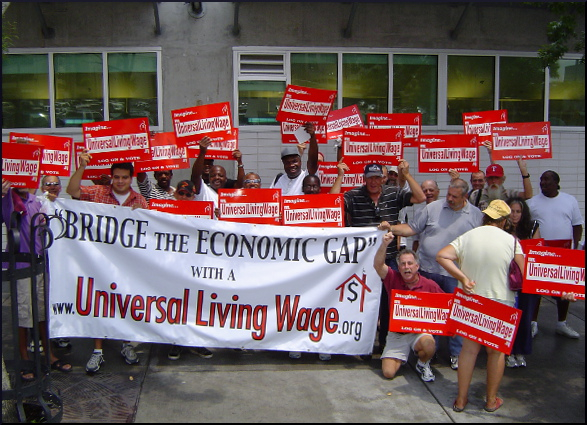
Federal resolve is insufficient; highly recommend Universal Living Wage formula indexed on the cost of housing wherever the person lives and works. 

Homeless is Another Word for Nothing Left to Lose

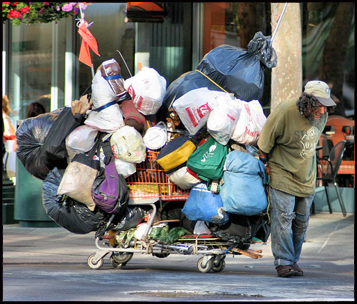
In Houston, Texas, a pair of documentarians roamed the streets to connect with people experiencing homelessness.
They had one specific purpose in mind: to learn what possessions people hold onto when everything else has to be jettisoned. The writer is John Nova Lomax, the photographer is Daniel Kramer, and their first discovery was old news:

It practically goes without saying, but the homeless are everywhere downtown — they throng San Jacinto Street pretty much from southern Midtown all the way to Buffalo Bayou and beyond, they are all around the vicinity of the downtown library, and many of them line the bayou’s banks at Allen’s Landing, and many others make their homes near the courthouse complex.

It comes as no surprise that photos are the most cherished of portable items, because they are certainly among the most portable of cherished items. One man kept a photo of his daughter in her official high school graduation robe, and he’s proud to relate that she went on to college. Another kept an Army beret to memorialize his veteran father. One depended on his laptop computer.

A very practical fellow named his bedroll as his favorite possession, and his second was a small pocketknife. He told the documentary team, “I ain’t had to cut nobody yet or nothin’ like that…” At the other end of the spectrum, some street people find comfort in a rosary or a New Testament. One person’s treasured item had been a Bible, but it went missing. Another had owned a John 3:16 medal, but it was gone. (The verse is, “For God so loved the world that he gave his only Son, so that everyone who believes in him may not perish but may have eternal life.”)

One man said his prized possession was his own heart, because it held his love of Jesus. Of course, the interviewees talked about other matters too, such as how they ended up on the streets. When a trained electrician with 18 years experience can’t find work, something is seriously awry with society. By the way, if it’s ever been in your mind to give one small, quick, no-strings-attached present to a homeless person, Lomax has a suggestion. Apparently, a cheap transistor radio with headphones and a lanyard for suspending it around a person’s neck can be bought for about $6. It’s a small thing, but the kind of gift that really does keep on giving.

Small things are really all you can have if you’re homeless. What does a person even do with a jacket on a warm day? Wear it or carry it. Because you’re going to need it at night. But what about high summer, when it’s hot as Hades all night long? You sure don’t want to keep a jacket with you all the time. What about when winter comes? A jacket will sure come in handy then. But what the hell are you supposed to do with it in the meantime?

Maybe you’re lucky enough to own a suitcase or duffel bag or even a nice big camping-style backpack. It’s a place to keep stuff, but then you need a place to keep it. Or lug it around everywhere — to the soup kitchen, to the free clinic. To the job counseling office, and if you’re lucky enough to get some kind of interview, then where do you leave your stuff? Carrying a duffel around says “homeless” to the world, it’s a much a sign of pariah status as the bells that lepers used to wear.

When a city has a No Camping ordinance — what city does not these days? — the law very likely forbids not only fire-making, cooking, setting up a tent, and sleeping, but “storing personal belongings.” That’s right, thou shalt not leave thy stuff anywhere.

At Change.org, SlumJack Homeless discusses his method of dealing with possessions, which is a bicycle with an attached trailer. It’s better than a shopping cart, but still precludes a lot of activities. The problem of material goods is one of the reasons why he prefers the streets to the shelters, because there is no provision for the safety of belongings.

Now, it’s easy to understand why a shelter doesn’t want all these various conglomerations of stuff on the premises. For one thing, bedbugs are a continuing and terrible problem. The more items that are allowed through the door, the more likelihood of infestation, which of course can only be bad for any shelter residents who aren’t yet carrying bedbugs around. SlumJack Homeless says,

This forces people to a ridiculous minimum of belongings… one of the factors that actually contributes to perpetuating a person’s homeless predicament. Also, you DON’T want other people at shelters to see what you DO own and have. There are many thieves that will then know what you’re carrying around with you, many of whom you WILL run across later… at night, alone, etc.

Let’s just short-circuit this problem by bringing into reality the Universal Living Wage, which can end homelessness for over 1,000,000 minimum-wage workers, and prevent economic homelessness for all 10.1 million minimum wage workers. Then people can keep their stuff in their own place, and close and lock the door. Sounds like a plan!

Reactions?

Source: “Prized Possessions — Homeless in Houston share their most important objects,” Houston Press, 01/20/11
Source: “Why I Choose Streets Over Shelter,” Change.org, 06/03/09
Image by Richard Masoner, used under its Creative Commons license.

Shozna: One Homeless Person Redeemed, Several Million to Go

In Britain, the recent marriage of Prince William and Kate Middleton was attended by a formerly homeless young woman who has one of the trademarks of celebrity: a single name, and it is Shozna.

Last fall, an organization called Centrepoint held a fundraiser where Shozna told her story and related how Centrepoint helped her to escape homelessness. Prince William calmed her nervousness before the speech, and blew everyone’s mind by hugging her after it. In the course of planning for the royal wedding, a hundred “Golden Ticket” invitations were extended, with William inviting representatives from all his favorite charities, while Kate invited folks from her parents’ village. Keri Sutherland of the Sunday Mirror reports,

Shozna’s struggle began when, while training in childcare, she had a stroke and needed a heart operation. Shortly afterwards she left home, staying with relatives and friends until her council referred her to homeless charity Centrepoint. Shozna, who asked us to withhold her last name, said: “I moved into Centrepoint housing in July. It was difficult, but luckily I’ve pulled through.”

Shozna was raised in East London, and Fay Schlesinger tells us how the enthusiastic student with career plans suffered a stroke at age 18 and became half-paralyzed. Months of medical treatment, surgery, and rehab followed. The reasons for Shozna’s subsequent break with her family are not told, but we do know she lived in a hostel and then a homeless shelter. Eventually, she moved to a council flat, which is what they call government-subsidized housing in Britain. (For an exercise in broadening the mental horizons, check out the comments of various British subjects at the blog London Muslim.) As far as Shozna’s future, the lingering effects of her heart problem and the stroke have eliminated some possibilities, but she now hopes to get into retail and work her way up to store manager.

For the great event, Shozna was accoutered by Warren Holmes (hair), Armand Beasley (makeup), Irresistible Headdresses (fascinator), Kyles Collection (jewelry), Jimmy Choo (shoes), and of course Raishma of London (dress.) Couturier Raishma describes the excitement from her perspective

I decided to go for a 50s style prom dress in a block colour scheme of papaya orange and red to give the look a modern take for 2011. I designed an embroidered border with delicate silk roses and hand beading to be positioned on her neckline… I then started worrying about the complete look… I styled Shozna from head to toe for the Big Day…

For the ceremony, the young woman’s escort was Centrepoint chief Seyi Obakin. The London Tonight crew filmed not just Shozna at the wedding, but the entire preparation procedure, one of the world’s most thorough and glittering makeovers. Question: At what point did the ITV network enter the picture? Because, surely, the royal couple did not expect Shozna to show up wearing something from the Oxfam charity shop.

On the one hand, thanks to this sequence of events, the word “homeless” has reached the ears of more people, and that’s a beautiful thing. On the other hand, it’s so easy to cheer for a lovely young woman, and to want to turn her into a fairy-tale princess. But one Cinderella is not enough. How nice it would be if we could see that all homeless women need the resources to take care of themselves and present their best faces to the world.

This includes the girls who become sloppy fat from soup-kitchen diets, which tend to be heavy on the starch; and the mothers whose hair has fallen out from anxiety as they experience homelessness with a passel of kids to worry about. It includes the women who have lost teeth through violence, poor nutrition, or lack of the most elementary facilities for self-care. Also, the abused, the tattooed, and yes, even the alcoholic and addicted.

In our own land of America, the Universal Living Wage can end homelessness for over 1,000,000 minimum-wage workers, and prevent economic homelessness for ten million minimum wage workers. Including a heck of a lot of women.

Reactions?

Source: “Royal wedding: Woman who was once homeless tells of joy at personal invite,” Sunday Mirror, 04/17/11
Source: “From homeless shelters to a front row seat,” Daily Mail, 04/17/11
Source: “Shozna the homeless Muslim Royal Wedding girl,” London Muslim, 04/18/11
Source: “Dressing Shozna from Centre Point Charity for the Royal Wedding,” Raishma.co, 05/03/11
Image of Shozna in gown by Raishma used under Fair Use: Reporting.

Homeless Women Especially Vulnerable to Violence

The concept of a hate crime has to do with civil rights, identity politics, and quite a few other sociological factors. The idea is that although it is wrong to hurt or kill a person, it is especially wrong to hurt or kill a person just because of their skin color, sexual or religious orientation, or other defining characteristic, depending on the jurisdiction. When people are at risk of being hurt or killed for the hate motive alone, they can be legally deemed a Protected Class, meaning that if the assailant is caught and tried, the penalty ought to be extra tough.

Why do we need the Protected Homeless Class Resolution? Briefly, because some people just simply have no alternative to living in public places. Their ordinary actions are criminalized by the authorities. Uniformed enforcers show up, and are seen to harass or brutalize the homeless. This example encourages every cowardly hater in the area to conclude that it’s okay to prey upon the homeless. Some of these bozos even talk themselves into believing they are doing the world a favor by eliminating the homeless as if they were vermin. On city streets or in rural homeless encampments, women are more vulnerable than men. Their numbers are fewer, and nature has not equipped them for effective self-defense. Objectified and depersonalized, they make attractive victims.

Last week, a homeless woman who occupied the hallway of a Milwaukee apartment building was beaten to death with a brick. From El Paso, Texas, Daniel Borunda reported on the issuing of an arrest warrant for a murder. In March, the body of Venus Sloan Driscoll was found in a desert lot. Driscoll had lived in a tent, and the fact that she apparently was killed by another person experiencing homelessness does not lessen the horror of this crime. In a properly functioning society, both killer and victim would have been somewhere else, doing something else with their lives.

Mid-April, in New Orleans, Chantell Christopher’s body was found under a highway exit ramp. She was beaten to death, and the crawlspace where her body was found was actually also where she lived. Jarvis DeBerry, editorial writer and columnist for The Times-Picayune, tells us that a grieving crowd attended a memorial service for Christopher in the garden of a church last Thursday afternoon. She was mentally ill, and somewhere, two children survive her. To find out more about homelessness as background for his story, DeBerry interviewed clients of a program called Ciara Community Services and Permanent Housing. One of his informants was, like Christopher and so many other people experiencing homelessness, mentally ill. But he was sufficiently in touch with reality to understand that, even if he contacted family members, they too were probably just hanging on in this terrible economy.

It’s like that for a lot of street people, even if they have others who care. The friends and family members are struggling themselves and can’t really do much, except shoulder the added burden of feeling bad about being unable to help. And some, whether rightly or wrongly, have too much pride to reveal that they are homeless, or to ask for help. Apparently, Christopher had not let her family know the depth of her troubles. The writer says,

Put Chantell’s, Cyril’s and William’s stories together, and you’re struck by their determination to make it without anybody’s help — even though help is necessary for anybody trying to overcome the challenges of mental illness.

From Austin, Texas, Chris Sadeghi relayed the news of a homeless woman found in a storage unit, after spending two days there with head injuries and a broken leg. The space was rented by a man who probably used it as living quarters, and he felt entitled to punish his victim for behavior that didn’t please him. Reportedly, he bashed her head against a concrete surface nearly 20 times. Sadeghi sought out Richard R. Troxell of House the Homeless, who explained the unfortunate tendency of people to look for such unorthodox living arrangements:

We are talking about the need to have safe decent affordable housing and it is not available at the wage people are being paid. So people are looking for alternatives and sometimes they are not the best alternatives.

These are exactly the kinds of situations that Richard’s Protected Homeless Class Resolution (PHCR) was created to prevent. It contains these words:

THERFORE, BE IT RESOLVED: That persons without a fixed, permanent, individual place of residence, and those that are earning 100% of Federal Poverty Guidelines or less, are sufficient in number characteristics, and vulnerability to compromise a distinct class of people, and as a result, shall hence forth constitute a Protected Class with all rights and protections under such a designation. Herein after, this Protected Class, will be referred to as the Indigent Homeless Population.

The PHRC would protect the indigent homeless from being treated as second-class citizens or non-citizens. It would protect them from laws against sleeping in public, and add extra to the penalties imposed on predators who take advantage of people who have no choice but to sleep in public. Hopefully, it would go some way toward decreasing the number of hate crimes. The PHRC has been adopted by the National Coalition for the Homeless, but not by any city, state or the federal government… yet.

Reactions?

Source: “Homeless woman beaten to death in Milwaukee,” The Examiner, 04/24/11
Source: “Suspect sought in slaying of homeless woman,” El Paso Times, 04/16/11
Source: “At memorial for New Orleans murder victim, a heavenly hope takes on new meaning,” The Times-Picayune, 05/01/11
Source: “Woman beaten, locked in storage unit,” KXAN.com, 04/29/11
Image by quinet (Thomas Quine), used under its Creative Commons license.
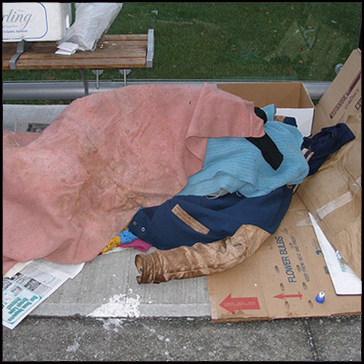
Why the Protected Homeless Class Resolution is Needed

Some societal malcontents will talk all day about what is wrong, a useful skill which has its place. But if someone asks how to fix the mess, they fall strangely silent. Not so with Richard R. Troxell. The one thing a person would never need to ask him is, “Yeah, but what are we supposed to do about it?” The complete plan for fixing this mess is already there between the covers of Looking Up at the Bottom Line. Troxell, the founder of House the Homeless, knows what to do about it, and lays it out in transparent, step-by-step simplicity.

One of the most important documents is the Protected Homeless Class Resolution (PHCR). Because many states and cities are passing and enforcing laws targeting poor and homeless people, House The Homeless feels the need for the adoption of this resolution by City, State and the United States governments. We have talked before about various aspects of the PHCR and the reasons for its creation — the shortage of affordable housing, the insufficient minimum wage, and the huge number of Americans who are involuntarily without permanent addresses. We have also talked about how the PHCR contains the foundations of Richard’s arguments for the urgency of adopting the Universal Living Wage, the solution that will help all Americans either directly or indirectly.

The United States has signed on to the Universal Declaration of Human Rights. We as a nation have agreed that all people are entitled to a minimum standard of living and dignity. This minimum standard’s components include something to eat, something to wear, someplace to live, and some care when sick. It doesn’t say the country has to give everybody these things, because the political systems of some countries are not built that way. But signing the Declaration is supposed to mean that the specific country agrees to recognize, serve, and protect the efforts of its citizens to obtain these things, under its political system, because it agrees with the concept that people should have them.

And then there’s another United Nations Document the U.S. signed, the Habitat Agenda, which has to do with various human rights including equality for women and the poor, and protection from illegal forced evictions, and not penalizing people experiencing homelessness because of their status.

Sometimes you wouldn’t know it from the way we act. Not long ago, Willy Staley, a Rockefeller Foundation Urban Leaders Fellow, and expert on federal urban policy, reported on the harassment situation in one of America’s most beautiful cities. There used to be a popular song that included the line, “If you’re going to San Francisco, be sure to wear some flowers in your hair.” The reason being, because “you’re gonna meet some gentle people there.” No longer. Staley’s piece is titled “If You’re Going to San Francisco, Be Sure to Never Sit on the Sidewalk.”

Staley reported on how the city’s no sit/no lie ordinance came into being. It seems that the Mayor, Gavin Newsom, took a walk on Haight Street and saw a gutter punk smoking crack. That incident was the impetus behind the wave of public support for an oppressive law. Because a politician happened to witness an offensive bit of bad behavior, all of San Francisco’s other various assorted subgroups of people experiencing homelessness paid the price. To make sitting a police matter was an example of civic overkill. Staley wrote,

Furthermore, SFPD doesn’t need a sit/lie ordinance to harass gutter punks on Haight Street; they’ll go ahead and do it anyway. They probably ought to. But a city-wide law that makes it illegal to sit or lie on the street anywhere in San Francisco strikes me as a real threat to any sort of city life other than that which makes the wheels of commerce turn smoother.

In April, an Associated Press story related how official efforts to sweep the homeless from the beaches and sidewalks of Honolulu only succeeded in making life more difficult and dangerous for the young. When an encampment of some 200 people, including 70 children, was broken up, advocates for the homeless voiced their distress. The article says,

Their concern is greatest for homeless children… going along with their families to areas that are increasingly further away from running water, electricity and transportation lines… The cleanup of a homeless encampment last month at Keaau Beach Park spurred many of the residents to move into shelters but led others to more secluded, undeveloped areas of the Waianae Coast farther away from the highway.

As we have often heard, children are the last resort of scoundrels. Any ridiculous restrictive law that the most retrogressive mind can think of, the ultimate argument they always resort to is, “Think of the children!” Now here we have a problem where “Think of the children!” is a legitimate and very real concern. But… these are only homeless children. So the civic leaders no longer cry, “Think of the children!” It’s just the lonely few advocates for the homeless who are thinking of the children this time.

And there is more to it than the difficulty of getting to stores and schools and free clinics, for these scattered people. Living together in a large encampment, no doubt some parents formed friendships that enabled shared child care and other benefits that come along with neighborliness and trust. When such a settlement is destroyed, even those tenuous bonds are torn, yet another loss for families that have lost everything already.

The Protected Homeless Class Resolution is meant to address the needs of people who have no alternative to living on the streets and who have no choice but to live, breathe, eat, sleep, sit, or stand in public places. One of the things it wants to protect them from is being persecuted and prosecuted as criminals for the crime of merely existing. If people experiencing homelessness are a vulnerable group that needs and deserves protection, children experiencing homelessness are many times more deserving.

Reactions?

Source: “If You’re Going to San Francisco, Be Sure to Never Sit on the Sidewalk,” AmericanCity.org, 03/09/10
Source: “Advocates say sweeps pushing Honolulu homeless to streets, remote areas,” Greenfield Reporter, 04/03/11
Image by Mcaretaker (Matthew Hunt), used under its Creative Commons license.
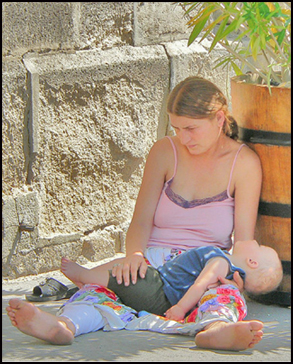
The Crime of Breathing While Homeless

In the United States over the past three decades, we have seen the invention of many new crimes (Driving While Hispanic, Voting While Black, Flying While Muslim, etc.) that are not officially on the books. But they are all too real for the people caught up in them. One of the new crimes is, apparently, Breathing While Homeless.

Check out this Executive Summary from the National Coalition for the Homeless (NCH). Its full title is “A Dream Denied: The Criminalization of Homelessness in U.S. Cities.” The numbers it utilized are a few years old, but if anyone imagines that things have improved since then, we have a nice bridge to sell them. (The bridge comes ready-equipped with a used tarpaulin, several sheets of prime cardboard, and… well, that’s all, actually.)

Depending on location, the statistics on people experiencing homelessness, and on available shelter space, may fluctuate. But the tendency to make homelessness a law enforcement problem continues to change for the worse. The authors of this report studied laws and practices in 224 cities and concluded,

This trend includes measures that target homeless persons by making it illegal to perform life-sustaining activities in public.

It mentions activities we have discussed on this blog, such as sittingsleeping, camping, cooking, eating, or begging in public places. Of course, most cities figure out quickly that a two-pronged approach works best. Go after the people experiencing homelessness, AND go after the people who try to help, such as organizations that provide food. Here are some of the measures that have been taken by municipalities in the Orwellian name of “Quality of Life,” according to the NCH report:

* Legislation that makes it illegal to sleep, sit, or store personal belongings in public spaces in cities where people are forced to live in public spaces;
* Selective enforcement of more neutral laws, such as loitering or open container laws, against homeless persons;
* Sweeps of city areas where homeless persons are living to drive them out of the area, frequently resulting in the destruction of those persons’ personal property, including important personal documents and medication; and
* Laws that punish people for begging or panhandling to move poor or homeless persons out of a city or downtown area.

There are of course numerous civil rights issues. Laws against vagrancy and loitering have always been constitutionally shaky, especially when the exact same behavior is accepted if the miscreant has a home where the police can tell them to go. (At Venice Beach, California, there used to be a street guy with a great line. If some tourist or local resident offended him, he would yell like a scolding parent, “Go to your room!”)

When a homeless person’s belongings are searched, or seized and arbitrarily destroyed, that’s Fourth Amendment territory. Begging for spare change just might be protected under the First Amendment. Then you’ve got the Eight Amendment, the one concerning cruel and unusual punishment, which applies when a person is accused of the heinous crime of sleeping.

So, what is accomplished by anti-homeless laws? They move people away from the centers, usually located in the inner city, where services such as food and job counseling are available. They make getting to these places even more difficult for people who must depend on buses (if they are lucky) or their own power of walking, to get around. Restrictive ordinances award thousands of homeless people with criminal records, as if they needed any more strikes against them in their efforts to emerge from the bottom layer of society. And the price of incarceration — don’t get us started. Jail is two or three times as expensive as supportive housing.

And then, there’s the little matter of international law. Our nation has signed on to global human rights agreements, prescribing humane treatment of people experiencing homelessness, which is fine for other countries but which we ourselves apparently don’t feel compelled to honor.

The report also offers some rays of light in a section called “Constructive Alternatives to Criminalization,” which is full of good ideas that have been either tried or contemplated by various localities. It offers helpful recommendations for the benefit of city governments, business groups, and the legal system, in dealing with these issues. Answers are proposed for both the chronic homeless, and the working poor or “economic homeless,” those who are unable to afford basic housing even though they have jobs.

However, House the Homeless has one big idea that would pretty much cover everything, and take away the need for each city to figure it out for themselves. It’s called the Universal Living Wage, and it will end homelessness for over 1,000,000 minimum-wage workers, and prevent economic homelessness for all 10.1 million minimum wage workers. You can also find out all about it in Richard R. Troxell’s book, Looking Up at the Bottom Line.

Reactions?

Source: “A Dream Denied: The Criminalization of Homelessness in U.S. Cities,” NationalHomeless.org
Image by quinn.anya (Quinn Dombrowski), used under its Creative Commons license.
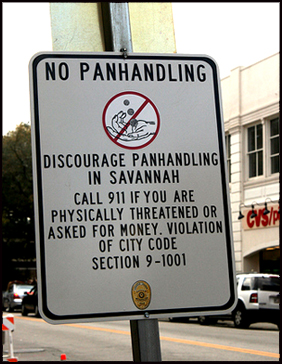
Lose – Lose – Lose – Lose: Tanya McDowell’s Homeless Plight

How important is it to end homelessness in America? Please see the information from House the Homeless on how the Universal Living Wage can save millions of Americans like Tanya McDowell and her young son.

John Nickerson reports on the situation in Norwalk, Connecticut, where McDowell faces a huge bill for reparations, and a 20-year jail term. The charges are grand larceny and conspiracy to commit first-degree larceny. The thing that was stolen, allegedly, was education for McDowell’s son, who was enrolled in the “wrong” elementary school for less than six months. They actually say that the attendance of A.J. Paches for that period of time amounted to more than $15,000 worth of educational services, which is astonishing. There are still colleges you can get into for less. The reporter tells us,

McDowell said she divides her time between an apartment on Priscilla Circle in Bridgeport, where she is not allowed to stay when the lease holder is away, the Norwalk Emergency Shelter and her minivan.

The address McDowell used to enroll her boy in Norwalk belonged to a friend in a public housing complex, who was subsequently evicted as punishment for her part in the alleged deception. (See our helpful article, “How to Become Homeless,” for more tips.) Emotions run high and hot on both sides of this controversy, and citizens have added many comments to the online coverage. If only people would become as excited about ending homelessness, as they are about a little boy going to school.

Part of the tragedy is that A.J. really loved going to school, and any parent knows how rare and precious that is. The Connecticut Parents Union has started a bottle-and-can drive to raise money to help McDowell pay the fine. The reporter talked to the group’s founder, Gwen Samuel, who said:

You would figure that a school district such as Norwalk would put the child first. Saying we had the child this long with no fixed address and you would think they would do anything to ensure that this baby is safe and stable. Instead they arrest the baby’s mother, knowing she has no fixed address. The system has failed this child because of what they did to his mother.

An even stronger reaction comes from Dr. Boyce Watkins, a Syracuse University professor who founded the Your Black World Coalition, and who sees not only homeless-bashing but racism in the Connecticut story. Dr. Watkins is still angry over a similar case in Ohio. Dr. Watkins characterizes McDowell’s crisis as sad and sickening, and says,

Simple logic implies that whatever resources were saved from him not being enrolled in his home district (whatever that might be) could be applied to the secondary district. So putting parents in jail for sending their kids to schools outside their district is simply a legalized way of fencing out those that the community deems to be undesirable… Beating up on a homeless woman who is doing all she can to get her child into school is a shameful microcosm of the kind of greed and selfishness our country has chosen to embrace. There was once a time when slaves were arrested for trying to learn how to read, and now poor mothers are being arrested for trying to send their children to the school of their choice.

Apparently, this is the first case of this kind in Connecticut that has actually been turned over to the police. (And let’s hope it’s the last.) The strange coincidence that McDowell and her son happen to be homeless, inspires some people to say “selective enforcement.” A homeless woman and child are easy victims.

But for the state to win is a Pyrrhic victory. It’s doubtful whether a woman with no address or job will pony up that $15,000. Say the going price for soda cans is 30 cents per pound. That seems to be about 37,000 pounds of redeemed metal. Or 300,000 cans at 5 cents each. Plus, how much will it cost the state to keep Ms. McDowell in jail for 20 years? Plus, a family is broken up. Plus, a kid who loved school will probably form a different opinion about that subject. Sounds like lose-lose-lose-lose, all the way around.

Reactions?

Source: “Homeless woman’s arrest for sending son to Norwalk school stirs debate,” Stamford Advocate, 04/21/11
Source: “Another Mom Jailed for Sending Child to Wrong School District,” DrBoyceWatkins.com, 04/19/11
Image by Nisha A, used under its Creative Commons license.

1

Austin Fire Creates Homelessness

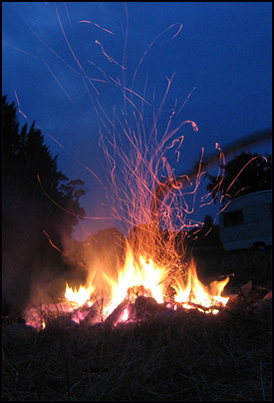
In Austin, Texas, Michael Weathers has been charged with arson (another report says felony reckless endangerment) for a fire that burned up 100 acres, causing severe damage to 10 houses and minor damage to six more. Dwellings have been destroyed, and people have been rendered… homeless.

This is a tragedy. Fire is one of the cruelest things that can happen in a person’s life, and its repercussions can last for years, forever. Weathers turned himself in, which is more than a lot of white-collar criminals have ever had the guts to do. How many homeless families are created by one corrupt mortgage company? How many bankers go to prison?

Weathers left the hot coals of a dying campfire unattended and went to buy beer. In a story already causing a great outcry, that’s the perfect detail to tip public sentiment over into virulence. Now it seems as if the reaction to one man’s dreadful mistake threatens to develop into something like a pogrom. That’s a strong word, but it does imply the organized persecution of a group of people, and in that sense it fits. As Andrea Ball, a philanthropy blogger for the Austin American-Statesman, expresses it,

The debate about Austin’s homeless is about to get very ugly.

Yes, the fire was intentionally set, and that is an element of the crime of arson, despite the fact that there was no intention to destroy anything. Yes, the man who did it should be held accountable. But when you’ve got local citizens who think it’s appropriate to talk about using the homeless “for target practice,” as one online commentator recommended, you’ve got a problem. The reporter says,

Austin’s homeless population already causes plenty of outrage amongst neighbors frustrated with the noise, garbage and disruptive behavior stemming from homeless camps in the greenbelt and other wooded areas. Advocates say the problem stems from a lack of affordable housing and other services to help the homeless.

Well, duh! Homelessness results from a lack of housing, that seems pretty obvious. Also, from expecting people who don’t even have facilities to wash themselves or their clothes, to get out there and function like high-powered yuppies. And from about a hundred other factors, none of which are helped by generating an atmosphere of fear and rejection. But even so, the issue has more sides than a pomegranate has seeds. This point was brought up by Statesman reader Mary Ellen King:

Even if affordable housing is an option as suggested in the article, many of them suffer from mental illness and will rarely sleep in shelters when afforded the opportunity.

So housing isn’t the only answer. To go along with walls and roofs, what we need is a society that cares for its members. For the mentally ill, there has to be some happy medium between the old way (incarceration in grim state institutions) and the new way (life on the streets.) Isn’t there a country somewhere on earth where this situation is handled? And if so, why aren’t we learning from that country and following its example?

Ball passed along one report of a large bonfire being irresponsibly built in the recent past, and she has learned that hundreds of people camp in the county’s wooded areas. Maybe a small percentage prefer the al fresco life. Probably, most would prefer not to be there. But what else can they to do? The Salvation Army shelter has space for 259 bodies. At the Austin Resource Center for the Homeless, there are only 100 beds. These have to be won by nightly lottery. The rest of the “beds” are 3 inch thick mats that one has to vie for in a second lottery.

ARCH is said to turn away as many as 50 people on a bad night. Lottery losers are turned out into the cold where they face “Quality of Life” ordinances such as no sitting, no sleeping and no camping. And now, because of the drought, the authorities have understandably announced a zero-tolerance policy toward open flames. Violation of the burn ban carries a $500 fine, and good luck on collecting it from a homeless person.

Police officers have begun visiting local homeless camps, urging them not to have campfires or open flames of any kind. In the department’s south district, officers were talking to people in the 35 to 40 known homeless camps and those panhandling at busy intersections.

As President of House the Homeless, Richard R. Troxell sent an email to colleagues that said,

Perhaps it was carelessness or perhaps it was a gust of wind that blew up from a dead still as it did in my presence just 5 minutes ago. The state of Texas is in a high fire condition. One and one half million acres have burned this year already… We all need to help one another and everyone is innocent until proven guilty either of arson or even carelessness.

Debbie Russell contributed this to the discussion:

So far I’ve not seen our community leaders lash out; but plenty of haters are doing so on online forums. I hope our leaders resist catering to the call for homeless-blood. One person is accused here; not a whole community. This is an isolated accident, not indicative of a practice of a group… To embark on a large-scale “sweep” campaign (as we have done already, in different areas of town like Waller Creek and on the camps) in an attempt to “solve” the “problem” would be wholly irresponsible of us… I’m REALLY hoping we can contain the knee-jerk urge to vilify all homeless people because of the act of one careless individual… Attacking the homeless is not the way to solve public safety issues. EVER.

Mellower Austinites suggest that this is a good opportunity to increase general awareness of homelessness, because it would be helpful to understand how people get in this position. Well, one of the ways they become homeless is when their house burns down because a fire was started in a nearby homeless camp. In other words, homelessness is a societal force that tends to grow exponentially. It’s like a snowball rollin’ down the side of a snow-covered hill.

One person’s story is that she let a homeless relative move in, which was against the terms of her government-sponsored housing lease, so she got evicted, and now she too is homeless. A young person’s story is that his homeless uncle moved into the family’s garage, and kept cornering him with sinister intent when nobody else was around. So he hit the road, and now there’s one more teenage runaway with an alley for a rec room. Homelessness begets homelessness.

So, yeah, understanding is good. Doing something is better. Now more than ever, Richard R. Troxell and House the Homeless urge the adoption of the Universal Living Wage. Richard says,

If we work together and house the homeless, then we dissolve the scenario. If local businesses paid fair living wages then 1/2 of the folks experiencing homelessness can work themselves off our streets and out of our woods. It’s not just up to the taxpayers to solve homelessness. We all share in the outcome. We’re all members of this community.

Reactions?

Source: “Oak Hill fire, arson and the homeless,” Charity Chat (Austin American-Statesman), 04/18/11
Source: “Police spread word of outdoor fire ban to homeless,” Austin American-Statesman, 04/18/11
Image by Jelle S. (Jelle), used under its Creative Commons license.3

Brianna Karp — One Woman’s Homeless Story

A lot of people have been writing about homelessness lately, and they fall into categories. In one group are the people who are chronically or temporarily homeless, telling their own stories from first-hand experience. We have talked about Becky Blanton, who spoke at the prestigious TEDGlobal conference in 2009 on the topic, “The year I was homeless.”

Because people experiencing homelessness form friendships and relationships just like anybody else, the writer might also tell stories of street comrades. For instance, Ace Backwords has been for many years the chronicler of the lives of Berkeley’s legendary street characters, like Blue, Talon, and Hate Man, “your typical, dress-wearing, former New York Times-reporting, hatred-spewing, homeless freak,” who is actually one of the nicest people you’d ever want to know.

Then, there are the objective reportorial types, journalists, bloggers, and allies who gather and then disseminate the stories of others. We have mentioned B. N. Duncan, longtime recorder of homeless lives in both words and photographs. Then there are the subjective reporters, who are not actually homeless themselves but who enter that world in order to bring back stories and publicize them, in hopes of raising public awareness. We’ll have more to say about them another time.

Today’s spotlight focuses on Brianna Karp, a native Southern Californian who started working at age ten, apparently because nobody else in her family was able to. All she ever wanted was to grow up to be a solid citizen, employed and home-owning. But it didn’t turn out the way she had planned — at least, not for long..

Karp had what anybody would call a good job, not that it mattered once she had been laid off. Only executives get those multi-million-dollar golden parachutes. The average employed person is just “let go” like a like an enemy spy shoved out of a helicopter over the ocean — bound, blindfolded, and with no parachute of any hue. Karp was luckier than many, and acknowledges it:

The company that I worked for was enormously kind and fair to each and every one of us, and compensated us well with a severance package, so I was OK for a while.

Thanks to that lucky break, and by scrambling for every possible opportunity to make a few bucks, Karp remarkably managed to delay her transition from housed to homeless for an entire half-year. But, inevitably, harsh exigency caught up. Because of another tragedy — the suicide of its owner — a travel trailer came into her possession and she set up a tenuous base from which to try and rebuild her life. Introducing her book, The Girl’s Guide to Homelessness, Karp says,

I am an educated woman with stable employment and residence history. I have never done drugs. I am not mentally ill. I am a career executive assistant –- coherent, opinionated, poised, and capable. If you saw me walking down the street, you wouldn’t have assumed that I lived in a parking lot. In short, I was just like you — except without the convenience of a permanent address.

Reviewed in Publisher’s Weekly and featured by TV shows, The Girl’s Guide to Homelessness was also written about by prominent author Augusten Burroughs in these words,

Brianna Karp is the perfect example of how a person can triumph not in spite of adversity but as a direct result of it. This smart, pragmatic young woman takes us inside the new face of homelessness in America and her dramatic memoir guides us through our assumptions, fears and judgment into a place of understanding, compassion and respect. Truly essential reading.

Once reestablished in the world of the housed and employed, Karp has not forgotten her desperate days, but wishes to help others cope, and to extend hope to people experiencing homelessness.

Here’s an idea that could change the landscape: the Universal Living Wage, which can end homelessness for over 1,000,000 minimum-wage workers, and prevent economic homelessness for all 10.1 million minimum wage workers. Please learn more about the Universal Living Wage and how to make it a reality.

Reactions?

Source: The Girl’s Guide to Homelessness by Brianna Karp
Source: “Where It All Began,” GirlsGuidetoHomelessness.com
Source: “Reviews,” GirlsGuidetoHomelessness.com
Image by PJFurlong06 (Patrick Furlong), used under its Creative Commons license.
Rulers and Vassals and Pay Differentials

If you only have time to look at one post today, please go straight to Richard R. Troxell’s piece on the 2011 Universal Living Wage Tax Day Event, because that’s coming up, and you might want to plan. Richard begins by quoting Deuteronomy 24:14-15, which instructs people not to abuse a needy and destitute laborer, because that person’s life depends on being paid. It’s a pretty sure bet that every spiritual tradition calls for similar behavior.

Once you start thinking about the whole subject of work and pay, whether in a religious context or in any number of purely materialistic ways; whether in the framework of homelessness or from the perspective of the millions of families hanging on by their fingernails, many questions come to mind. For instance, how much is a boss’s time worth, stacked up against the time of a low-level worker? This is the question answered by Douglas McIntyre for Daily Finance in a piece published several months ago, so please feel free to assume that the situation has not improved much. McIntyre says,

Even though the gap between executive and entry-level worker pay has shrunk ever so slightly in the past couple of years, it’s still not unusual for the CEO of a large public company to earn more per day than some of his employees earn over the course of an entire year.

Excuse me? What can a human being possibly do that makes one day of his labor worth more than someone else’s entire year? Sure, once in a while an astonishing genius comes along. A case could be made that the work of Thomas Edison was worth many, many times the work of certain other humans. But is the CEO of McDonald’s a reincarnation of Thomas Edison? No offense to whomever she or he may be, but probably not.

McIntyre looked at more than a dozen megacorporations and, working with the total compensation reports from proxy statements, came up with some mind-blowing numbers. The big boss at CVS Caremark Corporation makes the same amount of money as 1,461 entry-level workers. Doesn’t that just make steam come out of your ears? This is the outfit behind Long’s Drugs, #18 in the most recent Fortune 500.

What does it say about Americans that this retailer of pharmaceuticals is gigantically rich? When are we going to stop doing the things we do to make ourselves sick, and stop putting money in the pockets of rapacious health “care” providers? And here’s a heartbreaker. The Walt Disney Company is not all sweetness and light, nor is it all song, dance, and fun. The head honcho pulls down as much as 1,115 lowly employees.

Don’t forget to do business with a couple of companies whose pay scales are a bit closer to fair. At FedEx Corporation, for example, the biggest boss is worth the monetary equivalent of 251 entry-level employees, and at Costco Wholesale Corporation, the CEO’s pay envelope only holds an amount comparable to what 115 serfs are paid.

Mark Karlin wrote for Buzzflash about the amazing resurgence of monstrous bonuses for CEOs. The Wall Street Journal article that attracted Karlin’s attention is certainly provocative. Apparently, the newspaper commissioned a consultant to scrutinize pay disclosures made by corporate heads. Here is an example of the findings:

CEO bonuses at 50 major corporations jumped a median of 30.5%, the biggest gain in at least three years…

No doubt about it, something is wrong with this picture.

Reactions?Source: “How Many Workers Can You Hire for the Price of One CEO?,” Daily Finance, 07/07/10
Source: “A Tale of Two Americas: One America Lives on Greed; The Other America Barely Survives to Live,” Buzzflash, 03/18/11
Source: “Executive Bonuses Bounce Back,” The Wall Street Journal, 03/18/11
Image by Beau B, used under its Creative Commons license.5

Everybody’s Gotta Be Someplace

It’s hard to tell when this National Coalition for the Homeless (NCH) page was last updated. But it’s safe to assume that the overall situation has not improved, since whenever. The NCH page, entitled “The Criminalization of Homelessness in U.S. Cities,” says,

An unfortunate trend in cities around the country over the past 25 years has been to turn to the criminal justice system to respond to people living in public spaces. This trend includes measures that target homeless persons by making it illegal to perform life-sustaining activities in public. These measures prohibit activities such as sleeping/camping, eating, sitting, and begging in public spaces, usually including criminal penalties for violation of these laws.

Last week in Boulder, Colorado, a homeless man who was ticketed last April for sleeping in a parking garage, attempted to use an Eighth Amendment defense against the charge. That’s the one about cruel and unusual punishment. Once convicted, Michael Fitzgerald was supposed to either pay a $100 fine or do 12 hours of community service. Instead… well, let Heath Urie, staff writer for the Boulder Daily Camera, tell the story:

Fitzgerald appealed the case to the Boulder County District Court on the grounds that the city’s law against camping in public places essentially punished him for being homeless and having an involuntary need for warmth and shelter as he sleeps at night.

Yes, it looks like the rule he broke is not only cruel and unusual, but discriminatory. However, unfair as it is from the viewpoint of a person experiencing homelessness, so-called respectable society disagrees. Urie reports how Judge Lael Montgomery expressed a strangely familiar sentiment, saying,

The camping without consent ordinance applies to all persons who wish to camp in Boulder, regardless of whether they are homeless, shoestring travelers trying to avoid the cost of accommodations, or persons who merely enjoy the great outdoors.

Nobel Prize-winning author Anatole France said it decades ago:

The law, in its majestic equality, forbids the rich as well as the poor to beg in the streets, steal bread, or sleep under a bridge.

Attorney David Harrison, no doubt familiar with the classical allusion, echoed it in his argument about the city’s ordinance:

It’s certainly saying people with homes and people without homes can’t sleep under bridges… While certainly as a conceptual matter that’s true, as a practical matter (the law) targets the homeless population.

The journalist tell us that Fitzgerald is one of several local people experiencing homelessness who have challenged the tickets they’re received, on constitutional grounds. Boulder is like that. He also provides a helpful sidebar on the page, detailing the No Camping Ordinance, which has been in effect since 1980.

Recently, we talked about how in Austin, Texas, House the Homeless kept track of how many people were busted for sitting or lying down on public sidewalks in the downtown business area during 2009. Over the whole year, there were 708 convictions and 70 dismissals. The highest month was September, when 518 citations were issued. (The month-by-month count for the entire year adds up to way more than 778, so presumably, some legal processes were still going on when this survey was made.)

Anyhow, out of those mere 70 dismissals, only a paltry 52 were dismissed for mental health or medical disabilities. Statistically, what that means is, a lot of people were unfairly treated. Here’s why: In the health survey, 501 people were asked whether they needed to sit and rest now and then. The large majority answered yes. Even people who aren’t officially disabled need to sit down, occasionally. Think about it. Homes are filled with chairs. If people didn’t need them, they wouldn’t be there. People experiencing homelessness don’t have chairs. But they too need a place to sit.

(To be continued…)

Reactions?

Source: “A Dream Denied,” National Coalition for the Homeless
Source: “Boulder judge rejects homeless man’s appeal, upholds city’s anti-camping law,” Daily Camera, 04/08/11
Source: “Richard Troxell’s Health Survey Testimony,” House the Homeless, 07/20/10
Image by tobyotter (Toby Alter), used under its Creative Commons license.