Our Mission

Founded in 1989, HtH is the oldest all volunteer, action, homeless organization in the state of Texas. The mission is Education and Advocacy around the issues of ending and preventing homelessness.

Urgent Issues

Re-Criminalizing Homelessness — Speak up now!

HtH supports the direction being taken by the City of Austin’s relatively new Homeless Strategy Office, led by a very committed and responsive David Gray, and with the commitment of Charles Loosen and other staff. We further strongly advocate ALL positions below that preceded The vote to basically criminalize homelessness — especially:

reinstating a camping ban must consider that those with disabilities, the aged, and in fact anyone with no place to go. The no sit/no lie ordinance is absolutely inhumane and unconscionable we must have at least 15 minute respites particularly for those with disabilities and make other provisions.

Mayor Kirk Watson, elected in 2023, is working to secure funding for homeless services from the State and within the City Budget.

2025 interests:

City Council approved a resolution making homelessness a top financial priority.

Increase the capacity of the Homeless Strategy Office to address and implement a comprehensive approach to strategic advancements in homelessness response. (Plan detailed in a 50-page memo from David Gray, June 2025).

Examples:

1. Expand HOST (Homeless Outreach Street Team) support including team members:

APD officers, EMS paramedics, behavioral health clinicians, social workers, peer support staff.

2. Support for Marshaling Yard operations.

3. Rapid Response housing and safe housing, especially for families.

4. Increase shelter beds with support; and more.


The Austin city council recently voted to put on its May 2021 ballot a vote to reinstate the no camping ban including the no sit/no lie ordinances. Now is the time to contact your mayor and council members particularly those who have supported decriminalizing homelessness, such as Mayor Adler, Kathy Tovo, Ann Kitchen, Greg Casar, Sabino Renteria, and others, we pray.

First call to action is cold weather shelter. Anyone that reads this, our urgent plea is to email our mayor and city council in this urgent time of cold weather. House the Homeless is encouraging to use the Convention Center or other alternatives sites that are already over burdened due to Covid-19 or at capacity.

A second call to action is to not displace unsheltered neighbors from bridges and the four major camp areas without having an immediate plan for alternative shelter/housing.

Finally, advise your mayor and council members that the wording for the May ballot regarding reinstating a camping ban must consider that those with disabilities, the aged, and in fact anyone with no place to go. The no sit/no lie ordinance is absolutely inhumane and unconscionable we must have at least 15 minute respites particularly for those with disabilities and make other provisions.

Federal Minimum Wage Debate

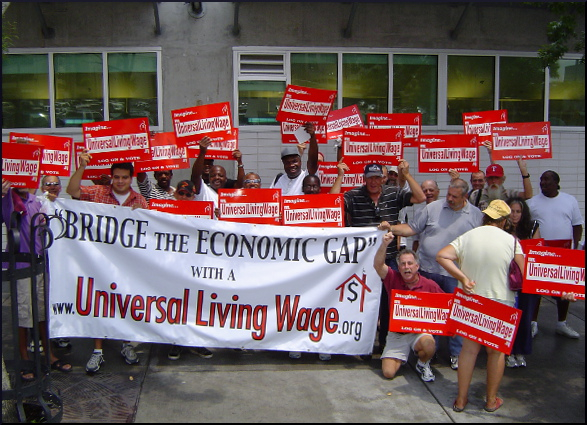
Federal resolve is insufficient; highly recommend Universal Living Wage formula indexed on the cost of housing wherever the person lives and works. 

The No Sit/No Lie Ordinance and the Americans with Disabilities Act

First tangent: Really, at this moment, the thing to pay attention to is the upcoming Tax Day Action. So, hop over to that page to find out what part you can play in making the Universal Living Wage a reality. Then come on back here, okay?

Second tangent: Did you ever accidentally run across some little tidbit of news or information that just makes your day? Sometimes it even does more than that — sometimes it lifts the heart and gives hope for the future. For instance, Nicole Pariser, having completed a combined honors degree in Global Studies and Anthropology at Wilfrid Laurier University, is now at York University, in Toronto. These words are from her Graduate Student Profile:

In broad terms, my research focuses on migration and mobility; who is allowed to move and who is not, and how these choices are justified, particularly by nation states to their citizenry… My research has primarily focused on human trafficking, however following experiences in Vancouver’s downtown eastside, as well as San Francisco, specifically relating to homelessness and the passage of ‘no-sit-no-lie’ policies, my research interests have expanded to include the ways in which migration and mobility come to be constrained not only across national borders, but within them as well… I believe… in the transformative power of engaged anthropology and activism to expose, contest and change that which is unjust.

Now back to our regularly scheduled post. We’ve talked about Austin’s No Sit/No Lie Ordinance before, but not in as much detail as the subject deserves. Here is the background. In 1989, Richard R. Troxell created House the Homeless (HtH) and began challenging the No Camping ordinance that criminalized the homeless for their economic circumstances by fining them $500 for sleeping outdoors. He is still fighting for change in the rules of that excellent Texas city.

Being especially appalled by the treatment of people experiencing homelessness who are also disabled, HtH strives to banish ignorance by collecting facts. As Richard testified to the Health & Human Services Committee of the City Council in July 2010, the HtH surveys found that nearly half of the homeless have medical (including psychological) conditions that make them need to sit down from time to time. Sometimes it’s the effect of their medication that makes them need to sit down, but they’re on medication because they have medical problems, so it amounts to the same thing. But there were no exceptions for this group of people, not even if they were on crutches or wearing a leg brace. Sitting around in public was good for a fine or a jail sentence.

HtH took the position that Austin was out of compliance with the Americans with Disabilities Act (ADA), one of the federal laws that states really are supposed to observe. Also, the ADA is not the Americans with Physical Disabilities Act.

HtH garnered support from other organizations such as Mobile Loaves and Fishes; St. David’s Episcopal Church; Legal Aid for the Homeless; Advocacy, Inc.; and the National Coalition for the Homeless. They were asking for 20 exceptions to the harsh law, but the city would not consider any of them. Among those expected to stay on their feet at all times were people newly released from hospital treatment; people officially recognized as unable to work by the fact that they receive disability checks; patients waiting in line at health clinics; and disabled veterans. Particularly, the city seemed to target people with mental disabilities, who can be persecuted and prosecuted without very much complaint from the voting public. As Richard says,

…people suffering with mental health disorders are routinely treated with very powerful drugs that often cause them to become woozy and dizzy. They often have sunlight and heat sensitivity that depletes them of their energy and causes them to need to temporarily sit and rest.

A mentally ill, disabled person experiencing homelessness is particularly vulnerable to being punished for her or his condition. How does a person like this go to court and prove that they were, on a certain day, at a certain time, suffering from pain, weakness, nausea, faintness or dizziness? But the city insisted that the accused must “create an affirmative defense.” Richard met with various authorities, including the chief of police, but reports, “The Chief said that he simply did not want disabled homeless people sitting and lying down all over the city.”

So there you have it. You’d think the city was being invaded by commies or rabid biker gangs or Black Panthers or terroristic Islamists or interplanetary aliens. But no, it’s worse. It’s a bunch of people who are in the midst of being pretty badly beat up by life. And they have the gall to sit on the ground, or, worse yet, lie on the ground. That is the threat from which the police are happy to defend us.

Reactions?

Source: “Anthropology Graduate Student Profiles,” York University
Source: “Austin City Council Discriminates Against the Disabled,” housethehomeless.org, 01/19/11
Image by Kevin Wong (Marlith), used under its Creative Commons license.
Homes Needed to End Homelessness

Following the success of our guide on “How to Become Homeless,” here are a few more suggestions. We spoke of earthquake, fire, foreclosure, and domestic disharmony as popular methods of achieving homelessness. Another strong force has been the change in entire societal institutions. In Looking Up at the Bottom Line: The Struggle For the Living Wage, Richard R. Troxell describes some of the ways in which large demographic segments have been rendered homeless, especially young men and single older men. He writes,

Adding to the complexity of homelessness was the loss of several million SROs (single room occupancy units) when motels and cheap apartments were torn down and replaced with condominiums or made into parking lots. Another dynamic affecting our nation’s poor was the decision by the YMCA, the Young Men’s Christian Association, to leave the SRO field of housing.

Back in the day, and we mean way back, even a family of lower economic status could conceivably be living in a large, rambling house. Almost any house could be made into a boarding house. Rooms could be rented to traveling salesmen, or teachers (who were not allowed to be married), or even actors.

More recently, the trend in houses became smaller, yet more open. It’s much more difficult to carve out a space for an extra person or family. Now, cities and neighborhoods and housing developments all have rules about how many unrelated people can cohabit, how many cars per household, how many toilets, and so on. Nobody’s home is their castle, not if they want to rent out a room. This is bad both for homeowners who need some extra cash, and for people who need cheap temporary digs.

If rental housing is available, the prospective renter is faced with numerous hoops through which to jump. High move-in costs, don’t get us started. First, they charge you to even look at the place. Yes, there is a fee to even apply. And if the manager is crooked, you may expect more special fees to be extracted, down the line. To move in requires a lump sum of first and last month’s rent plus security deposit, with of course more deposits for special circumstances like pets.

Not to say this is necessarily wrong. It costs a lot to refurbish a trashed apartment, and people can be pigs. The self-justification is, “So what? It’s the landlord’s money.” Maybe so, but he’s gonna get it back from all the other tenants. For that kind of vindictiveness, everybody pays. It may be necessary, out of fairness to landlords, to pay the equivalent of three months’ rent up front. But it’s not easy. Here’s the situation, as described in Looking Up at the Bottom Line:

More than the minimum wage is required in every state to be able to afford a one bedroom apartment at Fair Market Rent, as set by the U.S. Department of Housing and Urban Development

This is why America is seeing a lot of economic homelessness, which is what happens when even those who are working full-time can’t afford a place to live. You are invited to learn more about the Universal Living Wage, which is expected to end homelessness for over 1,000,000 minimum-wage workers and prevent economic homelessness for all 10.1 million minimum-wage workers.

We have talked about Jimmy McMillan, who got a lot of attention in last year’s New York State gubernatorial race. His platform, “The Rent Is Too Damn High,” inspired AnnaMaria Andriotis to explore the question in The Wall Street Journal.

She relates how, in the midst of a phone conversation with another reporter, McMillan stopped a passerby on the street to ask if his rent was too high. And one of the examples she gives of impossible rent comes from Austin, Texas, coincidentally the city where Richard R. Troxell lives and works with House the Homeless. Andriotis writes,

In Austin, Texas, a new two-bedroom two-bath condo runs around $1,800, but cost $1,200 before the downturn, says Jack McCabe, CEO of McCabe Research & Consulting, which tracks the housing industry. In Austin, income fell 4.9% to $35,522, making that 35% of income threshold a meager $1,036 rent payment.

Andriotis also mentions the mysterious formula that addresses the question, “How much rent should a renter pay, if a renter could pay rent?” She writes,

Many personal finance experts say you should spend no more than 35% of your take-home gross income on rent (not including renter’s insurance) whether you live in a high- or low-cost area.

Wait a minute! Just a little while ago, the experts were telling us not to spend more than 30% of our income on rent. Now it’s more. As responsible citizens today, we are supposed to feel as wise and mature about paying 35% as we felt a few years ago when the experts advised us to put a lid on at 30%. And it’s not as if we have a choice about it. Even 30% and 35% are not the worst. Apparently, some people spend more than 40% of their income on rent. That is one of the criteria for eligibility when Habitat for Humanity helps a family build a house.

You know what? It used to be 25%. That’s what the financial advisors used to say. Within living memory, it was taught in home economics class. You were a prudent money manager and a good citizen if you followed the rule of not paying out more than a quarter of your income for rent. It’s insidious percentage creep, meant to fool us into thinking we are doing the grown-up thing by handing over such a large proportion of our income for rent. They keep raising the bar, and pretending that nothing is amiss. They’re messing with our heads, and it’s positively Orwellian.

Reactions?

Source: Looking Up at the Bottom Line: The Struggle For the Living Wage by Richard R. Troxell
Source: “Is Your Rent Too Damn High?,” The Wall Street Journal, 10/19/10
Image by Rex Dingler/dingler1109, used under its Creative Commons license.0

Medical Ethics and the Hospital Industry

The lives of people experiencing homelessness are inextricably involved with hospitals. One of the most affecting parts of Richard R. Troxell’s book, Looking Up at the Bottom Line, is the story of Diane Breisch Malloy, whose tragic death in Texas inspired the inauguration of Austin’s annual Homeless Memorial. If this sick woman had been in a hospital where she had probably belonged, she would not have been sleeping in a dangerous spot, and would not have been swept away by storm water and drowned.

A few days ago, we talked about past behavior by an Inglewood, California, hospital that strikes many people as quite irresponsible, and some consider it downright unethical. At the very least, it was lousy patient discharge management. That news story was the latest, but not the only case of what has been rudely called homeless dumping, which looks like a growing trend.

Los Angeles Times reporter Richard Winton writes,

Since 2006, the city attorney’s office and Los Angeles Police Department have uncovered hundreds of cases in which patients were dumped by hospitals across the region at facilities in skid row and other homeless shelters.

Winton previously reported on other examples of what LA City Attorney Rocky Delgadillo calls a “horrendous and unconscionable practice.” For instance, the journalist wrote about how 54-year-old Gabino Olvera had been unloaded from a Hollywood Presbyterian Hospital van and left on Skid Row. This was done in front of several witnesses who questioned the driver about the lack of wheelchair or other support equipment. Winton wrote,

Olvera, wearing a soiled hospital gown and a broken colostomy bag, was found in February 2007 crawling in a gutter downtown.

In 2009, Winton joined with fellow reporter Cara Mia DiMassa to expose other similar disposals of discharged patients, like the one performed by College Hospital. The patient was Steven Davis, who was diagnosed with bipolar disorder and schizophrenia and schizoaffective disorder:

Doctors at the Costa Mesa mental institution prescribed him numerous drugs to deal with paranoid delusions that had led to an earlier suicide attempt. But that didn’t stop the hospital from hauling Davis into a van and driving him more than 40 miles north to downtown L.A., where they dropped him off outside the Union Rescue Mission. When mission officials complained to the hospital, the van returned and drove Davis a few miles south to another shelter. Davis wandered away without ever entering.

When these various news articles were published, comments from the public voiced emotions that ran the gamut from intense sympathy for the patients to total exasperation. What is a hospital supposed to do with a patient who has nowhere to go? If the person still suffers from the presenting diagnosis, but it’s not life-threatening, what then? If the person has been cured of an acute illness but is still burdened by one or more chronic illnesses, what then? If the person is as well as a homeless person ever gets — what then?

The reporters tell us about a new city law that requires the written consent of a patient to be taken anywhere other than his or her residence. Exactly how this will help any homeless patients is not clear. The Southern California hospitals that have been reprimanded and fined for wrongful disposition of discharged patients have also been made to sign an agreement about future behavior. An injunction orders them to not transport homeless psychiatric patients to the streets or shelters of the “patient safety zone,” in other words, Skid Row and the extended area of downtown and south LA where most of the missions and shelters are.

But… that’s where the missions and shelters are. What if that is exactly where the patient wants or needs to go? Taking them somewhere else just makes it more difficult for them to obtain the needed services. It’s hardly a solution. And, of course, like any rule, the rule against dumping discharged patients in the worst inner-city areas has to be enforced by somebody. That would be the police, and it’s another wrinkle in the overall situation. Apparently, law enforcement agencies are also in the habit of routinely dropping off people released from custody in the Skid Row area. Well, where else are they going to take them? Rodeo Drive?

Who is responsible for what? The situation is complicated by larger questions of personal freedom and autonomy. What if a person of legal age is discharged from an institution and simply does not want to be delivered anyplace? What if she or he doesn’t feel like requiring anyone to show up and take responsibility? Shouldn’t an adult citizen have the right to just walk out the door? The whole situation is a mess from any point of view, and it’s one problem that really, really needs to be handled.

Reactions?

Source: “Hospital accused of dumping L.A. homeless woman to pay $125,000 fine,” LA Times, 03/18/11
Source: “Skid row dumping suit settled,” LA Times, 05/31/08
Source: “College Hospital to pay $1.6 million in homeless dumping settlement,” LA Times, 04/09/09
Image by miss pupik (Shira Gal), used under its Creative Commons license.
2011 Tax Day Action: An Appeal from Richard R. Troxell

You shall not abuse a needy and destitute laborer, whether a fellow countryman or a stranger in one of the communities of your land. You must pay him his wages on the same day, before the sun sets, for he is needy and sets his life on it; else he will cry to God against you and you will incur guilt.

Deuteronomy 24:14-15

Greetings!

Mark your calendars and contact your Board of Directors! Friday, April 15th, is our 11th annual Universal Living Wage Tax Day Event! From 7:30-9:00 am and 4:30-6:00 pm, we will go to our nation’s post offices and call for a Universal Living Wage. Once again, 3.5 million minimum-wage workers are expected to experience homelessness this year. Using existing government guidelines, we have devised a single national formula that ensures that anyone working 40 hours a week will be able to afford basic food, clothing, shelter (utilities included), and have access to health care.

We have found that American businesses have grown to rely on government subsidies to pick up that portion of the basic wage that they have failed to provide. Workers have been forced in ever increasing numbers to depend on food stamps, general assistance, and Temporary Assistance for Needy Families (TANF). Congress intended these to be emergency, stop-gap measures. Instead, many businesses use government support to save on basic payroll. A national shift is occurring from the businesses’ responsibility of paying a “fair wage for a fair day’s work” to creating an ever increasing burden on the taxpayer.

We know that if businesses paid their employees a fair living wage, we could dramatically reduce the burden to taxpayers.

We will provide you a 4-foot by 10-foot banner, free, that says:

Reduce Your Taxes!
… with a
www.UniversalLivingWage.org

People will be drawn to the ULW website, which will display your contact information. We encourage you to use this opportunity to tout your own local living wage campaign. We can provide the banner, push cards (clearly explaining the formula), and a flyer explaining the issue.

Save us workplease email us your desire to participate. Some of you do not have email, so, for you, this will be our only opportunity to communicate. Call us at (512) 796-4366 or toll free at (888) 484-8591 if you wish to be a lead organization and receive a banner or just join in at a post office action lead by another organization.

Select the post office in your city where the media shows up every year to report on the last-minute tax return filers. Then call or email us with that address at rrtroxell@aol.com. Be sure to put “Tax Day” in the subject line.

Don’t delay, act now, April 15th is almost here!

Go to www.UniversalLivingWage.org to see photos of our past Tax Day and “Bridge the Economic Gap Day” held on September 6th. We are creating a national ground swell of support which will carry us to the “tipping point” when we will fix the Federal Minimum Wage and create a Universal Living Wage!

In Unity There Is Strength,
Richard R. Troxell

P.S. Hunger Action Network NY won our digital camera for best action. Is it your turn?1

Richard R. Troxell Speaks in Nation’s Capitol

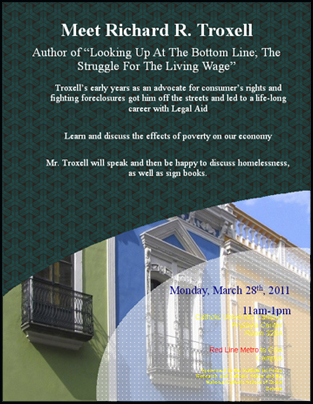
Yesterday, Richard R. Troxell spoke about Looking Up at the Bottom Line at the Catholic University of America (CUA) in the heart of Washington, D.C. As we know, and now the attendees of this event know, his message is that the Universal Living Wage can change America by ending homelessness for over a million minimum-wage workers, and prevent 10 million minimum-wage workers from falling into economic homelessness.

Economic homelessness is the lamentable condition people find themselves in when they are employed, maybe even working more than one job, and still can’t afford basic rent and utilities. Richard was invited by the Institute for Policy Research and Catholic Studies, whose interest in both the national economy and the housing crisis are longstanding.

Last month, for instance, Anthony Stasi wrote about the Veterans Affairs Supportive Housing (VASH) program. Stasi has been a policy associate with the National Alliance to End Homelessness and senior policy analyst for the Department of Homeless Services in New York City.

VASH, Stasi informs us, is the only permanent housing program focusing solely on military veterans. He points out the shameful fact that while veterans make up only 1% of the general population, they account for 10% of the homeless. He is concerned, as we all should be, about the large number of servicemen and women who have yet to return from foreign lands to this increasingly sick economy. Here is a sample of what Stasi is thinking:

Cities with high inventories of foreclosed property are desperate to find owners for these homes. Just this week, the Mayor of Detroit began offering police officers a similar incentive. What makes offering foreclosures to veterans even more sensible is that of the 20 cities with the highest foreclosure rates, most of them are in California, Florida, Nevada, and Arizona. These are all locations where many veterans already live after serving out their contracts.

Richard’s visit was also sponsored by the university’s National Catholic School of Social Service, whose very comprehensive program achieves a harmonious blend of scholarship, social justice, and service. CUA is the national university of the Catholic Church, founded way back in 1889, and currently teaching students at every level, from 97 different countries. It is right next to Basilica of the National Shrine of the Immaculate Conception, the largest Catholic church in the United States, and a short Metrorail ride from the Library of Congress and numerous other cultural monuments.

From the Sublime to the Publicity-Conscious

As always, Hollywood has been doing its bit for the cause. Not long ago, we noted Janet Jackson’s revelation that she and her late brother, on at least one occasion, bought food from a restaurant in Los Angeles and drove around giving it away. Michael was the driver and his sister took care of the distribution.

Also, for Celebrity Baby Scoop, Jenny Schafer reported on the doings of the world-famous singer’s extraordinarily attractive kids, as they shared resources with people experiencing homelessness:

Michael Jackson’s children — Prince, 14, Paris, 12, and Blanket, 9 — were photographed playing games and donating time and money ($10,000.00) to a homeless shelter in Los Angeles, Calif. on Wednesday (February 23).

In another part of Los Angeles, a musician calling himself Paz crashed Hilton’s birthday party and absconded with a birthday cake. An artifact of surpassing ugliness, the cake was worth $2,000 or possibly $3,200. Paz drove the cake down to Skid Row, cut it in 125 pieces, served it up to 125 homeless people, posted the photos on Facebook, and wrote very entertainingly about the whole episode, too.

This kind of news cannot be ignored, no matter how frivolous a person might think Paris Hilton is, because every effort to aid people experiencing homelessness deserves to be honored for its good intentions, and that includes even goofy publicity stunts like the cake caper which, believe it or not, probably went some way in raising awareness about homelessness. In under a week, Paz fielded nearly 150 requests for interviews, and claims to have tracked 12,560 news articles about the event, and 322 mentions on TV.

2011 Homeless

by Thom the World Poet (Thom Woodruff), dedicated to “Vagabond” Dustin Russell

you need to carry all you own
so you learn the art of stash-
perhaps a car that no longer works
can be your library /crash pad
perhaps couch surfing
trusting to the kindness of strangers
you are food for police
and anyone in authority
who forget we are all just one degree of separation
job cuts make homeless/dispossession is eternal
when you move, it will be walking-
a bicycle gets flat tires /a car breaks down
your two legs ,a bag, perhaps a shopping trolley
You learn by watching/earn by panhandling
perhaps you can drum or play guitar
(it needs new strings/you improvise)
Even if you seek work, you need an address
You hang out with the dispossessed-
in Green Belt or bush cover-away from eyes
where you can light a fire and stay calm
You know one hundred and sixty two of you
died on these streets this very year
You look for opportunities to work-
even the bad jobs are gone
There will be more of you when you are gone
you write this down. Settle down. Stay calm.
Whatever happens next is still unknown

Reactions?

Source: “Housing Our Heroes… And Helping Our Economy,” ipr.cua.edu, 02/09/11
Source: “National Catholic School of Social Service,” ncsss.cua.edu
Source: “The Jackson Siblings Donate To Homeless Shelter,” CelebrityBabyScoop.com, 02/26/11
Source: “Let Them Eat Cake,” Facebook.com, 02/22/11
Event poster courtesy of Catholic University of America; used under Fair Use: Reporting.
1

Homeless Dumping – the Wave of the Future?

It used to be that Southern California was the predictor. Whatever the folks in LA were doing, the rest of the country would be doing it pretty soon. Maybe that tendency still applies.

In the case of homeless dumping, let’s hope not. Some deny that there is such a thing. Others say well, yes, but what else are we supposed to do? This Los Angeles Times story could bring a strong man to tears or make an angel curse.

Staff writer Richard Winton tells us about a legal matter that has finally been settled after four years of wrangling. This goes back to early 2007, when a woman with lung disease, and connected to a portable oxygen tank, was discharged from Centinela Freeman Regional Medical Center in Inglewood, California. She was dropped off at a homeless shelter — not even an established, permanent shelter, but a temporary cold-weather shelter at the Armory in West Los Angeles.

A lawsuit was brought by the City Attorney’s office, and here’s the upshot:

The hospital’s owner will pay $125,000 in penalties and charitable contributions and will abide by rules forbidding such practices at medical facilities it owns… The hospital corporation did not acknowledge any wrongdoing but agreed to abide by best practices protocols for discharging homeless patients.

Let’s fantasize for a moment. What if that $125,000 had been spent on the homeless woman? For much less, the hospital could have hired private-duty nurses round the clock to take care of that patient’s every need, plus an advocate to work full-time at finding a safe lodging for her. For comparison purposes, it costs the criminal justice system $47,000 per year to incarcerate someone out there in Cali. That 125 grand could have bought that homeless woman more than two and a half years’ lodging in the Graybar Hotel. It could have even paid room rent for a couple of years in a real hotel, a nice one.

At first glance, that $125,000 figure sounds almost impressive. But it is illusory. It breaks down to $5,000 worth of civil penalties, a cash amount that in no way compensates the city for what it cost to prosecute the case. Not even close. This is not to imply that the charges should not have been brought, merely to point out that the heftiest portion of the bill is paid, as usual, by the taxpayers. As for the hospital owners, the bulk of the settlement will be payable in the form of $120,000 worth of “charitable contributions to a homeless recovery network that helps mentally ill patients.”

A person doesn’t like to be cynical, but this sounds kind of amorphous. A good lawyer could convert the sentence to “in kind” contributions, like some vaguely promised counseling program for certain types of patients, which may or may not ever materialize. A person doesn’t like to be distrustful, but this penalty appears to be largely symbolic. And it took four years to even get that much.

Centinela Freeman is not the only hospital that agreed to an out-of-court settlement recently. In a similar case, Kaiser Permanente (having sent a 63-year-old woman out into the world by taxicab, wearing a hospital gown) promised to donate half a million dollars or, possibly, something intangible that it claims is worth that much.

College Hospital must pay $1.6 million in penalties and charitable contributions to various agencies. It is said that in 2007 and 2008, this one hospital alone dumped more than 150 patients on skid row. Mentally ill patients. Hollywood Presbyterian’s homeless dumping case involved the donation of $1 million to nonprofit groups. It would be real interesting to know if anything close to a million ever finds it way to those organizations.

Of course, they all promise to adopt better discharge rules. Hospitals can volunteer to sign on with a voluntary code of ethics. Or they can be required to, as part of the settlement agreement, if they are accused of unscrupulousness. Things have reached the point where hospitals must be told not to dump patients on skid row. Wouldn’t that be a thing you would want to kind of take for granted? Winton says,

The protocols, signed in recent years by several Southern California hospitals, give specific requirements for how patients are to be released from hospitals and how they should be evaluated after their release. It also outlines a process for getting those who need additional care placed into medical or social service programs.

As for homeless dumping spreading to the rest of the country, it looks like it already has. Last November, for instance, we noted an incident in Indiana where a bureaucrat shocked the parents of a disabled child whose benefits had run out, by suggesting that they drop off the patient at a homeless shelter.

Los Angeles had a couple of City Attorneys, Rocky Delgadillo and Carmen Trutanich, who took this shabby treatment of people experiencing homelessness very seriously. California has a state law designed to prevent unfair business practices, which allows a corporation to be sued for unscrupulous behavior. Imagine that! In general, granting human status under the law to corporations is a lousy idea. But if they can be sued for a lack of scruples, there’s an example of how it might not be such a bad thing.

What the hell is going on with the human beings, here on Planet Earth? More to the point, what is going in the USA? As Southern California sets the fashion for the nation, America sets things in motion for the rest of the world. We think we’re so great, we want every other country to imitate us in every possible way, adopt all our systems and assumptions, and model itself after the United States of America. And this is the example we are setting for the world.

Reactions?

Source: “Hospital accused of dumping L.A. homeless woman to pay $125,000 fine,” LA Times, 03/18/11
Image by Joe Shlabotnik, used under its Creative Commons license.

How to Become Homeless

Here, in no particular order, are a few contributing factors to becoming homeless.

1. The earthquake/tsunami combination is a guaranteed creator of homelessness on a massive scale. Live in a place like Japan, Haiti, or California, and sooner or later, you or someone you love will be displaced by natural disaster. Same goes for hurricanes, just about anywhere. Floods are also a traditional and almost totally reliable way to be rendered homeless.

Richard R. Troxell says in Looking Up at the Bottom Line:

Many factors led to the full-blown homelessness in which we now see our nation embroiled. For the last several years, the number of people experiencing homelessness on an annual basis in our country has risen to three and a half million people. At times, the numbers have swollen beyond that due to disasters like hurricanes Rita and Katrina.

2. Fire is a popular way to become homeless. Quantitatively, fire may not account for the largest number of people experiencing homelessness for the first time, but it sure does make headlines. Nowadays, after every fire, there is not only a death toll and an injured toll, but a homeless toll. This is a perfect example of what we mean by awareness. These numbers help to remind us that there are other kinds of damage besides being dead or wounded. Also, there are other losses more important than the destruction of buildings.

3. Mortgage foreclosure used to be a relatively rare and extremely awe-inspiring phenomenon, but now it’s like the common cold. It leads to a wider range of possible outcomes. Some former homeowners manage to get into a cheaper house, or a rental, or they move in with relatives. Others wind up in family shelters, or live in vehicles. And, of course, there is always the street.

Buying a house is the biggest purchase and most serious financial commitment that most people will ever make. It takes a truly analytical mind to appreciate the deep absurdity of some of the stuff that has been going on. Robert Scheer, for instance, described how the process that controls the fate of millions of homeowners is run by robots. Astonishingly, even some of the voracious banks in charge of the disastrous housing market had to admit that it was time to curb the insanity and call a temporary moratorium on foreclosures. Scheer asked,

How do you foreclose on a home when you can’t figure out who owns it because the original mortgage is part of a derivatives package that has been sliced and diced so many ways that its legal ownership is often unrecognizable?… To engage in the recklessness of turning people’s homes — their castles and nest eggs — into playthings of Wall Street market hustlers, or securitization of the assets, as it was termed, homeownership record-keeping had to be mangled beyond recognition.

Speaking of working at a minimum-wage job… According to the last several U.S. Conference of Mayors reports, you can work a full 40-hour minimum-wage job and still be unable to afford basic housing. This is true throughout the entire U.S. Imagine working full time and still not being able to put a roof over your head… other than a bridge.

4. Domestic discord. This can occur between couples, between generations in a family, or between friends. In any shared household, somebody is always vulnerable to being kicked out. It might be you! Or… sometimes there is an intolerable situation, and a person has to leave home. If you are one of them, you will probably run up against critics who just don’t get it. They think the best thing for you would be to get back under the parental or spousal roof. It’s hard for them to imagine that sleeping in a shelter or in an alley could be a step up from what you had before.

Reactions?

Source: “Looking Up at the Bottom Line,” Amazon.com
Source: “Invasion of the Robot Home Snatchers,” Truthdig, 10/12/10
Image by yeowatzup, used under its Creative Commons license.
A Few Shelters Here and There

It’s hard to say anything negative about shelters when municipal and state budgets everywhere are being cut. The last thing you want to do is give some bureaucrat the excuse to decide, “Shelters can be awful places, so let’s stop funding them.” And no one wants to denigrate the efforts of the people who found, fund, and administer non-government facilities. Thousands of volunteers have given untold hours to help keep these places of refuge open and stocked with food, blankets, and all the other needed materials.

Still, there are reasons why people experiencing homelessness would rather not sleep in a shelter. One of them being, it might not even be possible to get any sleep. BTW, in case you missed it, the House the Homeless 2011 Health Sleep Survey contains some eye-opening facts about what it’s like to attempt a night’s sleep as a person experiencing homelessness. Even an otherwise healthy person who is not in pain finds it a real challenge. Just imagine how little sleep is available for those with medical problems.

A while back, we reminisced about how cities prepare for the Olympics or a political convention by taking extreme measures to remove street people. In those circumstances, people very much resent being moved around like so much dirt being swept under a rug. Even if offered accommodation in a shelter, sometimes they don’t want to go there. And even in normal times, with no impending major civic event, many street people don’t want to be in a shelter even if space is available and they are eligible. “It may be better than freezing to death, but not by much,” is the feeling in some quarters.

When Australia was preparing for its turn as Olympic host, Mary Beadnell reported on how the first priority of a city council task force was to create a dossier on every person experiencing homelessness, as the initial step in finding a place to warehouse them. But many of the unhoused had no intention of cooperating. Beadnell wrote,

Among homeless people, hostels and boarding houses throughout the Sydney metropolitan area have the reputation of being more dangerous than the streets, because of the increasing frequency of violent assaults, theft and food poisoning that occur there.

In January, the Times of India reported that even though the city contains as many as 150,000 people experiencing homelessness, many would rather not stay in the shelters, which can only accommodate 12,000 anyway. So, why bother mentioning that some think the streets are better? Why is this news? Probably to emphasize the danger. This article says,

Even as Delhi shivers in the bone-chilling winter, the city’s homeless… prefer to sleep in the streets under the open skies rather than use the 150 night shelters, citing lack of safety and facilities.

So there it is again — safety. In many shelters, the inhabitants face danger not only from predatory or violent individuals, but from contagious diseases and insect pests. In Canada, the problems are the same. John Colebourn, reporting on the situation in Vancouver, British Columbia, interviewed a fellow named John Green, who told him that the problem for many is that they are not allowed to bring their possessions into the shelters, and of course anything you leave outside will be stolen. The loss of everything you own, even if it’s not much, is a steep price to pay for a night indoors.

Of course, in a way, this makes ultimate sense, because bundles of belongings can contain life forms that are not wanted inside the shelter. In fact, insect parasites are a major problem in shelters, and are another factor that makes people prefer to take their chances outside. Green himself told the reporter,

Right now I’d rather be homeless than be bitten alive by bed bugs.

Bed bugs have become a huge problem, not only in homeless shelters but in regular houses and apartments, too, and even in vehicles. The bugs like to travel from place to place in clothing, in baggage, and in furniture. They especially like to live in wooden bedframes, which kind of discourages the whole recycling concept. They also hitchhike around on pets and wild animals. One experienced online commentator says the bites hurt so bad, you want to cry.

Inside a building, bedbugs migrate from one area to another via the heating ducts. Once ensconced in their new home, they are very hard to detect, although specially trained dogs can alert to their presence. Once found, they are hard to get rid of. They have developed resistance to DDT.

In Africa, the bed bugs have adapted so well to the stuff, it makes them even livelier and more robust. Any chemical that can wipe out bed bugs is pretty bad for humans. The good news is, they can be quashed by biological control. The bad news is, their natural enemies are things like cockroaches, which you don’t want in the place either.

On the Change.org website, Homeless Nate contributed this to the discussion:

The Berkeley shelter had the most horrendous bedbug problem. I showed to them where the problem was and how they could fix it (by removing the wooden part of the beds). And they were like ‘What do you know? You’re homeless!’

But all this is small potatoes, compared to what goes on in China, where ruthless managers of private shelters have been selling people to factories for years. The mentally disabled start out at an agency with a comforting name like “Disabled Self-Reliance Group” and wind up as slave laborers. An uncredited article from a German news service reported,

State media have reported several other cases of forced labor since the government promised a crackdown after a scandal in 2007 involving the enslavement and maltreatment of more than 1,000 beggars and mentally disabled people at brick kilns in the northern province of Shanxi.

In one of the more interesting alternatives to public shelters, some volunteers open their own homes. In Bradford, West Yorkshire, England, there is a faith-based organization called Hope Housing where housed people sign up to let someone stay, usually only for a night, but sometimes for a week or a month. It was begun to help people over 26, supplementing the efforts of an already-existing volunteer organization, Nightstop, which was created for people under 26. These organizations also offer help in finding more permanent accommodations.

Reactions?

Source: “Sydney’s homeless to be removed for Olympics,” WSWS, 02/03/00
Source: “Delhi’s homeless prefer streets to night shelters,” Times of India, 01/11/11
Source: “Homeless struggle with decision to seek shelter or risk theft, bed bugs,” The Province, 01/05/11
Source: “Why I Choose Streets Over Shelter,” Change.org, 06/03/09
Source: “Shelter manager detained for selling homeless as forced labour,” Monsters and Critics, 12/14/10
Image by brownpau (Paulo Ordoveza), used under its Creative Commons license.
Problems with Numbers

Maria Foscarinis is founder and executive director of the National Law Center on Homelessness and Poverty. (Her complete biography is found at the NLCHP website.) She calls for a commitment to the principle that “in a country as wealthy as ours, everyone should have a place to call home.” Homelessness is simply not a thing that should be tolerated in this country.

Foscarinis discusses two reports that came out recently, on people experiencing homelessness in America. Last December, the U.S. Conference of Mayors found a 9% increase in family homelessness. Then the National Alliance to End Homelessness announced another set of dire numbers. Foscarinis has a problem with its definition:

The Alliance numbers capture only a very narrowly defined slice of homelessness: People in shelters or other emergency housing, or in public places.

Unlike some other organizations or government bureaus, the Alliance does not count as homeless the families that double up with relatives, or singles who are couch-surfing. Sometimes these arrangements are meant to be temporary, and sometimes they end unexpectedly because of personality clashes, inability to contribute to the household finances, or any number of other stress factors inherent in shared living quarters. The people who are staying with relatives or friends this year have an estimated one-in-10 chance of being literally homeless next year, in a shelter or on the street.

A lot of these people are experiencing “economic homelessness.” They are not bums or freeloaders. They may be working full time, but even so, the expense of an apartment is beyond them, even if they are lucky enough to be in an area where there are apartments to rent. This is why House the Homeless endorses the Universal Living Wage. It is believed that implementation of the Universal Living Wage will end homelessness for over 1,000,000 minimum-wage workers, and prevent economic homelessness for all 10.1 million minimum-wage workers in America.

Getting back to the two reports Foscarinis talks about, both of them point to unemployment and the foreclosure crisis as the major causes of homelessness, which, frankly, seems fairly obvious to anybody who has lost his or her job and/or had gone through the hell of paying mortgage on time while unemployed. And even the government admits that around 40% of the homeless are unsheltered because the resources just are not there. Whether a family or an individual needs housing, legal help, or food, the safely net is in shreds. Foscarinis calls it a human rights crisis and she’s right. She says,

Last year, our country spent hundreds of billions of dollars to save banks that were considered ‘too big to fail.’ Now the conventional wisdom in Washington is that there’s ‘no money’ to help ordinary people who are suffering in poverty and homelessness.

As for the estimated six million American families that have been forced to move in with relatives, this is really only new for some Americans. Even in the decades when middle-class white America spread out into suburbs and single-family homes, minority families have always been squeezed together by economic necessity. New arrivals to our shores and undocumented people have always lived eight or 12 to a room.

For at least some doubled-up families there might be a bit of a silver lining. In a way — and this is by no means meant to sugarcoat or excuse homelessness — there could be an upside. For decades, sociologists have lamented the demise of the extended family. For a lot of different reasons, it is not optimally healthy for each nuclear family to be sequestered in its own little shell. Well, like it or not, many Americans have now been forced to move in with relatives or endure having relatives move in. That adds up to a lot of overcrowding, friction, and discord.

On the other hand, we can hope that at least some families have benefited from the mingling of generations and the increased contact with family members, or even unrelated families. In the 60’s, communal living was an eagerly sought alternative to the traditional nuclear family. Living with a bunch of people doesn’t have to be a nightmare. It would be nice if at least some people were able to find unexpected blessings in adversity.

The enumeration of people experiencing homelessness is a complex undertaking, and it turns out to be a touchy, tricky subject everywhere. Especially important is the definition of exactly who should be considered homeless. Also vital is the methodology. In Australia, the Bureau of Statistics (ABS) wants to change how homelessness is calculated, as Farah Farouque explains. There would be a new counting method, and the old statistics would be revised retroactively. Farouque says,

The ABS will revisit figures based on the 2001 and 2006 censuses using a new formula devised by in-house statisticians in a discussion paper to be released this month.

Among opponents of the proposed change, there is talk of inconsistency, and of goalposts moved in the middle of the game. It really doesn’t even matter if a new counting method is better or worse than the old method, because either way it will skew the results over time.

The thing is, the Australian government promised to cut homelessness in half by the year 2020. Homeless advocates believe that using the proposed method could magically reduce the number of apparent homeless by as much as one-third. But the actual situations of the people experiencing homelessness would not be changed. It would be a clever way of understating the problem, consisting of smoke and mirrors. The next census happens in August, so they need to figure it out pretty soon.

Reactions?

Source: “Too Big to Fail? Homelessness Increases as Help Decreases,” The Huffington Post, 01/13/11
Source: “Fears over re-count of homeless,” The Age, 03/14/11
Image by Quinet (Thomas Quine), used under its Creative Commons license.
The Homeless Shelter and the City Council

For the sociologically inquisitive, the headline “Bonne Terre Council meets about homeless shelter” (link is ours) is irresistible. Knowing nothing whatsoever about this city in Missouri, except that its name means “good earth,” a person can easily imagine the Cleaver family or Ozzie and Harriet, of vintage TV sitcom fame. It sounds like typical middle America, and that’s not a judgment. Thanks to the very detailed reportage of Teresa Ressel, staff writer for the Daily Journal, a person can form strong impressions and almost share the experience.

The city council meeting is described as “packed,” with about 40 people attending, which implies that, routinely, there might not be as many, so that gives some indication of civic scale. But this was a special session, convened to address concerns around the Shared Blessings shelter for people experiencing homelessness. City officials had some questions for the shelter’s executive director, Charlene Huskey.

Questions were asked by Mayor LeeRoy Calvert, the police and fire chiefs, the city administrator, and council members. Because of the meeting’s special nature, these were the only people allowed to ask questions. Members of the general public can have their say at the next regular meeting.

Ms. Huskey arrived with the impression that the shelter was under attack and that the authorities intended to shut it down. She had provided printed materials beforehand, including the shelter’s rules and regulations, and background information about Shared Blessings, which is always a good idea in situations like this. The paperwork might answer some of the potential questions, though of course it will inevitably lead to others.

Ressel gives us a rundown of the shelter rules, and information about its day-to-day routine that was requested from the director by the council members. A person can stay for as long as a month, if enrolled in counseling programs, or actively job-hunting or, presumably, both. The Shared Blessings shelter is allied with the Career Center/East Missouri Action Agency, the source of job training and job-hunting help.

Generally, the residents go out in the morning, return for lunch, and stay in the rest of the day. Of course, the physically disabled don’t have to go out at all, nor do preschool children or their mothers. And, if the weather is very bad, nobody is made to leave. Ressel writes,

Residents aren’t allowed to do drugs or use alcohol. They have a curfew of 9 p.m. and must be ready to leave the shelter by 7:30 a.m. She said the shelter is not equipped to take anyone with serious mental health problems. The men stay upstairs except for meals and women and children stay downstairs.

Currently, the caretaker position is being filled temporarily by Pastor Roy Bearden and members of the Miracle Center, a local religious institution. Normally, it’s a paying job that includes a furnished apartment on the Shared Blessings premises, and of course the person hired will need to pass a background check.

The caretaker provides the meals, but that’s the least of it. He or she welcomes new residents by searching their bags to make sure no weapons or drugs come in. If the person has a prescription for any kind of narcotic, the caretaker puts it under lock and key, and doles it out.

It’s not clear whether this is done by Huskey or the caretaker, but someone looks up prospective residents on Case.net and the sex offender registry because the shelter doesn’t accept anyone with a serious criminal record or a sex offense in their history. The caretaker logs the residents in and out when they come and go, familiarizes them with the rules, and makes sure they observe the rules. Director Huskey took some heat, apparently, for not overseeing the operation more closely. She has told the council that it’s usual for her to be in daily contact with the caretaker, and she tries to visit the shelter at least once a week.

The journalist gives a thorough report on a certain part of the discussion, which seems to hint that maybe a specific incident might have brought the wrong kind of attention to the shelter. Huskey told the council that she had asked police chief Doug Calvert if he would run criminal background checks on the residents. But Chief Calvert said the only way that can be done is if the person signs a waiver, as part of a job application process, or if there is an active criminal investigation underway. He can, however, check for outstanding warrants and is willing to do so.

The police chief also took the opportunity to air some of his dissatisfactions:

He said the last caretaker called him asking for help in evicting a woman and her two children out in the cold for breaking a shelter rule. He said unless the person committed a crime or unless someone signs a lawful complaint, he can not lawfully evict someone. He added that in that case, the woman did end up having warrants for her arrest so she was arrested and the children were placed in the care of DFS.

The most interesting part of all is a short bit that a fiction writer’s imagination could really run away with:

A former caretaker for the shelter had shared his concerns with Bonne Terre city officials before the meeting. Concerns had included fire safety and safety of residents there, as well as other concerns.

Reading between the lines, it sounds as if a disgruntled former employee put this whole inquiry in motion. That doesn’t make anyone a hero or a villain. In so many efforts to accomplish social good, the great tragedy is that people with the best intentions, who all want to help, often disagree over exactly what needs to be done and the best way to do it. This one news story from one specific place is such a microcosmic reflection of all the vast forces that shape our social climate.

Reactions?

Source: “Bonne Terre Council meets about homeless shelter,” Daily Journal Online, 03/01/11
Image by Valerie Everett, used under its Creative Commons license.